

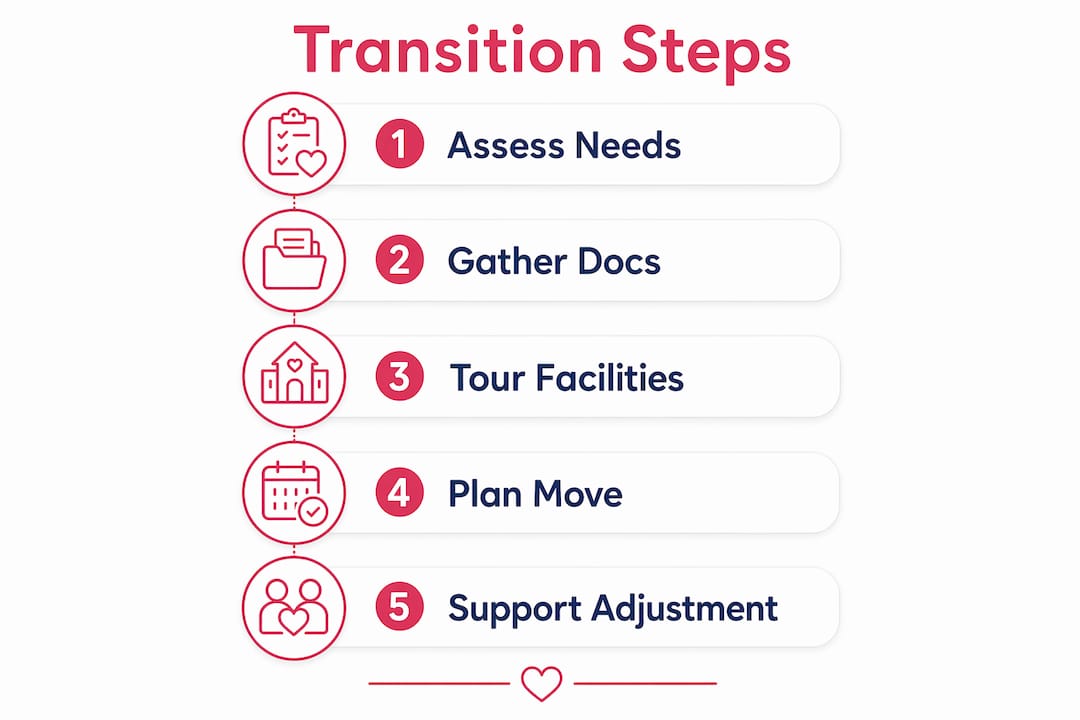
Transitioning a senior to assisted living is defined as the structured process of moving an older adult from their current home or care setting into a community that provides personal care, medication management, and daily living support. This process involves care needs assessments, legal documentation, financial planning, and emotional preparation for both the senior and the family. Medicare plays a limited role in covering these costs, which makes early planning with tools like care assessment checklists and long-term care insurance policies especially critical. Families who understand each phase of the assisted living transition process are far better positioned to make confident, compassionate decisions for their loved ones.
How to assess when a senior needs to transition to assisted living
Assisted living is designed for seniors who need minimal to moderate help with activities of daily living (ADLs) but do not require 24/7 skilled nursing care. This distinction matters because placing a senior in the wrong care level, either too high or too low, creates unnecessary disruption and cost. Independent living communities, by contrast, provide minimal or no ADL assistance and suit seniors who are largely self-sufficient.
Common functional triggers that signal a need for assisted living include:
- Difficulty with bathing, dressing, or toileting without assistance
- Repeated falls or mobility limitations that create safety risks at home
- Missed medications or inability to manage a medication schedule independently
- Cognitive changes such as memory lapses that affect daily safety
- Nutritional decline from difficulty preparing meals
- Social isolation or signs of depression from limited interaction
Safety risks carry the most weight in this assessment. A senior who has fallen twice in three months or who has left the stove on repeatedly is signaling that home-based care alone may no longer be sufficient. Families should also consider whether current in-home support can realistically scale to meet increasing needs.
Pre-admission health assessments and physician clearances typically occur within 30 to 90 days before assisted living admission to confirm that the care level is appropriate. Many states require a formal medical evaluation before a contract is signed, and delays in obtaining this paperwork can postpone the move-in date significantly.
Pro Tip: Involve the senior's primary care physician early in the assessment process. A physician can document functional limitations objectively, which strengthens the admissions case and satisfies state licensing requirements faster.
What key documents and preparations are needed before the move
Assisted living admissions rely on clinical evaluation and documentation to protect resident safety and satisfy licensing requirements, which means paperwork must be treated as a priority, not an afterthought. Families who wait until the final weeks before move-in frequently encounter delays that push back the start date by days or even weeks. Requesting intake packets from the community as early as possible gives families the time needed to gather everything without pressure.
The core documents every family should prepare include:
- Durable power of attorney for both healthcare and finances
- Advance directive or living will outlining the senior's medical wishes
- Healthcare proxy or medical power of attorney designating a decision-maker
- Medicare and Medicaid cards, plus any supplemental insurance documentation
- Current medication list with dosages, prescribing physicians, and pharmacy contact
- Physician's medical clearance form completed within the required 30 to 90 day window
- Recent lab work and specialist reports relevant to ongoing conditions
- Immunization records, particularly for influenza and pneumonia
A legal binder containing powers of attorney and advance directives should be kept physically accessible on moving day, not packed in boxes or loaded onto a moving truck. Care staff need immediate access to these documents to begin implementing the care plan from day one.
Pro Tip: Request the community's full intake packet the moment you begin touring facilities. Completing forms in parallel with your search, rather than after selecting a community, can shave two to four weeks off the admission timeline.
How to plan the assisted living transition process step by step
Families should start planning 2 to 6 months before the intended move date. This timeline allows enough space for community tours, financial planning, care assessments, and the emotional conversations that are just as important as the logistics. Rushing this process is one of the most common mistakes families make, and it often leads to choosing a community under pressure rather than based on genuine fit.
The planning timeline generally follows this structure:
- Months 4 to 6 before move: Research communities, schedule tours, and begin financial planning. Request intake packets and review contract terms carefully.
- Months 2 to 3 before move: Schedule the physician's assessment, complete the medical clearance forms, and finalize the community selection. Begin downsizing conversations with the senior.
- Month 1 before move: Confirm the move-in date, arrange transportation, and pack personal belongings. Prioritize familiar items like photographs, a favorite chair, or a bedside lamp to create comfort in the new space.
- Move-in week: Deliver the legal binder personally, meet with the care coordinator, and review the initial care plan together.
Downsizing is emotionally charged for most seniors. Framing the process as curating the most meaningful items, rather than discarding possessions, tends to reduce resistance. Involving the senior in every decision about what comes along respects their autonomy and reduces the sense of loss.
Communication throughout this process is non-negotiable. Seniors who feel informed and included in decisions about their own care adjust more successfully than those who feel the transition is happening to them rather than with them.

| Assisted living option | Typical monthly cost range | What is included |
|---|---|---|
| Basic assisted living | $3,500 to $5,000 | Room, meals, basic ADL support |
| Memory care unit | $5,000 to $8,000 | Secured environment, dementia-specific programming |
| Continuing care retirement community | $4,000 to $10,000+ | Multiple care levels on one campus |
| Small residential care home | $2,500 to $4,500 | Fewer residents, more personalized attention |
Pro Tip: Pace the packing process over several weeks rather than compressing it into a single weekend. Spreading it out gives the senior time to process each decision and reduces the emotional weight of the move.
What to expect after moving and how to support adjustment
The adjustment period after moving to assisted living typically spans 30 to 90 days, during which the senior adapts to new routines, staff relationships, and the physical environment. This is a normal and expected phase, not a sign that the wrong decision was made. Families who understand this window in advance are less likely to panic during the first difficult weeks.
Supporting a senior through this period involves several consistent strategies:
- Visit regularly but avoid hovering. Frequent short visits are more stabilizing than rare long ones.
- Encourage participation in community activities, even if the senior initially resists. Social engagement accelerates adjustment more than any other single factor.
- Communicate openly with care staff about the senior's preferences, history, and emotional triggers. Staff who know a resident's background provide more personalized care.
- Validate the senior's feelings without reinforcing avoidance. Saying "It makes sense that this feels hard" is more helpful than "You'll love it here in no time."
- Watch for warning signs that go beyond normal adjustment, including significant weight loss, withdrawal from all social contact, or expressions of persistent hopelessness.
Care-plan drift is a real and frequent challenge after the move. Monitoring changes in bathing, dressing, mood, and medication management can reveal when the initial care plan no longer matches the resident's actual needs. Families should proactively request care reviews when new challenges emerge rather than waiting for the community to initiate them.
How to navigate financial considerations and Medicare realities
Medicare does not cover assisted living room, board, or custodial care costs. This is one of the most misunderstood facts in senior care planning, and it catches many families off guard when the first monthly bill arrives. Medicare Parts A, B, and D may cover specific medical services provided within an assisted living setting, such as physician visits, skilled therapy after a qualifying hospital stay, and prescription drugs, but the base cost of living in the community is entirely the family's responsibility.
Families often overestimate Medicare's role in paying for assisted living, which leads to financial surprises and rushed decisions about funding. Planning should reflect the reality that private pay covers the majority of assisted living costs for most residents.
Funding options worth exploring include:
- Long-term care insurance: Policies vary widely; review benefit triggers and daily benefit amounts carefully.
- Medicaid: Covers assisted living in many states through Home and Community-Based Services (HCBS) waivers, but eligibility requirements and waitlists vary significantly by state.
- Veterans benefits: The VA Aid and Attendance benefit provides monthly payments to eligible veterans and surviving spouses to help cover assisted living costs.
- Private pay: Savings, retirement accounts, and proceeds from a home sale are the most common funding sources.
When evaluating communities, ask directly whether they accept Medicaid, what triggers a rate increase, and how care costs change if the senior's needs escalate. These questions protect families from unexpected financial strain down the road.
Pro Tip: Build a financial projection that extends at least three years beyond the initial move-in date. Assisted living costs increase annually, and care needs often grow over time, so a budget that only covers year one creates false security.
Key takeaways
A successful senior care relocation depends on early assessment, organized documentation, realistic financial planning, and consistent post-move support throughout the adjustment period.
| Point | Details |
|---|---|
| Assess care needs first | Use ADL evaluation and physician input to confirm assisted living is the right care level. |
| Prepare documents early | Gather powers of attorney, advance directives, and medical clearance forms 2 to 3 months before move-in. |
| Plan 2 to 6 months out | Early planning allows time for community tours, financial review, and emotional preparation. |
| Expect a 30 to 90 day adjustment | Normal adjustment takes up to three months; monitor for care-plan drift and request reviews proactively. |
| Medicare covers very little | Budget for private pay as the primary funding source; explore Medicaid, VA benefits, and long-term care insurance. |
What I've learned about making assisted living transitions work
The families I've seen navigate this process most successfully share one trait: they treat the transition as a team effort rather than a task to complete. They bring the senior into every conversation, even when those conversations are uncomfortable. They ask the community hard questions about staffing ratios and what happens when care needs increase. And they give themselves permission to grieve the change while still moving forward.
The most common pitfall I observe is waiting too long. Families delay the conversation out of love, not wanting to upset their parent or acknowledge that things have changed. But transitions that happen proactively tend to protect independence longer than those made in crisis. A senior who moves while still socially engaged and cognitively present adjusts far better than one who moves following a hospitalization or a serious fall.
The other mistake worth naming is treating the first care plan as permanent. Assisted living is not a static environment. A resident's needs will evolve, and families who check in regularly with staff, request formal care reviews, and stay visible in the community get better outcomes. The communities that earn high satisfaction ratings are the ones where families stay engaged, not the ones where families step back and assume everything is handled.
This process is hard. It asks families to hold both grief and hope at the same time. But when it is done thoughtfully, assisted living genuinely improves quality of life for seniors who need more support than home can provide.
— Care
How Carexroads supports families through this transition
Finding the right assisted living community is one of the most consequential decisions a family will make, and doing it without reliable guidance adds unnecessary stress to an already difficult process.

Carexroads was built specifically for families in this position. The platform offers verified provider listings, real family reviews, and practical guides covering every stage of the senior care relocation process, from initial assessment through post-move adjustment. With a 4.8 average family satisfaction rating, Carexroads gives caregivers the confidence to compare options clearly and act decisively. Explore senior care resources at Carexroads to find the guidance your family needs right now.
FAQ
What is the difference between assisted living and independent living?
Assisted living provides support with ADLs such as bathing, dressing, and medication management for seniors who need moderate help. Independent living offers minimal or no personal care assistance and suits seniors who are largely self-sufficient.
How long does the assisted living transition process take?
Most families need 2 to 6 months to complete the full transition, from initial assessment and community selection through move-in day. Starting early reduces stress and avoids delays caused by incomplete paperwork or missed physician clearance windows.
Does Medicare pay for assisted living?
Medicare does not cover room, board, or custodial care in assisted living. It may cover specific medical services such as physician visits or skilled therapy provided within the community, but the base monthly cost is the family's responsibility.
What documents are needed for assisted living admission?
Families should prepare a durable power of attorney, advance directive, healthcare proxy, Medicare and insurance cards, a current medication list, and a physician's medical clearance form completed within 30 to 90 days of the planned admission date.
How can families support a senior's adjustment after the move?
Regular visits, encouragement of social activities, and open communication with care staff are the most effective strategies. The adjustment period typically lasts 30 to 90 days, and families should request a formal care review if new challenges with ADLs or mood emerge during that time.