

PACE (the Program of All-Inclusive Care for the Elderly) is a government-backed, community-based program that provides comprehensive medical and support services for people 55 and older who meet nursing-home level of care but want to remain at home. It works best for frail seniors with complex health needs and a caregiver willing to stay involved. Your first move: check eligibility at Medicare or call 1-800-MEDICARE.
TL;DR:
- Most PACE programs serve only certain counties, so verifying local availability and the presence of waitlists early is essential.
- Enrollees must use PACE-affiliated providers, which can limit choice and lead to suspension of other Medicare or Medicaid plans.
- Dual-eligible participants generally pay nothing out of pocket, while Medicare-only enrollees face monthly premiums that vary by state and program.
- PACE covers a broad range of services, including primary care, therapy, dental, vision, prescription drugs, transportation, and home care, with additional services possible.
- The enrollment process involves a home and in-person assessment, with eligibility confirmed by an interdisciplinary team within about 30 days.
Table of Contents
- How Does the PACE Program for Seniors Actually Work?
- Who Qualifies for PACE, and Why Does Location Matter?
- How Much Does PACE Cost for Seniors and Families?
- What Services Does PACE Cover for Older Adults?
- How Do You Find a PACE Program Near You?
- What Happens During PACE Enrollment?
- Is PACE a Good Fit, or Are There Real Trade-Offs?
- Perspective: Pairing Official Checks With Local Legwork
- Let Carexroads Help You Compare Local Options While You Wait
- Authoritative Resources and Contact Points
- Sources
- FAQ
How Does the PACE Program for Seniors Actually Work?
PACE runs on capitated funding. Medicare and Medicaid pay a fixed monthly amount per participant regardless of how many services that person uses, flipping the usual incentive: instead of billing per visit, the program is rewarded for keeping people healthy and out of the hospital. That single funding pool gives programs room to cover services beyond standard Medicare or Medicaid benefits whenever a care team decides they're medically necessary.
That care team is the interdisciplinary team, or IDT, and it's the operational core of the model. A typical IDT includes:
- A primary care provider and registered nurse
- A social worker
- Physical, occupational, and recreational therapists
- A dietitian
- Transportation and home care coordinators
The IDT meets regularly to review each participant's plan and adjust it as needs change. Most care happens at an adult day health center, supplemented by in-home visits and contracted specialists for anything the center doesn't provide directly.
Who Qualifies for PACE, and Why Does Location Matter?
Federal rules under 42 CFR § 460.150 set four eligibility requirements, and a person has to meet all four:
- Be age 55 or older
- Live within the PACE organization's certified service area
- Be certified by the state as needing nursing-home level care
- Be able to live safely in the community at the time of enrollment, with PACE support
Enrolling in PACE typically means leaving behind other Medicare Advantage or Medicaid managed care plans, since PACE becomes the sole source of covered care. Enrollment is voluntary, and participants can leave at any time. Involuntary disenrollment is rare but can happen for nonpayment, prolonged absence from the service area, or behavior that endangers staff or other participants. Recertification of nursing-home level care happens periodically to confirm the person still qualifies.
How Much Does PACE Cost for Seniors and Families?
Dual-eligible participants, meaning those enrolled in both Medicare and Medicaid, typically pay nothing out of pocket for PACE [Medicare.gov]. Medicare-only participants pay a monthly premium covering the long-term care portion, plus a separate Part D premium for prescription drugs, since PACE folds Medicare's drug benefit directly into its coverage, according to Medicare.gov. Private-pay enrollees exist too. A common misconception is that PACE is Medicaid-only; someone without Medicaid can still enroll, but pays the portion Medicaid would otherwise have covered, according to the National Council on Aging.
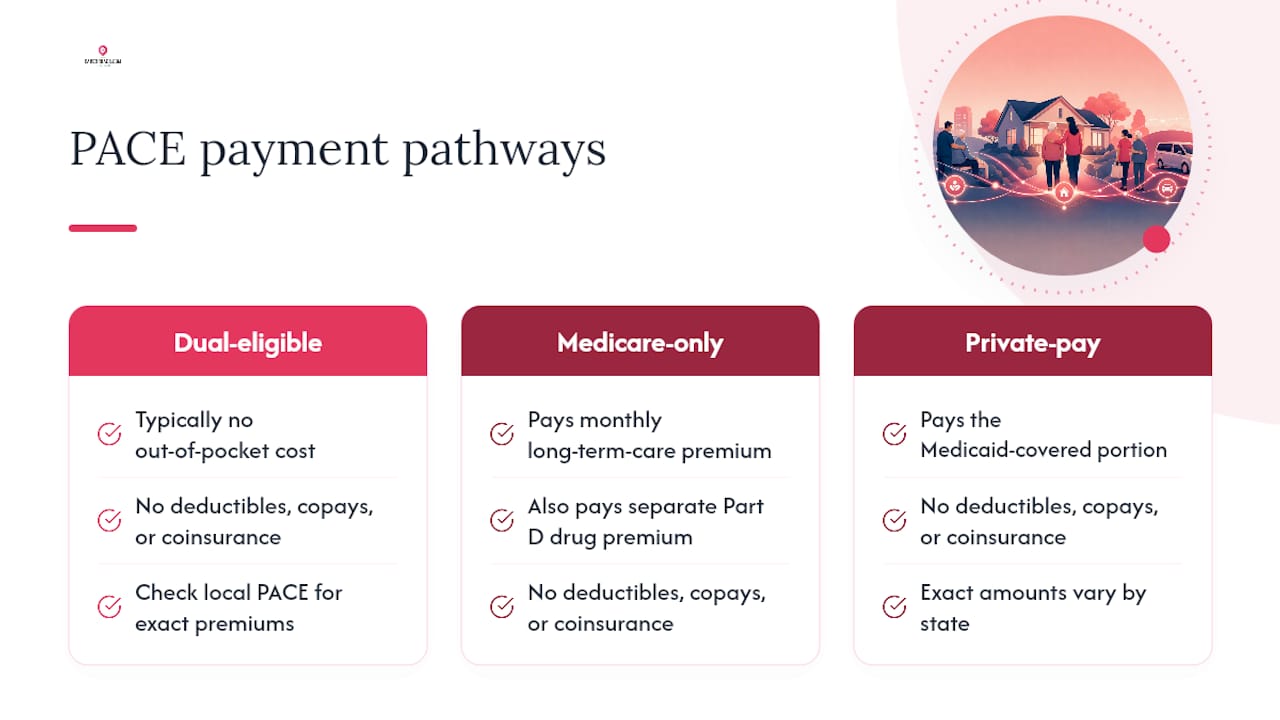
Whatever the payment tier, one rule stays constant: there are no deductibles, copays, or coinsurance for any PACE-approved service. Exact premium amounts vary by state and program, so get precise numbers directly from the local PACE organization rather than relying on a national average.
What Services Does PACE Cover for Older Adults?
PACE bundles nearly everything a frail older adult might need under one roof, according to Medicare's own program summary. The covered list includes:
- Primary care and specialty medical care
- Nursing care and behavioral health services
- Physical, occupational, and speech therapy
- Dentistry, vision care, and audiology
- Prescription drugs through Part D
- Social services and meals
- Adult day services at a PACE center
- Transportation to appointments and the day center
- Home care, respite care, and hospice or end-of-life coordination
Beyond that baseline list, the IDT can approve additional services it judges medically necessary, even when they fall outside standard Medicare or Medicaid coverage, because the capitated funding model gives programs that flexibility. Most participants attend the day center a few days a week, with home visits and transportation filling the gaps. That rhythm is what lets someone with dementia or multiple chronic conditions stay out of a nursing facility while still getting daily oversight.
How Do You Find a PACE Program Near You?
- Start with Medicare.gov/pace or the National PACE Association's program locator to check ZIP-level availability.
- Call 1-800-MEDICARE or your state Medicaid office to confirm which programs serve your county.
- Contact the local program directly and ask about service-area boundaries, current openings, waitlist length, and whether they accept Medicare-only or private-pay enrollees.
- Ask about typical enrollment timelines, since assessment and paperwork can take several weeks.
Availability varies enormously by state, since PACE currently operates in only 33 states and Washington, D.C., through roughly 194 programs nationwide, according to StatPearls. Rural counties and several states have no program at all. If a program has a waitlist, ask to be added and simultaneously explore assisted living or home care as a bridge.
Pro Tip: Call two or three programs even if the first one has openings. Network breadth for specialists differs by organization, and that affects which outside doctors your parent can keep seeing.
What Happens During PACE Enrollment?
- A PACE staff member conducts a home visit, and the IDT performs an in-person comprehensive assessment covering medical, functional, and social needs.
- The team consolidates every assessment into one individualized care plan, usually within 30 days of enrollment, according to the CMS PACE manual.
- You sign an enrollment agreement authorizing release of medical records and, for Medicaid participants, agreeing to post-eligibility treatment of income.
- Ask upfront whether the program accepts retroactive Medicare eligibility, since that detail affects when Part D coverage actually begins.
Gathering medical records, insurance cards, and income documentation ahead of the assessment speeds the whole process considerably.
Is PACE a Good Fit, or Are There Real Trade-Offs?
PACE delivers coordinated care that measurably reduces hospitalizations and helps participants stay independent longer than comparable traditional care arrangements, according to StatPearls. The trade-offs are real too:
- You must use PACE-network doctors and specialists, giving up outside providers
- Local capacity is limited, and waitlists are common in many areas
- Enrolling typically means dropping other Medicare Advantage or Medicaid plans
If your loved one has complex needs but a stable home environment and an involved caregiver, PACE often fits well. If placement feels urgent or no local program has an opening, assisted living or home care may need to serve as the interim plan.
Perspective: Pairing Official Checks With Local Legwork
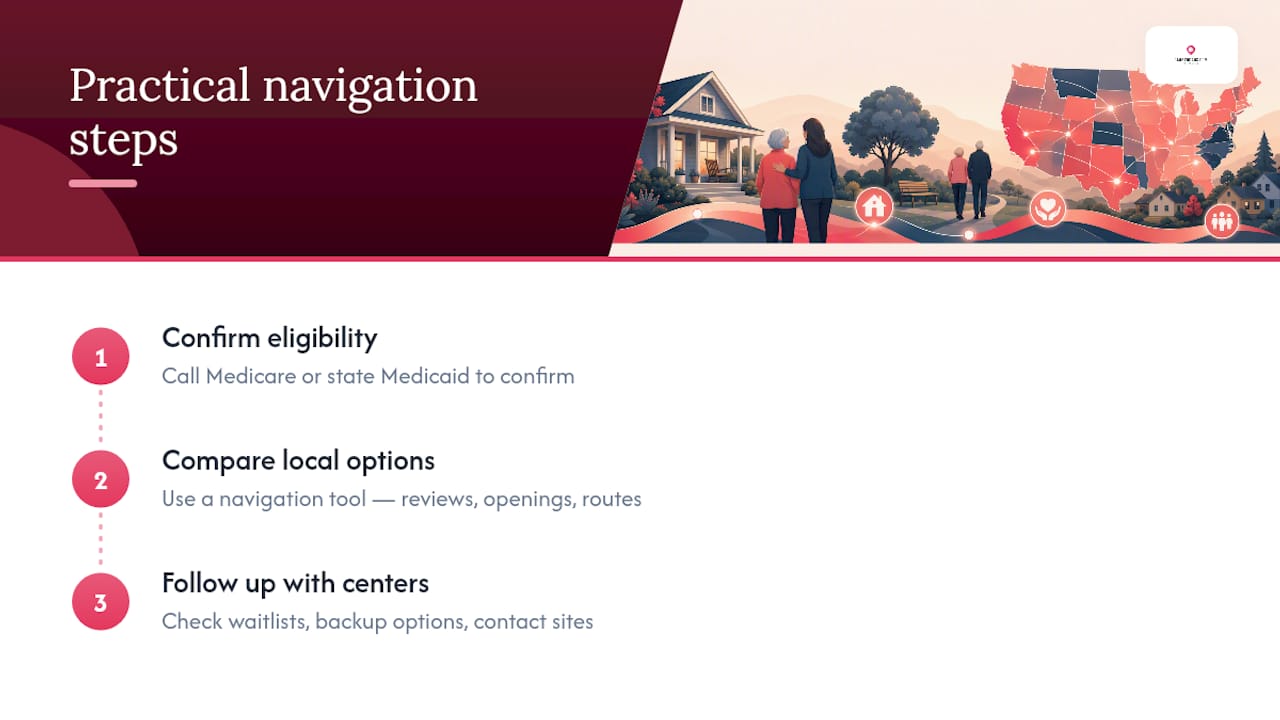
CMS and Medicare.gov answer the eligibility question. They don't tell you which local PACE center actually has an opening this month, how its transportation routes run, or what families say about the day center's atmosphere. That's the gap Carexroads fills with verified family reviews and free assessments that compare local options side by side.
Our honest recommendation: call Medicare or your state Medicaid office first to confirm eligibility and service-area status. Once you know PACE is technically available, use a navigation tool to sort out the practical questions, like waitlists, network breadth, and backup options, that official government pages were never built to answer.
— Care
Let Carexroads Help You Compare Local Options While You Wait
If PACE has a waitlist in your area, or if you're weighing it against assisted living or home care, you don't have to sort through every option alone. There are searchable directories of senior care providers, verified family reviews, and free local assessments that show what is actually available near your parent, not just what is technically covered on paper.

The practical path: confirm PACE eligibility through Medicare or your state Medicaid office first, then request a Carexroads assessment to compare local programs, home care agencies, and assisted living communities side by side. It's a faster way to see your real choices than calling providers one by one, and there's no cost to start. Get your free local comparison today.
Authoritative Resources and Contact Points
For eligibility rules, consult 42 CFR § 460.150. For program details, see Medicare.gov's PACE page or call 1-800-MEDICARE.
This article is general information, not a substitute for advice from a qualified doctor. Consult a qualified healthcare professional about your own circumstances before acting on anything here.
Sources
- StatPearls / NCBI Bookshelf — Program of All-Inclusive Care for the Elderly (PACE)
- Medicare
- CFR — 42 CFR § 460.150 (PACE eligibility)
- CMS PACE manual — Chapter on eligibility and IDT processes
FAQ
How much does PACE cost per month for seniors?
Dual-eligible participants typically pay $0 monthly. Medicare-only participants pay a monthly premium for the long-term care portion plus a separate Part D premium, with exact amounts varying by state program.
What states have the PACE program for seniors?
PACE operates in 33 states and Washington, D.C., through about 194 programs, according to StatPearls. Coverage within those states is often limited to specific counties or ZIP codes, so checking your exact service area matters.
What are the disadvantages of the PACE program?
The biggest limitation is network restriction: participants must use PACE-affiliated doctors and give up outside specialists. Local capacity is also limited, so waitlists are common, and enrolling usually means dropping other Medicare or Medicaid plans.
Where do seniors go if they can't afford assisted living?
Options include PACE (if income-qualified through Medicaid), in-home care scaled to a family's budget, adult day programs, or state-funded home and community-based waiver services. Comparing assisted living alternatives locally often turns up options families didn't know existed.