

Aid and Attendance is an increase to a needs-based VA pension that helps wartime veterans and surviving spouses pay for regular personal care when they meet the VA's functional standards. The VA pays up to a Maximum Annual Pension Rate, and the actual award depends on countable income, net worth, and unreimbursed medical expenses. This guide walks through eligibility, current MAPR and net-worth figures, the medical evidence VA requires (including Form 21-2680), and the practical steps to file a strong claim.
TL;DR:
- Proper documentation, including detailed medical forms and comprehensive financial records, is critical for expediting Aid and Attendance claims and avoiding delays.
- The claim's success hinges on demonstrating functional need through specific, daily assistance examples rather than vague descriptions or diagnoses.
- Medical evidence must include precise activity descriptions and caregiver logs, with medical forms like VA Form 21-2680 closely scrutinized for detail.
- Aid and Attendance benefits are non-taxable and do not affect Social Security, but they can impact Medicaid eligibility depending on state rules and income limits.
- The VA pays the difference between the claimant’s income and applicable MAPR, with thresholds and limits clearly specified for veterans, dependents, and survivors.
Table of Contents
- Who Qualifies for VA Aid and Attendance?
- How Much Does VA Aid and Attendance Pay?
- What Does VA Form 21-2680 Need to Show?
- How Do You Apply for VA Aid and Attendance?
- How Does Aid and Attendance Work for Surviving Spouses?
- Aid and Attendance vs. SMC vs. VA Caregiver Programs
- Will Aid and Attendance Affect Medicaid or Social Security?
- Are VA Aid and Attendance Benefits Taxable?
- How Long Does an Aid and Attendance Claim Take to Process?
- What Happens After You Start Receiving Aid and Attendance?
- Why Do Aid and Attendance Claims Get Denied, and How Do You Appeal?
- Immediate Next Steps for Families
- Carexroads: How We Can Help You Find Care and Document Costs
- Sources
- FAQ
Who Qualifies for VA Aid and Attendance?
Aid and Attendance is not a separate program. It is an add-on to the needs-based Veterans Pension, so a claimant must first meet basic pension eligibility: qualifying wartime active-duty service and a discharge other than dishonorable, along with income and net worth inside VA limits, according to the VA's pension eligibility rules. Once that foundation is in place, the VA looks at function, not diagnosis.
You (or the veteran you care for) can qualify by meeting at least one of these standards, as outlined by the VA's Aid and Attendance and Housebound page:
- Needing another person's help with daily activities like bathing, dressing, eating, or using the bathroom
- Being bedridden because of a disability
- Living in a nursing home due to loss of physical or mental abilities related to a disability
- Having corrected vision of 5/200 or less in both eyes, or a visual field contracted to 5 degrees or less
A caregiver's typical day often tells the story better than a diagnosis list. A veteran who needs someone to stand by during showers, cue him through each step of getting dressed, and remind him to take blood pressure medication twice a day meets the "regular assistance with daily activities" standard, even without a single hospital admission on record. That is the kind of detail examiners and claims processors respond to.
Aid and Attendance sits on the pension (needs-based) side of VA benefits. A related but separate track, Special Monthly Compensation, pays aid-and-attendance style benefits tied to service-connected disability ratings on the compensation side. They are evaluated under different rules, so do not assume approval for one guarantees the other.
Pro Tip: Aid and Attendance and the lower-tier Housebound benefit cannot be paid together. If you qualify for both, the VA pays whichever amount is higher, so there is no reason to apply for both separately.
For families weighing whether a loved one's needs already cross this threshold, a practical rundown of what regular assistance looks like day to day can help. Carexroads has covered this in detail for families evaluating the VA Aid and Attendance benefit.
How Much Does VA Aid and Attendance Pay?
MAPR stands for Maximum Annual Pension Rate. It is the ceiling the VA uses to calculate your pension, not a flat check everyone receives. The VA pays the difference between your countable income and the MAPR that applies to your household, based on the current pension rates for veterans.
For the period running December 1, 2025 through November 30, 2026, the Aid and Attendance MAPR figures look like this:
| Household status | Annual MAPR |
|---|---|
| Veteran alone | $29,093 |
| Veteran with one dependent | $34,488 |
| Surviving spouse alone | $18,697 |
The VA also enforces a net-worth limit for Veterans Pension, currently set at $163,699 for this same period. Net worth combines your assets and annual income, though your primary residence and vehicle are generally excluded from that count.
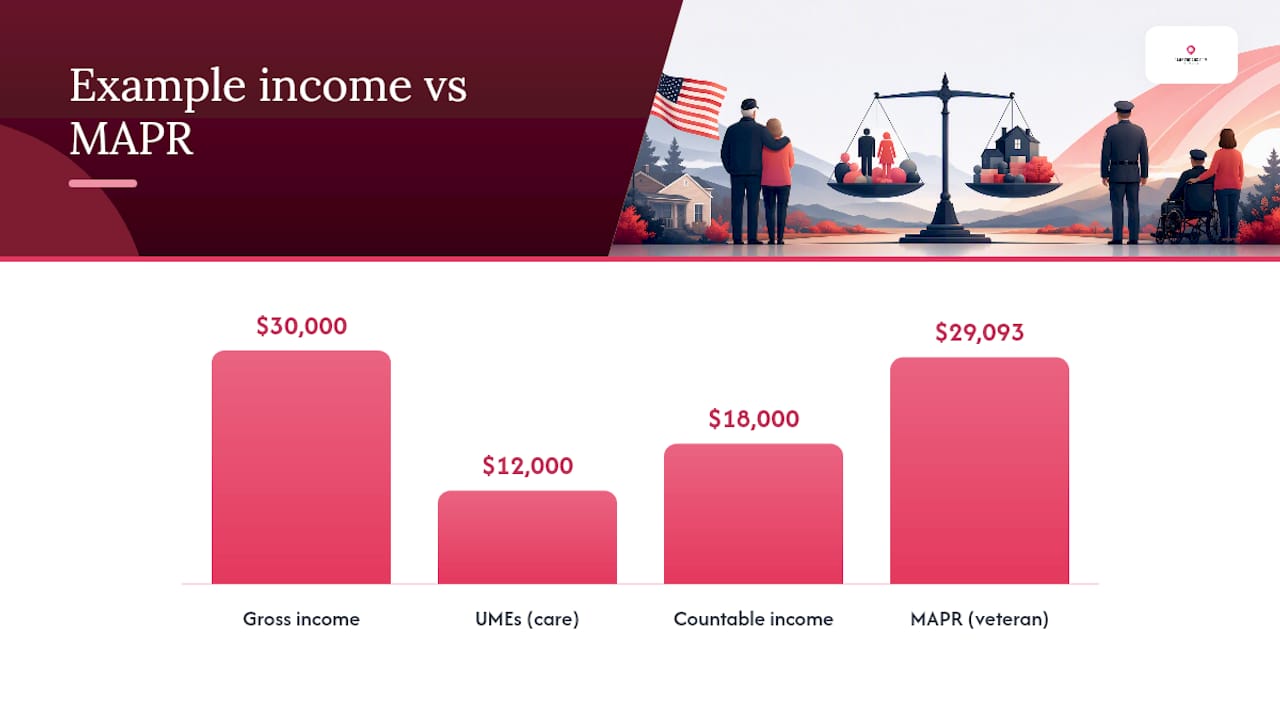
Here's where the math gets interesting for most families: unreimbursed medical expenses, often called UMEs, reduce your countable income dollar for dollar in many cases. Say a veteran's gross annual income is $30,000, but he pays $12,000 a year out of pocket for in-home care. That $12,000 in UMEs lowers his countable income to $18,000, which is below the $29,093 MAPR for a veteran alone, potentially qualifying him for a meaningful annual benefit.
The VA expects documentation to back every deduction: itemized receipts, provider invoices, and proof of payment or insurance reimbursement. Loose estimates or verbal claims about care costs will not hold up during review.
What Does VA Form 21-2680 Need to Show?
Form 21-2680, "Examination for Housebound Status or Permanent Need for Regular Aid and Attendance," is the medical document that translates a veteran's condition into the language VA claims processors use to make decisions. A physician, nurse practitioner, or physician assistant completes it, and the level of detail they provide often determines whether a claim moves quickly or stalls.
The form itself asks the examiner to describe how the claimant gets around, what they can and cannot do during a typical day, and how often they need help. According to the form's own instructions, vague answers like "needs some help" carry far less weight than specifics.
Before the appointment, prepare the clinician with:
- A short day-in-the-life log covering a typical 24 hours, including meals, hygiene, mobility, and medication times
- A note on how often assistance is needed (daily, several times a day, constant supervision)
- Details on transfer needs, such as help getting out of bed or a chair
- A list of medications and who manages dosing and timing
- Any safety concerns, like wandering, fall, or confusion requiring supervision
Pro Tip: A caregiver who walks into the appointment with a written log, rather than trying to recall details on the spot, gives the clinician exactly what they need to complete the form accurately the first time.
If the veteran lives in a nursing home, the facility should also complete Form 21-0779, which documents the level of care the facility provides. One important caveat: Form 21-2680 documents medical need, but it does not by itself establish pension eligibility. VA still requires proof of qualifying service, discharge status, and financial eligibility alongside the medical evidence.
How Do You Apply for VA Aid and Attendance?
You can file three ways: online through the VA's pension application portal, by mail to the Pension Intake Center, or in person at a regional VA office. Each route accepts the same evidence, so the choice comes down to convenience and how much in-person guidance you want.
Whichever route you choose, package these documents together:
- Discharge papers (DD214 or equivalent) showing qualifying wartime service
- Financial records showing income, assets, and net worth
- Completed VA Form 21-2680 from a medical examiner
- Nursing home invoices or Form 21-0779, if applicable
- Itemized receipts for unreimbursed medical or care expenses
- Marriage certificate and, for survivors, the veteran's death certificate
Submitting everything in one packet rather than piecemeal cuts down on the back-and-forth that slows claims. The VA notes that missing non-medical evidence, like financial documentation or service records, is one of the most common causes of delay, even when the medical case is airtight.
Decision times vary widely depending on claim complexity and regional office workload, so treat any timeline estimate as a range, not a promise. If the process feels like too much to manage alone, an accredited Veterans Service Organization representative or the VA Caregiver Support Line can walk you through documentation at no cost.
How Does Aid and Attendance Work for Surviving Spouses?
Surviving spouses apply through Survivors Pension, the underlying needs-based benefit that Aid and Attendance increases. Eligibility depends on the deceased veteran's qualifying service record and the survivor's own income and net worth, according to the VA's survivors pension rate tables.
The MAPR ceiling for a surviving spouse alone is $18,697 annually, lower than the veteran-alone figure of $29,093, since the household size differs. The same countable-income and UME math applies: care costs still reduce what counts against that ceiling.
Survivors need a slightly different document set:
- Marriage certificate showing the marriage to the veteran
- The veteran's death certificate
- Proof of the veteran's qualifying wartime service
- The survivor's own financial records and, if applicable, a completed Form 21-2680
Aid and Attendance vs. SMC vs. VA Caregiver Programs
Families often mix up three distinct tracks, and confusing them wastes time on the wrong application. Aid and Attendance is a pension add-on, meaning it is needs-based and does not require a service-connected disability rating.
Special Monthly Compensation, by contrast, sits on the compensation side and requires a service-connected disability. A veteran can qualify for SMC's aid-and-attendance provision without ever touching the pension system.
VA caregiver programs are different again:
- The Program of Comprehensive Assistance for Family Caregivers generally requires a 70% service-connected disability rating and a need for at least six months of continuous, in-person personal care
- The Program of General Caregiver Support Services offers a lighter tier of support without the same disability threshold
- Neither caregiver program pays the same monthly benefit as Aid and Attendance, and they follow separate application paths
Some families pursue Aid and Attendance and a caregiver program at the same time, since one supports the veteran's income and the other supports the caregiver directly. If you are unsure which to prioritize, start with whichever the veteran clearly meets: a high disability rating points toward SMC or caregiver programs, while modest income and clear functional need point toward pension-based Aid and Attendance.
Will Aid and Attendance Affect Medicaid or Social Security?
Aid and Attendance is VA pension income, which means it can interact with other benefit programs in ways families do not always expect. Social Security does not count VA pension, including the Aid and Attendance increase, against Social Security retirement or disability payments, since the two programs run on entirely separate income rules.
Medicaid is where things get more complicated, and the interaction varies by state. Because Medicaid eligibility often depends on countable income, receiving Aid and Attendance can push a recipient's income above a state's Medicaid threshold in some cases, particularly for institutional Medicaid tied to nursing home care. Many states, however, exclude the Aid and Attendance portion of the VA pension from countable income specifically because it is intended to offset care costs rather than serve as general income.
The rules differ enough by state that a blanket answer will not hold true everywhere. If a loved one already receives Medicaid, or is applying for it alongside a VA claim, check with the state Medicaid office or an elder law attorney before assuming the benefits will stack cleanly. Getting this wrong in either direction, either losing Medicaid coverage or under-claiming a benefit you are entitled to, can cost a family real money over the course of a year.
Are VA Aid and Attendance Benefits Taxable?
VA pension benefits, including the Aid and Attendance increase, are not taxable income at the federal level. The IRS does not require veterans or surviving spouses to report this benefit as income on a federal tax return, unlike Social Security benefits, which can be partially taxable depending on total household income.
This tax-free treatment matters when you are budgeting for care costs. A veteran comparing a taxable pension against a VA benefit of the same nominal dollar amount actually comes out ahead with the VA benefit, since none of it gets reduced by federal tax withholding.
State tax treatment generally mirrors the federal approach, since most states that tax income also exempt VA benefits, though it is worth confirming with a tax preparer familiar with veterans' benefits in your state, especially if you also receive other taxable retirement income. Keep records of what you receive and how you spend it anyway. If you are claiming unreimbursed medical expenses to reduce countable income for VA purposes, those same receipts may support other deductions, and clean documentation never hurts when tax season arrives.
How Long Does an Aid and Attendance Claim Take to Process?
Processing time depends heavily on how complete your initial submission is, and complete claims consistently move faster than partial ones. A packet that arrives with service records, financial documentation, and a fully detailed Form 21-2680 all at once has a much better shot at a first-pass decision than one that trickles in over several submissions.
The most common source of delay is not a slow examiner. It is missing paperwork on the administrative side, financial records that arrive late, or a medical form with vague answers that forces the VA to request clarification, according to the VA's own guidance on Aid and Attendance evidence. Each round of follow-up correspondence can add weeks or months to a timeline that would otherwise move steadily.
Decision times vary by regional office workload and claim complexity, so there is no single number that applies to every applicant. What you can control is submission quality: package every document together, double-check that the clinician filled out every relevant section of Form 21-2680, and confirm nursing home documentation is attached if applicable. Working with an accredited Veterans Service Organization representative can also help catch gaps before they turn into delays, since VSOs review claims against VA's evidence requirements before submission.
What Happens After You Start Receiving Aid and Attendance?
Approval is not the end of the paperwork. The VA periodically reviews Aid and Attendance recipients to confirm continued eligibility, since both medical condition and financial circumstances can change over time.
You are generally responsible for reporting changes in income, net worth, or medical status that could affect your award. If a veteran's care needs increase, decrease, or a household gains additional income, such as an inheritance or a new pension, that information needs to reach the VA rather than wait for a scheduled review.
The VA may periodically request updated medical evidence to confirm the functional need for Aid and Attendance still exists, particularly if a condition was expected to improve. Keep copies of everything you originally submitted, including receipts for unreimbursed medical expenses, since ongoing UME deductions typically require continued documentation, not just a one-time submission at the start of the claim.
Missing a recertification request or failing to report a financial change can lead to an overpayment, which the VA will eventually seek to recover. Treat any VA correspondence requesting updated information as time-sensitive, and respond well before the deadline listed in the letter.
Why Do Aid and Attendance Claims Get Denied, and How Do You Appeal?
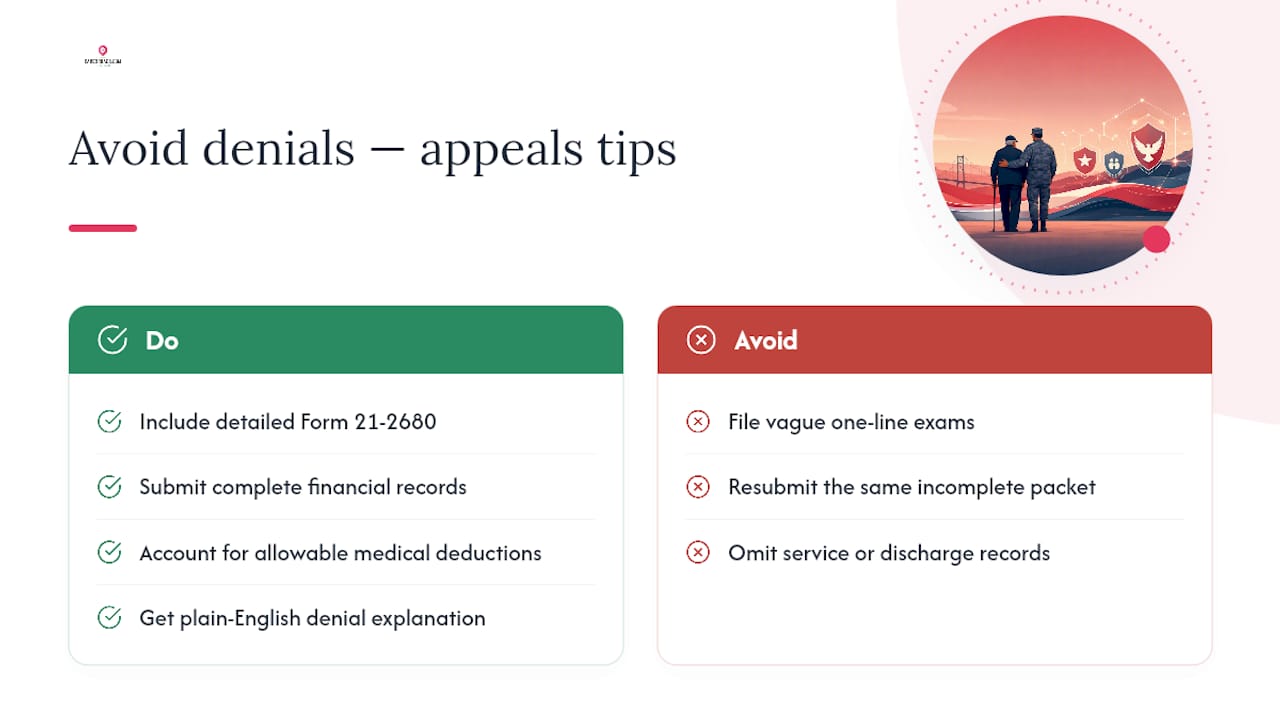
The most common denial reasons trace back to gaps rather than genuine ineligibility. A claim can fail because the medical evidence on Form 21-2680 is too vague, because financial documentation is incomplete, because net worth exceeds the $163,699 limit without accounting for allowable medical expense deductions, or because service and discharge records were never submitted alongside the medical evidence.
Sometimes the denial is simply a documentation problem masquerading as an eligibility problem. A veteran who clearly needs daily help but whose examiner wrote a one-line summary instead of describing specific limitations may get denied not because he lacks need, but because the form did not communicate it.
If you receive a denial, you have the right to appeal. Options generally include requesting a Higher-Level Review, filing a Supplemental Claim with new evidence, or appealing directly to the Board of Veterans' Appeals. A Supplemental Claim is often the fastest path when the denial stemmed from missing documentation, since it lets you submit the specific evidence that was absent the first time, such as a more detailed Form 21-2680 or the financial records the VA requested.
Before filing any appeal, get a plain-English explanation of the denial reason from the decision letter. An accredited Veterans Service Organization representative can review that letter with you and help identify whether the fix is new medical evidence, financial documentation, or a procedural correction, rather than guessing and resubmitting the same incomplete packet.
Immediate Next Steps for Families
Start by gathering service records, running a quick check of income and assets against the $163,699 net-worth limit, and writing a caregiver day-in-the-life log before the medical appointment. Ask the clinician to complete Form 21-2680 with specific, detailed answers rather than general statements.
If the process feels like too much to manage alone, an accredited VSO or the VA Caregiver Support Line can walk you through documentation at no cost.
— Care
Carexroads: How We Can Help You Find Care and Document Costs
Carexroads is the resource families use when the VA paperwork is only half the problem and finding trustworthy care is the other half. Once you know what Aid and Attendance requires in the way of invoices, provider details, and documented care hours, the next challenge is actually sourcing that care from a provider you can trust.

The directory features family reviews and satisfaction ratings across listed providers, covering in-home care, assisted living, memory care, and hospice. Browsing categories like in-home care and assisted living helps you compare local providers and start generating the itemized invoices your VA claim will eventually need. If you want a lower-pressure starting point, book a free in-home care assessment to get a clear picture of what care your loved one needs and what it will cost, information that feeds directly into both your VA application and your family's budget. Carexroads is not a VA representative and does not process claims. It is a place to find the right care provider and start building the documentation your claim depends on.
This article is general information, not a substitute for advice from a qualified financial advisor. Consult a qualified financial professional about your own circumstances before acting on anything here.
FAQ
Can You Get VA Compensation and Aid and Attendance at the Same Time?
Yes, in some circumstances. Aid and Attendance under the pension system and Special Monthly Compensation on the disability compensation side are evaluated separately, so a veteran can potentially receive one, the other, or in rare structured cases elements of both, depending on service-connected disability rating and financial eligibility.
What Are the VA Aid and Attendance MAPR Amounts for 2026?
For the period running December 1, 2025 through November 30, 2026, the Aid and Attendance MAPR is $29,093 annually for a veteran alone, $34,488 for a veteran with one dependent, and $18,697 for a surviving spouse alone. The VA pays the difference between your countable income and the applicable MAPR.
Is It Hard to Get VA Aid and Attendance Benefits?
Approval depends heavily on documentation quality rather than the severity of need alone. Claims with a detailed Form 21-2680, complete financial records, and organized service documentation move through review far more smoothly than claims missing any one of those pieces.
Can You Get VA Caregiver Benefits and Aid and Attendance at the Same Time?
Yes, these are separate programs with different requirements, so qualifying for one does not exclude the other. Aid and Attendance is a needs-based pension increase, while VA caregiver programs like PCAFC require a 70% service-connected disability rating and support the caregiver directly rather than increasing the veteran's pension.
Recommended
- How to Qualify for VA Aid and Attendance in Michigan | Home Care Benefits for Veterans
- Understanding the VA Aid & Attendance Benefit in Los Angeles
- Supporting Veterans Safely at Home: Community Resources for Middle Tennessee
- Local Support for Veteran Service Officers: Connecting Families with In-Home Care Resources