

Around-the-clock home care in the United States typically runs within a moderate daily range for a live-in arrangement, or a higher daily range when rotating awake shifts cover every hour. Stretched across a full month, families can expect to budget within a broad range for live-in care and a correspondingly higher range for continuous shift-based coverage. Three factors move your number most: where you live, whether you choose live-in or rotating shifts, and how much medical support your loved one actually needs.
According to a 2026 national overnight rate estimate, overnight caregiver rates run approximately $25–$35 per hour, which alone can add $200–$280 to a single night's bill before any daytime hours are counted.
Key Takeaways
Around-the-clock home care costs vary widely, with live-in arrangements generally costing significantly less than rotating awake-shift models. Factors such as location, caregiver qualifications, and overnight coverage model drive most of the cost differences.
| Point | Details |
|---|---|
| Live-in vs. rotating shifts | Live-in care runs $200–—; rotating awake shifts cost $400–$600/day or more. |
| Overnight premium is real | National overnight rates run approximately $25–$35/hour, adding significantly to nightly totals. |
| Medicare won't cover custodial care | Medicare covers skilled home health only; ongoing personal care requires Medicaid, VA, insurance, or private pay. |
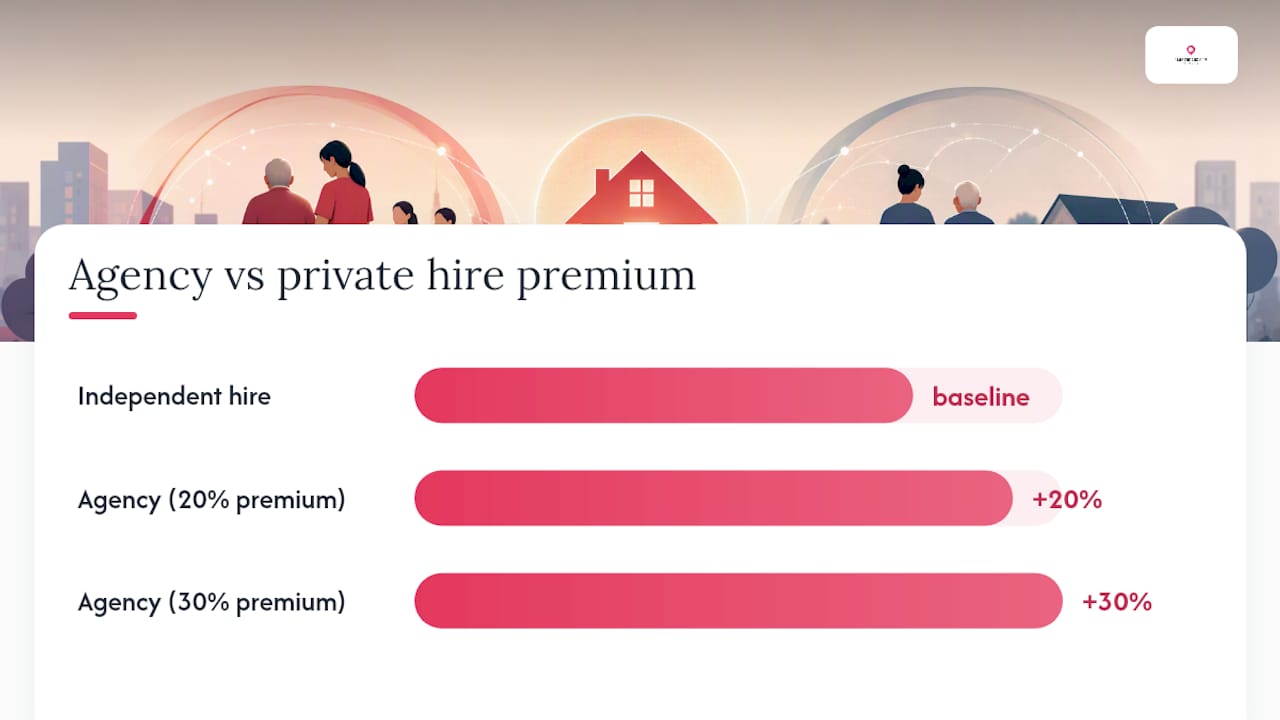
| Agency premium buys reliability | Agencies cost 20–30% more than independent hires but provide backup staffing, insurance, and payroll handling. |
| Get three written quotes | Request itemized quotes from at least three providers and confirm overtime, minimums, and backup staffing in writing. |
Carexroads' perspective on planning for continuous home care
Families who come to Carexroads are often in the middle of a difficult moment: a parent has just been discharged from the hospital, a spouse's needs have escalated overnight, or a sibling across the country is trying to coordinate care from a distance. What they need most is not another generic cost estimate. They need a clear picture of what care actually costs in their specific area, which providers are vetted and available, and what questions to ask before signing anything.
Carexroads exists to make that process less overwhelming. The platform's directory connects families with verified local home care providers, assisted living communities, and specialized services, all searchable by location and care type. Families can read real reviews from other families who have navigated the same decisions, compare options side by side, and request written quotes directly through the site.
If you are starting to plan for 24/7 care, the most useful first step is to request at least three written quotes from local providers and to run the calculation template in this article against each one. Start your search at Carexroads to find vetted providers near you, read family reviews, and access guides tailored to your situation.
This article is general information, not a substitute for advice from a qualified financial advisor. Consult a qualified financial professional about your own circumstances before acting on anything here.
Table of Contents
- How much does 24 hour home care cost, broken down by day and month?
- What does 24-hour home care actually include?
- What factors drive the price of continuous home care?
- How do families typically pay for around-the-clock home care?
- Agency vs. private hire: what does the cost difference actually buy you?
- What research and government sources say about 24/7 care costs
- Lower-cost alternatives that can reduce a 24-hour care bill
- A simple estimate template and two worked examples
- Questions to ask and red flags to watch for
- Sources
How much does 24 hour home care cost, broken down by day and month?
Two billing models dominate the market for continuous home care, and they produce very different monthly totals.
Live-in daily rate model: One caregiver lives in the home and is available throughout the day, with a legally permitted sleep break (typically 8 hours) deducted from billable time in states that follow Department of Labor sleep-time rules. Providers charge a flat daily rate rather than an hourly one.
Rotating shift model: Two or three caregivers work consecutive 8–12 hour shifts, each billed at an hourly rate. Because every hour is covered by an awake caregiver, this model costs more but provides active overnight supervision.
The table below summarizes typical low, mid-range, and high rates by caregiver type, based on aggregated daily and monthly ranges where labor, overtime, and agency overhead are the dominant cost drivers.
Worked example A: rotating-shift agency plan
Assume three 8-hour shifts per day at $32/hour (agency rate):
- Daily cost: 24 hours × $32 = $768/day
- Monthly cost: $768 × 30 = $23,040/month
That figure reflects full awake coverage with no sleep-time deduction. Weekend and holiday premiums can push it higher.
Worked example B: live-in private caregiver
Assume a live-in independent caregiver at a flat $250/day rate:
- Daily cost is set at a flat rate, with the monthly cost calculated accordingly for live-in care.
The gap between these two examples is real and significant. Live-in pricing relies on sleep-time deductions and a single caregiver's presence, which works well for lower overnight needs. Rotating shifts cost more because you are paying for continuous awake coverage.
Regional note: Urban markets like New York City, San Francisco, and Boston typically run 30–50% above national midpoints. Rural areas in the South and Midwest often come in below the national typical range. Holiday and overtime surcharges, usually 1.5× the standard rate, apply in most agency contracts.
What does 24-hour home care actually include?
Understanding what is and is not covered helps you compare quotes accurately and spot gaps before signing a contract.
Commonly included services:
- Companionship and social engagement
- Assistance with activities of daily living (ADLs): bathing, dressing, grooming, and toileting
- Medication reminders (not administration)
- Mobility assistance and fall prevention
- Transfers (bed to chair, chair to standing)
- Light housekeeping and laundry
- Meal preparation and feeding assistance
- Transportation to appointments
Custodial vs. skilled care: a critical distinction
Most 24-hour home care is custodial, meaning it supports daily living rather than treating a medical condition. Custodial care is provided by personal care aides or home health aides and is generally not billed as a medical service. CMS defines skilled care as services that require the training of a licensed nurse or therapist, such as wound care, IV therapy, catheter management, or physical rehabilitation. Skilled services may qualify for Medicare reimbursement under specific conditions; custodial care generally does not.
What is usually not included: prescription medication administration (requires a licensed nurse), wound care or injections, durable medical equipment (wheelchair, hospital bed), incontinence supplies, and specialized memory care programming. Families typically purchase supplies separately, and durable medical equipment is often covered in part by Medicare Part B when prescribed by a physician.
What factors drive the price of continuous home care?
Several variables interact to produce the final bill, and knowing them helps you ask better questions when comparing providers.
Live-in vs. rotating shifts is the single largest cost lever. Rotating shifts with awake overnight coverage cost roughly two to three times more per month than a live-in arrangement, primarily because of labor hours and overtime rules.
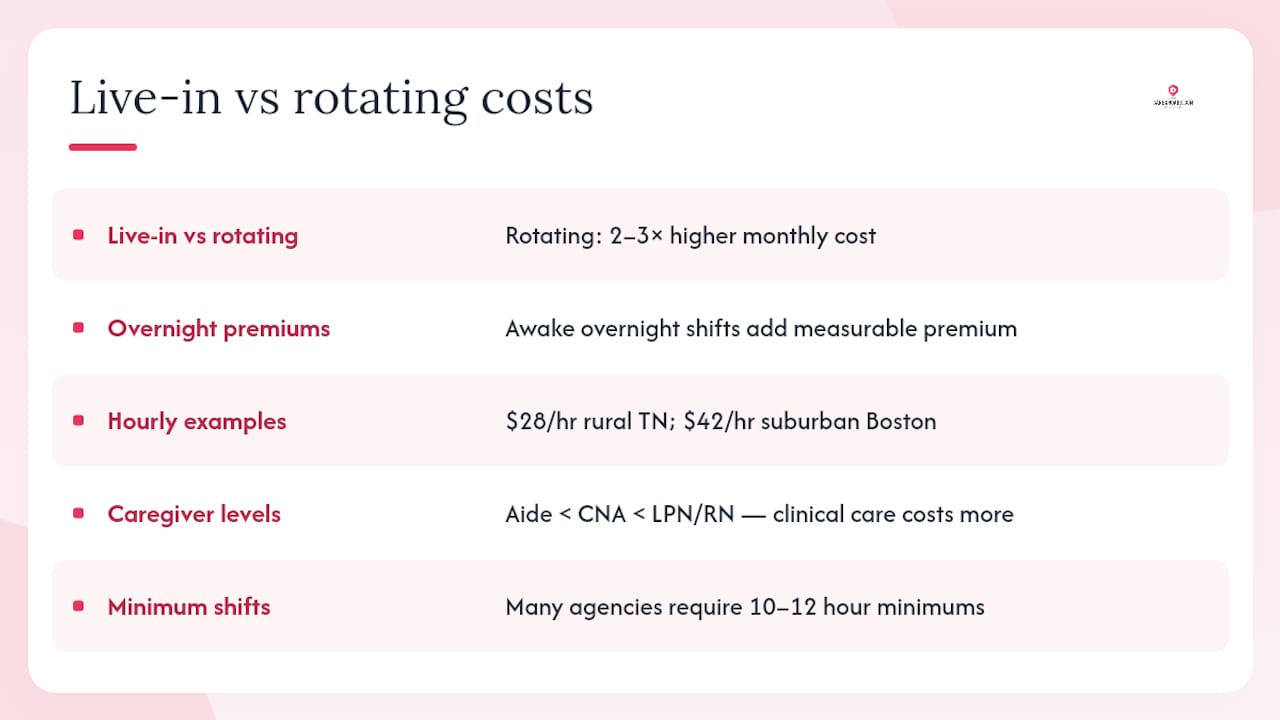
Caregiver qualifications matter significantly. A personal care aide costs less than a certified nursing assistant (CNA), who costs less than a licensed practical nurse (LPN) or registered nurse (RN). If your loved one needs wound care, medication administration, or ventilator management, a licensed clinician is required, and the rate climbs accordingly.
Geographic labor markets reflect local wages and cost of living. The same agency may charge $28/hour in rural Tennessee and $42/hour in suburban Boston for the same level of care.
Overnight and shift differentials add a measurable premium. Overnight shifts are harder to staff because fewer caregivers are willing to work those hours, and demand for late-night coverage consistently outpaces supply. Care that live-in, sleeping, and awake overnight arrangements are priced differently, and Department of Labor sleep-time rules directly affect how providers calculate live-in rates.
Agency overhead covers background checks, insurance, payroll processing, and backup staffing. These protections are real, but they are built into the hourly rate.
Minimum shift lengths are a common hidden cost. Many agencies require 10–12 hour minimums per shift, meaning a 4-hour gap-fill still bills at 10 hours. Always confirm how minimums and emergency fill-ins are priced.
Pro Tip: Ask every provider to walk you through their overnight staffing plan in writing: how many caregivers cover a 24-hour period, whether sleep time is deducted from live-in billing, and exactly how overtime and weekend premiums are calculated. Vague answers here are a red flag.
How do families typically pay for around-the-clock home care?
ACL's long-term care cost guidance confirms that Medicaid, private pay, VA benefits, and insurance each carry distinct limits and eligibility rules. No single source covers everything, and most families use a combination.
Payment sources and their key limits:
- Private pay: Out-of-pocket from savings, retirement accounts, or family contributions. No eligibility requirements, but costs deplete assets quickly at $7,500–$23,000/month.
- Medicare: Covers skilled home health services when medically necessary, but Medicare does not pay for ongoing custodial 24-hour care. It may cover short-term skilled nursing visits after a hospitalization.
- Medicaid and HCBS waivers: Medicaid's 1915(c) waivers can fund home- and community-based services in some states, potentially covering portions of in-home care that Medicare will not. Eligibility and covered hours vary significantly by state.
- VA Aid & Attendance: VA Aid & Attendance and Housebound benefits can offset in-home care costs for eligible veterans and surviving spouses, subject to income and resource limits.
- Long-term care insurance: Policies vary widely. Check the daily benefit amount, elimination period, and whether the policy covers custodial care at home. ACL's long-term care insurance resources explain how policies interact with other payers.
- Reverse mortgage or home equity: Can generate monthly income to fund care, but carries its own costs and risks. Consult a HUD-approved housing counselor before proceeding.
- Charitable and veteran caregiver programs: Some nonprofit organizations and state-funded programs offer supplemental support for low-income families.
Action checklist: who to call first
- Medicare: Ask your parent's physician whether any services qualify as "skilled" under Medicare's home health benefit. If yes, request a referral to a Medicare-certified home health agency.
- Medicaid: Contact your state Medicaid office and ask specifically about 1915(c) HCBS waivers, whether there is a waiting list, and what functional eligibility criteria apply.
- VA: If your loved one is a veteran or surviving spouse, call 1-800-827-1000 and ask about Aid & Attendance eligibility and the Community Care program.
- Long-term care insurer: Pull the policy and call the claims line. Ask about the elimination period, daily benefit cap, and whether a care coordinator assessment is required to activate benefits.
- Tax considerations: If you hire a caregiver privately (not through an agency), you may become a household employer responsible for FICA, federal unemployment tax, and state payroll taxes. An agency handles all of this on your behalf, which is one concrete reason the agency rate is higher.
Agency vs. private hire: what does the cost difference actually buy you?
Agencies typically charge 20–30% more than hiring an independent caregiver directly, a premium that reflects real operational costs rather than pure markup.
| Factor | Agency-staffed care | Private/independent hire |
|---|---|---|
| Cost premium | Higher (20–30% above independent rates) | Lower baseline rate |
| Background checks | Conducted by agency | Family's responsibility |
| Payroll and tax handling | Agency manages all | Family becomes household employer |
| Insurance and bonding | Agency carries liability coverage | Family assumes risk |
| Backup staffing | Agency provides replacement caregiver | Family must find coverage |
| Contract and termination | Formal agency agreement | Informal or self-drafted |
| Training and supervision | Agency-managed, ongoing | Family-managed |
The home care services model that agencies use bundles these protections into the hourly rate. For families arranging continuous care, backup staffing is often the deciding factor. A single caregiver calling in sick at 11 PM with no agency backup can collapse an entire care plan overnight.
When the overnight hours are medically complex or when your loved one has dementia and requires consistent, trained supervision, the agency premium tends to pay for itself in reliability and reduced family stress. For lower-acuity situations where a trusted private caregiver is already known to the family, independent hiring can be a reasonable way to reduce monthly costs, provided the family is prepared to handle payroll, taxes, and backup coverage.
What research and government sources say about 24/7 care costs
The National Institute on Aging documents the broad value of aging in place and the role of home-based supports in helping older adults maintain independence longer. That preference is real and widespread, but it comes with a financial reality that families need to plan for honestly.
Medicare's home health coverage rules confirm this: skilled care that is medically necessary and ordered by a physician may be covered, but continuous custodial care at home falls outside Medicare's scope. Families who assume Medicare will cover a live-in aide often discover the gap only after care has already begun.
On the overnight premium specifically, Care.com's overnight caregiver rate guide explains how Department of Labor sleep-time rules affect live-in economics. When a caregiver is permitted an uninterrupted 8-hour sleep period, that time may be excluded from paid hours in states that allow it, which is why live-in daily rates are lower than a straight 24-hour hourly calculation would suggest. However, if the caregiver is interrupted more than twice during the sleep period, the entire sleep period typically becomes compensable.
Pro Tip: Request a written staffing plan from any agency you are seriously considering. It should show exactly how many caregivers cover a 24-hour period, what hours each works, how overtime is calculated, and what happens when a caregiver calls in sick. If an agency cannot produce this document, keep looking.
Lower-cost alternatives that can reduce a 24-hour care bill
Full-time continuous care is not always the only safe option. Several alternatives can reduce monthly costs while preserving your loved one's safety and quality of life.
- Shared shifts with family caregivers: A family member covers overnight hours while a paid caregiver handles daytime. This can cut monthly costs by 30–50% depending on how many hours the family member reliably covers.
- Nighttime monitoring technology: Motion sensors, bed exit alarms, and remote monitoring systems can safely replace an awake overnight caregiver for individuals who sleep through the night and have low overnight needs.
- Adult day programs: Structured daytime programming at an adult day center reduces the hours of paid in-home care needed each day. Many programs run 6–8 hours and cost $75–$100 per day, far less than equivalent in-home hours.
- Respite or short-term coverage: Using agency care for specific high-need periods (post-hospitalization, recovery from surgery) rather than continuously can preserve budget for when it matters most.
- Assisted living: For individuals who need moderate personal care but not continuous skilled nursing, assisted living can cost less than full-time in-home care. Comparing assisted living to in-home care is worth doing when monthly in-home costs exceed $10,000. That said, assisted living costs vary widely by location and care level, and some memory care communities cost as much as or more than in-home care.
- Long-term care insurance and VA benefits: If either applies, activating them early reduces out-of-pocket spend from day one.
When cost-saving alternatives are not safe: Do not reduce overnight coverage for individuals who require ventilator management, have frequent overnight transfers, experience active nighttime agitation from dementia, or have a history of falls requiring immediate response. In these situations, awake overnight coverage is a clinical necessity, not a preference.
A simple estimate template and two worked examples
Use this template to build a quick monthly estimate before you request formal quotes.
Calculation template
- Hourly rate (agency or independent): $______
- Shift length (hours per shift): ______
- Number of caregivers per day (to cover 24 hours): ______
- Overtime assumption (hours over 40/week billed at 1.5×): ______
- Agency fee or markup (if applicable): ______
- Weekly hours (Step 2 × Step 3 × 7): ______
- Monthly total (Step 6 × hourly rate × 4.33 weeks, adjusted for overtime): $______
Example A: rotating-shift agency plan with awake overnights
- Three 8-hour shifts per day, agency rate $32/hour
- Each caregiver works 5 days/week (40 hours), no overtime triggered
- Monthly cost: 24 hrs/day × $32 × 30 days = $23,040/month
- Weekend premium (1.25×) on 8 days/month adds roughly $1,500
Example B: live-in private caregiver with sleep-time deduction
- One caregiver, flat daily rate of $250 (reflects 16 billable hours after 8-hour sleep deduction)
- Monthly cost: $250 × 30 = $7,500/month
- No overtime if the caregiver works 7 days and the sleep-time deduction is lawfully applied
The difference between these two examples, roughly $15,000/month, reflects the cost of continuous awake coverage versus a live-in arrangement with permitted sleep time. Families weighing live-in care arrangements should confirm with their state's labor rules whether the sleep-time deduction applies before budgeting around it.
Timeline for arranging continuous care
- Weeks 1–2: Research agencies and independent caregivers, request written quotes from at least three providers, confirm insurance and licensing.
- Weeks 2–4: Conduct background checks (if hiring privately), interview candidates, review contracts, and clarify billing terms in writing.
- Weeks 3–5: Complete onboarding, introduce caregiver to the home and daily routines, and establish a communication protocol with the family.
- Ongoing: Identify a backup caregiver or agency contact for emergency coverage before the primary caregiver starts. Do not wait for the first sick day to solve this.
Questions to ask and red flags to watch for
Asking the right questions before signing a contract protects your family and your budget.
Ask every provider:
- How many caregivers cover a 24-hour period, and what are their exact shift hours?
- What is your backup staffing procedure when a caregiver calls in sick or is unavailable?
- Can you provide a written scope of duties and a sample care plan?
- How is billing handled for overtime, minimum shift lengths, holidays, and last-minute replacements?
- Who handles payroll taxes and employer responsibilities?
- Are caregivers bonded and insured? Does the agency carry general liability coverage?
- What dementia or memory care training do your caregivers receive?
Red flags that warrant caution:
- No written backup staffing plan or a vague verbal assurance that "someone will always be available"
- Billing terms that are not itemized in the contract (overtime rates, holiday premiums, minimum shift charges)
- No written contract or a contract that cannot be reviewed before signing
- Caregivers who appear to be misclassified as independent contractors when the agency controls their schedule (this shifts payroll tax liability onto the family unexpectedly)
- Prices significantly below the local market rate with no clear explanation and no verifiable references
- Inability or unwillingness to provide references from families with similar care needs
Get every promise in writing. Ask specifically for references from families whose loved ones had overnight or continuous care needs similar to yours, and call those references before committing.
Sources
Government pages and established industry guides are the most reliable places to verify program rules, since state Medicaid waivers and VA eligibility criteria change periodically. The sources below are the primary references used throughout this article.