
The national average assisted living cost runs about $5,830 per month, with a typical U.S. range from about $4,000 to nearly $8,000 per month depending on location, apartment size, and how much hands-on care your loved one needs. CarePriced's 2026 estimates place the national median closer to $5,200/month, while Carescout's 2025 data puts the median at $6,200/month, a figure that reflects a roughly 5% year-over-year increase. Avecare's 2026 summary narrows the state-level spread to $3,700–$7,300/month. Use the mid-$5,000 to high $5,000 range as your planning benchmark, then adjust it for your state, your loved one's care needs, and the community's pricing model.
Key Takeaways
National assisted living costs range from $3,700 to $8,000 per month depending on state, care level, and pricing model, making local verification and written fee schedules the most important steps any family can take before signing a contract.
| Point | Details |
|---|---|
| National monthly benchmark | The average assisted living cost runs $5,500–$5,830/month; state ranges span $3,700–$7,300/month. |
| Pricing model matters | All-inclusive, tiered, and à la carte models produce very different total bills; always compare what's included. |
| Watch for add-ons | Move-in fees (median |
| Plan for a 22-month stay | The median length of stay is 22 months; budget for 3–5% annual increases on top of the base rate. |
| Use Carexroads to verify | Search the Carexroads directory for verified local providers and family reviews to confirm real pricing before committing. |
Table of Contents
- What monthly fees usually cover and how communities price their services
- How to estimate assisted living costs for your specific area
- Common extras that raise the monthly bill
- How families pay for assisted living
- A checklist to compare communities on cost and value
- How monthly costs add up over a typical stay
- How seasonal and market shifts affect assisted living prices
- Urban vs. rural cost differences within states
- Carexroads' perspective on using cost estimates wisely
- How Carexroads helps you compare assisted living costs and providers
- Sources
What monthly fees usually cover and how communities price their services
Most assisted living communities bundle several services into a single monthly fee. That base rate typically covers a private or semi-private apartment, three daily meals, light housekeeping and laundry, scheduled transportation, social programming, and basic care coordination. Help with activities of daily living (ADLs) such as bathing, dressing, and medication management may be included or billed separately depending on how the community structures its pricing.
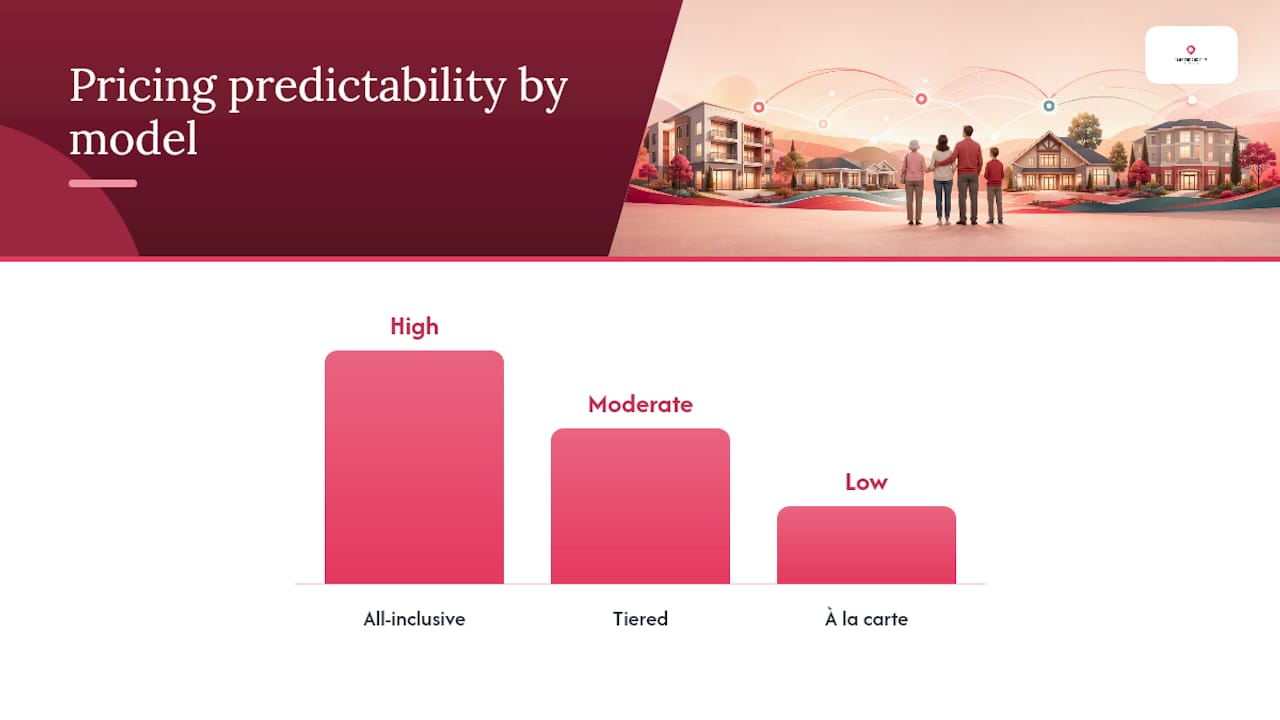
Three pricing models dominate the market:
- All-inclusive: One flat monthly rate covers housing, meals, and most care services. Predictable for budgeting, but the base rate is often higher upfront.
- Tiered pricing: The community assigns a care level (Level 1, 2, 3, etc.) based on ADL needs, and each tier carries a higher monthly fee. Costs rise as needs increase, which can catch families off guard if a loved one's condition changes quickly.
- À la carte: A lower base rate covers housing and meals; every additional service is billed separately. Looks affordable at first glance, but add-ons accumulate fast.
A lower base rate can still be more expensive overall when many services are charged separately. Always compare what's included, not just the sticker price.
| Pricing model | Predictability | Cost if needs rise | Transparency | Common add-ons |
|---|---|---|---|---|
| All-inclusive | High | Stable | High | Few; major care changes may trigger tier jump |
| Tiered | Moderate | Increases by tier | Moderate | Therapy, specialty programs |
| À la carte | Low | Can rise sharply | Low | Medication management, laundry, transportation |
Pro Tip: Ask every community for a full written fee schedule and a sample monthly invoice before signing anything. A community that hesitates to provide these documents is a red flag worth noting.
How to estimate assisted living costs for your specific area
Start with the national benchmark of $5,830/month, which translates to roughly $69,960 per year. Over a median stay of 22 months, that baseline totals approximately $128,260 before any adjustments.
Three local factors will move that number up or down:
- Location. States like California, New York, and Massachusetts consistently run well above the national median. States in the South and Midwest often fall below it. Within any state, urban metro areas cost more than rural communities, largely because staffing accounts for roughly 60–70% of a community's operating budget, and wages are higher in cities.
- Apartment size. A studio costs less than a one-bedroom, which costs less than a two-bedroom suite. The difference can range from a few hundred to over $1,000 per month at the same community.
- Level of care. A resident who needs help with two ADLs will pay less than one who needs help with five. Level-of-care upcharges often range from several hundred to a few thousand dollars above the base rate, with memory care premiums considerably higher.
Sample calculation: If the state median in your area is 10% above the national average ($5,830 × 1.10 = $6,413/month), and your loved one needs a mid-level care tier adding $800/month, the realistic monthly estimate is about $7,213, or roughly $86,556 per year.
To verify local rates, check your state's Medicaid agency cost pages, request fee schedules directly from communities you're considering, and search the Carexroads directory for verified local providers. When you call a community, ask specifically: "What is the base monthly rate for a studio, and what does that include?" and "How is care level assessed and how often does it change?"
Common extras that raise the monthly bill
Beyond the base rate, several recurring and one-time charges can add hundreds or thousands of dollars per month:
- Move-in or community fee: Median near $3,000; some communities charge up to $5,000 or more. Usually non-refundable.
- Second-person fee (for couples): Median around $1,200/month added to the base rate.
- Medication management: Often $300–$600/month if not included in the base.
- Physical, occupational, or speech therapy: Billed per session or as a monthly package.
- Laundry, internet, and cable: Frequently itemized separately, adding $50–$200/month.
- Pet rent: Common at pet-friendly communities, typically $50–$150/month.
- Salon services, private transportation, and parking: Variable; ask for the full menu.
- Level-of-care upcharges: $500–$2,500/month above base, per Avecare's 2026 data.
Watch for these red flags in fee disclosures: vague language like "care services as needed" with no dollar amounts attached, no written fee schedule available before signing, and large unexplained deposits beyond the standard community fee.
How families pay for assisted living
Most families rely on a combination of sources rather than a single payment method.
- Private pay (income and savings): The most common starting point. Covers costs directly from retirement income, savings, or investment accounts.
- Long-term care insurance: Policies vary widely in daily benefit amounts and elimination periods. Pull the policy documents and call the insurer before touring communities to confirm what's covered.
- Medicaid state waiver programs: Medicaid generally does not cover room and board in assisted living, but many states offer Home and Community-Based Services (HCBS) waivers that help pay for personal care services within an assisted living setting. Eligibility rules and benefit amounts differ by state. Contact your state Medicaid office or visit Medicaid.gov to check waiver availability.
- VA benefits: Veterans and surviving spouses may qualify for the Aid and Attendance benefit, which can add several hundred to over $1,000 per month toward care costs. Start at VA.gov or call 1-800-827-1000.
- Proceeds from selling a home: A common funding source when a parent transitions from homeownership to assisted living. Coordinate the timeline carefully so funds are available when needed.
- Reverse mortgage: An option for homeowners who want to age in place first, then transition; proceeds can fund assisted living later, though terms vary.
One important caveat: Medicare generally does not cover long-term assisted living. It may pay for short-term skilled nursing or rehabilitation after a hospital stay, but ongoing residential care is not a Medicare benefit.
Checklist before applying for benefits:
- Gather the last three years of financial statements and tax returns.
- Locate all insurance policies (long-term care, life, Medicare supplement).
- Request a benefits eligibility screening from your state's Area Agency on Aging.
- For VA benefits, gather the veteran's discharge papers (DD-214).
A checklist to compare communities on cost and value
Use this list on every tour or phone call:
- Confirm the exact base monthly rate and what it includes in writing.
- Ask how care levels are assessed and what triggers a move to a higher tier.
- Request the full add-on fee schedule and a sample monthly invoice.
- Ask about the notice period required before rate increases take effect.
- Clarify the refund policy for the community fee and any deposits.
- Confirm staffing ratios for day, evening, and overnight shifts.
- Ask whether staff are employees or agency contractors.
- Verify state licensure and any recent inspection reports (available through your state health department).
- Check verified family reviews through a platform like Carexroads, which carries a 4.8 average family satisfaction rating based on verified family reviews, to see how current residents' families describe the day-to-day experience.
- Ask whether the community can accommodate increasing care needs or whether a move to memory care or skilled nursing would be required.
How monthly costs add up over a typical stay
The median length of stay in assisted living is approximately 22 months, according to Stacker's analysis of National Center for Assisted Living data. That figure shapes how families should think about total cost, not just the monthly rate.

Carescout's data shows roughly a 3–5% annual increase in assisted living costs, driven by labor and operational inflation. The table below applies a 4% annual increase to three benchmark monthly rates to show 12-month, 22-month, and 36-month totals.
These figures assume a stable care level. A move to a higher care tier or memory care mid-stay will push totals higher. Build a 10–15% contingency into any multi-year budget.
How seasonal and market shifts affect assisted living prices
Assisted living costs don't fluctuate month to month the way hotel rates do, but broader market forces do push rates upward over time. The most consistent driver is labor: when state minimum wages rise or regional labor markets tighten, communities pass those costs along through annual rate increases, typically announced 30–60 days before they take effect.
Occupancy cycles also matter. Communities with high vacancy rates sometimes offer move-in incentives such as a waived community fee or a discounted first month, particularly in slower winter months. Families who are flexible on timing may find modest savings by asking about current availability and incentives directly.
Inflation in food, utilities, and insurance has added to operational costs across the industry, reinforcing the 3–5% annual increase trend that Carescout's data documents. When budgeting for a loved one who may stay two or more years, factor in at least one or two rate adjustment cycles.
Urban vs. rural cost differences within states
The gap between urban and rural assisted living prices within a single state can be as wide as the gap between two different states. In Texas, for example, a community in Houston or Dallas will typically cost several hundred dollars more per month than a comparable community in a smaller city or rural county. The same pattern holds in Florida, Ohio, and most other large states.
Local labor costs and real estate explain most of this gap. Metro communities pay higher wages to compete for staff, carry higher property costs, and often offer more amenities to match resident expectations in competitive urban markets. Rural communities may offer lower base rates but sometimes have fewer specialized services, smaller activity programs, or longer distances to medical facilities.
For families weighing a move to a community near other relatives, the decision factors around proximity and cost are worth mapping out carefully before committing to a specific region.
Carexroads' perspective on using cost estimates wisely
The benchmark numbers in this article are a starting point, not a final answer. A family that stops at the national average and picks the community closest to that figure often misses the real question: what does this community actually deliver for that price?
At Carexroads, we recommend using the national median to set a realistic budget range, then doing the local work: requesting written fee schedules, asking for a sample invoice, and reading verified family reviews from people whose loved ones live there now. The communities that are transparent about pricing from the first phone call tend to be the same ones that handle care transitions and billing disputes well later on. That pattern shows up consistently in the reviews families share on our platform.
How Carexroads helps you compare assisted living costs and providers
Finding the right community means comparing real costs, not just advertised rates. Carexroads gives families a searchable directory of assisted living providers with verified family reviews, location-based filtering, and practical guides covering everything from pricing models to transitioning a senior into assisted living. The platform's 4.8 average family satisfaction rating reflects the experience of families who have already done the comparison work you're doing now.

Search the Carexroads directory to find verified assisted living communities near you, read real family reviews, and connect with a specialist who can help you build a local cost estimate and compare options side by side.
Sources
- How much does assisted living cost? A state-by-state guide | Stacker
- Cost of Long Term Care by State | Cost of Care Report | Carescout
- How Much Does Assisted Living Cost in 2026? A State-by-State Guide | CarePriced
- Assisted Living Cost by State 2026: All 50 States
This article is general information, not a substitute for advice from a qualified financial advisor. Consult a qualified financial professional about your own circumstances before acting on anything here.