

Start the claim now: contact the insurer by phone or online portal and begin gathering the attending physician statement, plan of care, invoices, and power of attorney paperwork. Insurers pay only after they confirm a benefit trigger, usually an ADL or cognitive impairment, and after the elimination period is satisfied. Reimbursement is the most common payment model, so submitting itemized invoices promptly keeps benefits flowing once approval comes through.
TL;DR:
- Insurers typically require proof of care, physician certification, and detailed invoices, which must be complete and accurate to prevent delays.
- Benefits are paid after confirming a benefit trigger, with the elimination period counting either calendar days or service days, significantly affecting claim timing.
- Most policies pay through reimbursement or indemnity models, and submitting invoices monthly helps sustain benefits without interruptions.
- Errors such as missing signatures or incorrect provider eligibility are common causes of claim denials, so careful documentation is essential.
- Coordinating documentation early with discharge planners and using verified provider directories can streamline the claim process and reduce delays.
Table of Contents
- How Do I Start a Long-Term Care Insurance Claim?
- What Documents Does the Insurer Need to Approve a Claim?
- How Does the Elimination Period Actually Work?
- Reimbursement vs. Indemnity: How and When You Get Paid
- Why Do Long-Term Care Claims Get Delayed or Denied?
- What Happens After You File? A Realistic Timeline
- How Do You Appeal a Denied LTC Claim?
- Do Policy Riders Change How a Claim Gets Approved?
- How Should You Talk to the Insurance Adjuster?
- Are Long-Term Care Insurance Benefits Taxable?
- How Do LTC Benefits Coordinate With Medicare and Medicaid?
- Publisher Perspective: How Families Can Simplify Claims Using Care Navigation
- Another Option: Using Carexroads to Find Qualified Providers Faster
- Sources
- FAQ
How Do I Start a Long-Term Care Insurance Claim?
Opening a long-term care insurance claim is largely an administrative act, not a medical one. The insurer needs to know care is happening or about to happen, and the sooner that notice goes in, the sooner the elimination-period clock starts running in your favor.
A spouse, adult child, power of attorney, or the policyholder can open the claim, but whoever calls should have the policy number, the insured's full legal name, date of birth, and a general description of the care situation ready before dialing.
- Call the insurer's claims line or start online. Most carriers, including John Hancock, let you initiate a claim by phone or through a secure web portal.
- Request the claim initiation kit. This packet contains the claimant statement, attending physician statement, and plan of care forms the insurer requires.
- Register the insured or POA on the account. If someone other than the policyholder is managing the claim, the insurer will need proof of authority before releasing information.
- Schedule the in-home or telephonic assessment, if the insurer requests one, to verify functional or cognitive status.
During every call, write down the date, the claim number once assigned, the representative's name, and any stated deadline. This log becomes invaluable if a dispute arises later. Opening the claim early, even before the elimination period is fully satisfied, preserves credit toward that waiting period and gets the insurer engaged in gathering forms sooner rather than later.
What Documents Does the Insurer Need to Approve a Claim?
Every long-term care insurance claim rests on four categories of paperwork. Missing or incomplete forms in any one category are the most common reason claims stall.
- Claimant/policyholder statement and attending physician statement. The insured or POA completes the claimant portion; a licensed physician completes the clinical section, certifying ADL loss or cognitive impairment. A common pitfall is a physician's office rushing the form and leaving diagnosis codes vague.
- Plan of care. This document must connect specific deficits, such as difficulty bathing or dressing, directly to the services being requested. A plan of care that explicitly ties ADL loss to recommended services moves through clinical review with far fewer follow-up requests.
- Provider invoices and licensing proof. Itemized invoices, not summary statements, are standard. If a facility bills through Medicare, insurers sometimes want UB-04 forms. Independent caregivers need proof of licensing or agency affiliation.
- Power of attorney and HIPAA authorization. Insurers distinguish between financial POA and health-care proxy, and submitting the exact type requested avoids a common, fixable delay.
Pro Tip: Ask your loved one's physician's office for two copies of the attending physician statement at the same visit. Getting a signature once, rather than chasing a second signature later, can save two to three weeks.
How Does the Elimination Period Actually Work?
The elimination period is the waiting window between when care begins and when benefits start paying, and how it's counted matters enormously. Most policies set this window at 30 to 90 days, but whether those are calendar days or service days changes everything.
- Calendar-day elimination periods count every day that passes, whether or not care was actually delivered that day. A 90-day calendar elimination period finishes 90 days after it starts, period.
- Service-day elimination periods count only days on which paid care was received. If care happens three days a week, a 90-service-day elimination period can stretch to seven months or longer before it's satisfied.
- Benefit triggers require certification that the insured cannot safely perform at least two of six ADLs (bathing, dressing, toileting, transferring, continence, eating) without help, or has a severe cognitive impairment such as advanced dementia.
- Medicare paperwork alone often lacks the line-item detail insurers need. If a carrier asks for UB-04 statements to credit service days, request those directly from the provider rather than relying on an Explanation of Benefits.
Reimbursement vs. Indemnity: How and When You Get Paid
Most long-term care policies pay through one of two models, and knowing which one applies to your policy changes how you manage paperwork every month.
Under a reimbursement model, the insurer repays actual care expenses up to the policy's daily or monthly limit, and payment is commonly processed once complete invoices are received. Under an indemnity or cash model, the insurer pays a fixed benefit amount once eligibility is confirmed, regardless of exact spending, giving families more flexibility in how the money is used.
Some families choose an assignment of benefits, where the insurer pays the provider directly rather than reimbursing the family. This can simplify cash flow but requires the provider to accept insurer billing timelines, which sometimes run slower than a family paying out of pocket and waiting for reimbursement.
- Submit invoices monthly, not quarterly. Consistent submission builds the administrative rhythm insurers expect and is the single most effective habit for keeping reimbursement claims moving.
- Keep a running file with invoice dates, provider contact information, and dated service notes for every visit.
Pro Tip: Set a recurring reminder on the same day each month to gather and submit invoices. Insurers process complete, on-time submissions faster than a stack of backlogged paperwork.
Why Do Long-Term Care Claims Get Delayed or Denied?
Denials rarely come down to one dramatic disqualifying event. They come down to small, fixable errors that pile up. Industry claims specialists point to filing for services outside the contract's covered categories or failing to document medical necessity as the leading causes, right alongside plain paperwork mistakes.
- Missing signatures or the wrong POA type. Confirm with the insurer, in writing, exactly which authorization document they require before submitting.
- Provider eligibility mismatches. Some policies only pay for licensed home care agencies, not independent caregivers. Verify a provider's eligibility with the insurer before care begins, not after invoices pile up.
- Elimination-period miscounting. If your policy uses service days, track every paid care day in a simple log; do not assume the insurer's count matches yours.
- Incomplete clinical documentation. A physician statement that doesn't clearly link a diagnosis to functional loss invites a request for more information, which adds weeks.
If a claim is denied, request the denial letter and the specific reason in writing immediately, as verbal explanations may not suffice for appeals.
What Happens After You File? A Realistic Timeline
Insurers typically acknowledge a new claim within a few business days of receiving the initiation kit. From there, a clinical reviewer examines the physician statement and plan of care, and many carriers schedule an in-home or telephonic assessment to verify the benefit trigger firsthand.
Eligibility decisions commonly land around 40 business days from the date the insurer receives a complete claim packet, though incomplete paperwork extends that window considerably.
- Prepare the insured for the assessment by having recent medical records and a list of daily challenges on hand.
- Expect recertification, often annually, where the insurer reconfirms the benefit trigger still applies.
- Call the claims department every two to three weeks if you haven't heard back; polite persistence keeps a file from stalling in a queue.
How Do You Appeal a Denied LTC Claim?
A denial is a setback, not a dead end. Most policies include a formal internal appeal process with a deadline, so it is important to proceed promptly, following the insurer's stated timeline.
- Request the denial letter and full claim file in writing, including the specific policy provision cited for denial.
- Assemble new or clarified evidence: an updated plan of care, a more detailed physician attestation, or missing invoices.
- File the internal appeal before the deadline stated in the denial letter, referencing the exact provision disputed.
- Contact your state insurance department if the internal appeal also fails; every state maintains a consumer division that handles LTC complaints.
- Consider independent claims assistance or an elder law attorney when the dollar amount at stake is significant or the denial involves a disputed diagnosis; these professionals can push back on insurer determinations with formal language insurers take seriously.
Do Policy Riders Change How a Claim Gets Approved?
Riders and amendments attached to a long term care policy can tighten or loosen what an insurer will approve, so pulling the actual rider schedule before filing saves guesswork later.
An inflation protection rider increases the daily benefit amount over time, but it doesn't change the benefit trigger definition, so a claim can still be denied on eligibility grounds even with generous inflation adjustments in place. A shared care rider, common in spousal policies, lets one spouse draw from the other's pool of benefits once their own is exhausted; insurers will ask for both policy numbers and proof of the marital relationship before approving a shared-care claim.
Nonforfeiture riders matter if a policy lapsed for nonpayment. They preserve a reduced benefit even after lapse, but the reduced amount and eligibility rules shift, and claims examiners will calculate benefits against the nonforfeiture schedule rather than the original policy terms.
Restoration of benefits riders replenish the total benefit pool after a claimant recovers and stops using services for a defined period. If your loved one's care needs paused and later resumed, mention this rider explicitly when reopening a claim. Some older policies also carry a survivorship rider, which waives future premiums if a spouse dies, but this has no bearing on benefit eligibility itself.
The practical lesson: read the rider schedule in the policy declarations page before assuming standard elimination periods or triggers apply. Amendments filed years after the original policy sometimes change definitions that families assume are fixed.
How Should You Talk to the Insurance Adjuster?
The adjuster reviewing your claim is working through a checklist, not making a judgment call about your family's need for care. Framing every conversation around their documentation requirements, rather than the urgency of the situation, moves things faster.
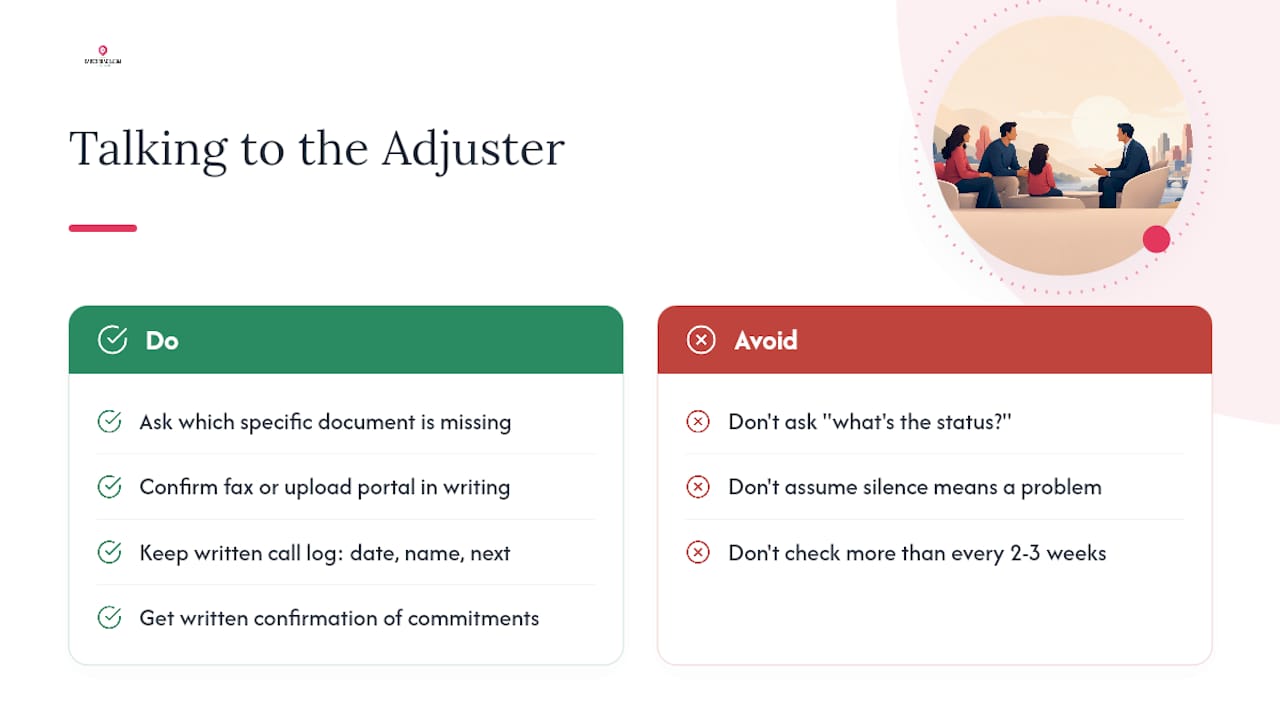
Ask directly what specific form or document is missing rather than asking generally "what's the status." Adjusters can usually name the exact gap immediately, which turns a vague follow-up call into an actionable to-do list. Confirm the fax number or upload portal in writing after every call, since misdirected paperwork is a common, invisible cause of delay.
Keep a written log of every call: date, adjuster name, what was discussed, and what happens next. If an adjuster gives a verbal commitment, such as "we'll expedite the physician statement review," ask them to confirm it by email or note it in the claim file. Escalate politely and specifically if a stated deadline passes. Instead of "why is this taking so long," ask "the file notes said review would complete by [date]. Can you tell me what's outstanding?"
Never assume silence means a problem. Insurers process thousands of files, and a claim in good standing sometimes simply sits in a review queue. A brief, friendly check-in every two to three weeks keeps your file visible without becoming adversarial.
Are Long-Term Care Insurance Benefits Taxable?
Most benefits paid under a tax-qualified long term care insurance policy are not counted as taxable income, whether paid under a reimbursement or indemnity model, as long as the payments don't exceed the actual cost of qualified long-term care services or the IRS's per-diem limit for indemnity policies. If an indemnity payment exceeds the qualified per-diem limit, only the excess portion may become taxable.
Premiums paid on a tax-qualified policy can also be partially deductible as a medical expense, subject to age-based limits that adjust annually. Because these limits and exclusions change and depend on how a specific policy is structured, families dealing with unusually large indemnity payouts or a non-qualified policy should confirm treatment with a tax professional or CPA familiar with long-term care products before filing. This isn't a detail to guess on when a benefit payment shows up as a line item on next year's tax documents.
How Do LTC Benefits Coordinate With Medicare and Medicaid?
Long-term care insurance, Medicare, and Medicaid solve different problems, and coordinating them correctly prevents both gaps in coverage and accidental overpayment.
Medicare covers short-term, medically necessary skilled care, such as rehabilitation after a hospital stay, but it does not pay for long-term custodial care like help with bathing or dressing. A long term care policy fills that gap. If your loved one is receiving Medicare-covered skilled nursing or home health care, that period generally does not count toward the LTC policy's elimination period unless the insurer specifically credits it, so confirm this with the claims adjuster rather than assuming.
Medicaid becomes relevant only after a person has spent down assets to the state's eligibility threshold, and it typically covers nursing home care and, in some states, home and community-based waiver services. A long term care policy paying benefits does not usually disqualify someone from Medicaid, but the income and asset rules vary by state, so this needs individual verification. Some hybrid life insurance and LTC policies also interact with Medicaid's asset protection rules under state Partnership programs; ask the insurer whether your policy qualifies.
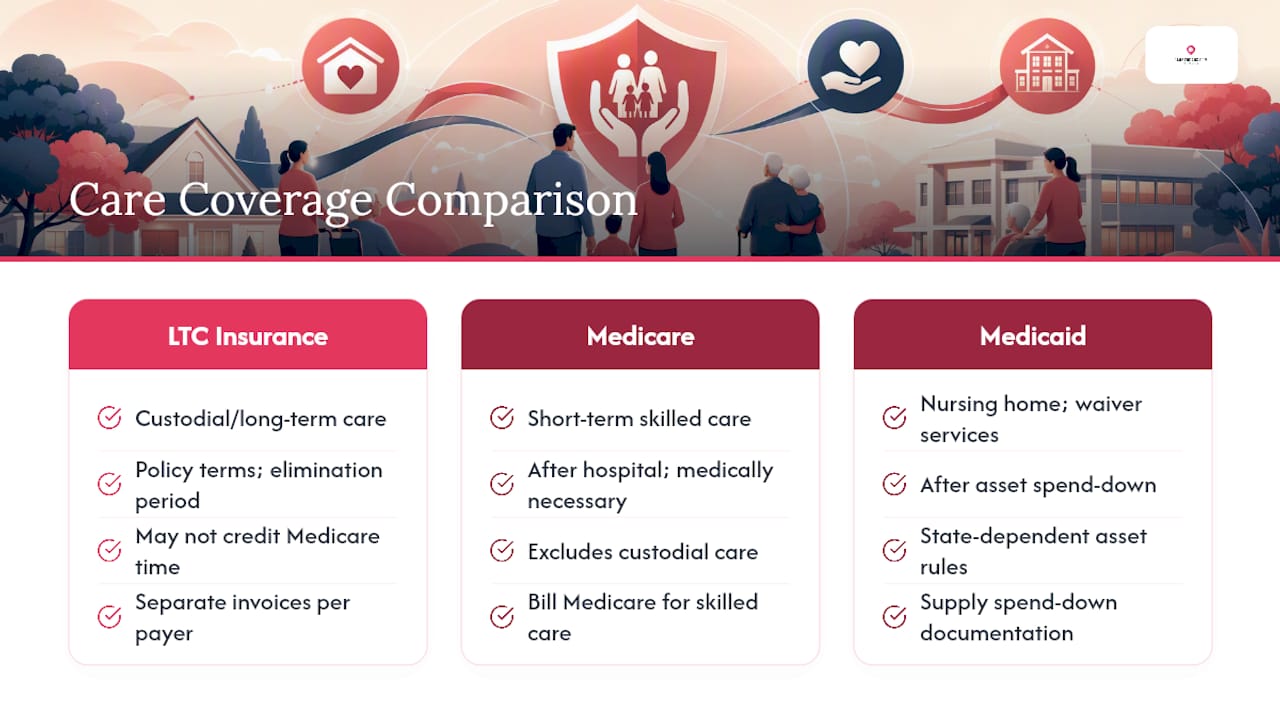
If care involves multiple payers simultaneously, keep separate invoice records for each. An invoice submitted to Medicare for skilled care shouldn't also go to the LTC insurer as a claim for custodial services; overlapping submissions can trigger review delays or accusations of double billing that are entirely avoidable with clean recordkeeping.
Publisher Perspective: How Families Can Simplify Claims Using Care Navigation
The gap between what a policy promises and what a family actually experiences at claim time usually isn't the insurer's fault, and it isn't the family's fault either. It's a coordination problem. Discharge planners, physicians, and home care agencies each hold a piece of the documentation an insurer needs, and nobody is naturally positioned to connect those pieces except the family, often at the exact moment they're least equipped to manage paperwork.
Coordinating with hospital discharge planners early, rather than after a claim stalls, closes documentation gaps before they cost weeks. Carexroads built safe discharge support and provider verification specifically because families told us the hardest part wasn't understanding their policy. It was finding a licensed provider whose paperwork actually satisfied what the insurer wanted on the first try.
One honest caveat: Carexroads helps families locate providers and organize documentation. It does not adjudicate insurance claims, and no navigation tool replaces the physician statement and plan of care your insurer requires directly from clinical sources.
— Care
Another Option: Using Carexroads to Find Qualified Providers Faster
Chasing down a licensed home care agency while also managing physician statements and an insurer's paperwork deadlines is where most families lose time they don't have. The platform is built around addressing that challenge: offering a searchable directory of verified home care, home health, assisted living, and hospice providers, supported by real family reviews, to simplify the process of selecting a licensed agency during claim preparation.

Carexroads also connects families with safe discharge support, which helps align hospital documentation with what an insurer will ask for during the claim initiation kit stage, and with practical guidance drawn from post-discharge care coordination. Neither service files your claim for you, but both reduce the friction that turns a straightforward claim into a three-month back-and-forth.
If you're starting from scratch, request a free in-home care assessment to identify a licensed provider that fits your loved one's needs, or browse the full directory of provider categories to compare options before your next physician visit locks in a plan of care.
This article is general information, not a substitute for advice from a qualified financial advisor. Consult a qualified financial professional about your own circumstances before acting on anything here.
Sources
FAQ
How Do I File a Claim on a Long-Term Care Policy?
Call the insurer or start online, request the claim initiation kit, and submit the attending physician statement, plan of care, invoices, and POA documentation as soon as they're ready.
How Long Does the Average Long-Term Care Claim Take?
Eligibility decisions commonly take around 40 business days after the insurer receives a complete claim packet, though missing paperwork extends that timeline.
Do You Get Money Back From Long-Term Care Insurance?
Under a reimbursement model, yes, the insurer repays documented care expenses up to policy limits once complete invoices are submitted; under an indemnity model, you receive a fixed benefit amount once eligibility is confirmed.
What Are the Three Types of Long-Term Care Insurance?
Common structures include traditional standalone LTC policies, hybrid life insurance or annuity policies with an LTC rider, and short-term care policies with lower benefit periods; each defines elimination periods and benefit triggers differently, so confirm the exact terms in your declarations page.
Where Can Carexroads Help During a Claim?
Carexroads doesn't process insurance claims, but its verified provider directory and discharge support help families secure the licensed provider documentation insurers require to approve a claim.