

Yes, in most states Medicaid can pay a family member or friend to provide care, typically through self-directed programs, certain HCBS waivers, or structured family caregiving arrangements. The care recipient must already qualify for Medicaid and be assessed as needing long-term services and supports. The rest comes down to which program your state offers, who is eligible to be paid, and how much that pay actually covers. That's what the sections below walk through, in order.
TL;DR:
- Medicaid family caregiver payments depend on state-specific programs, with options like HCBS waivers offering limited slots and state plans providing broader access.
- Qualification requires the care recipient to be Medicaid-eligible with confirmed needs assessments and the caregiver to meet relationship and enrollment rules.
- Payment rates are set by states and typically range from hourly wages to daily stipends, with total monthly pay capped by authorized hours or rates.
- Waiver waiting lists can delay payment by months, and strict documentation practices are essential to avoid audits or repayment demands.
- Starting with the LTSS assessment and confirming the exact program name is more important than focusing on pay rates early in the process.
Table of Contents
- Which Medicaid Caregiver Pay Programs Actually Exist?
- Who Qualifies to Give and Receive Paid Care?
- How Do You Apply and Get Started?
- How Much Do Family Caregivers Actually Get Paid?
- What Restrictions and Red Flags Should You Watch For?
- How Carexroads Helps Families Navigate This Process
- What We Think Families Get Wrong About This Process
- Find Local Help Through Carexroads
- Where to Confirm the Rules in Your State
- Sources
Which Medicaid Caregiver Pay Programs Actually Exist?
Medicaid doesn't run one national caregiver-pay program. It runs several, and the one available to your family depends entirely on your state and the care recipient's needs.
The most common vehicle is the HCBS waiver, authorized under Section 1915(c) of the Social Security Act. These waivers let states offer home and community-based services as an alternative to nursing home placement, and many include a participant-direction option, meaning the Medicaid recipient (or their representative) can hire, train, and pay their own caregiver, including a relative. Medicaid let participants control their own care budget under specific state authorities.
A second path runs through the state Medicaid plan itself rather than a waiver. Section 1915(j) allows states to build self-direction into their regular state-plan personal care services, and Community First Choice (a state-plan option under Section 1915(k), often called CFC) offers a similar attendant-services benefit in states that adopt it. Because these sit in the state plan, they tend to function more like an entitlement.
A smaller number of states run Structured Family Caregiving (SFC), which pays a daily stipend to a caregiver, often a relative, who lives with or near the person they're supporting. An agency typically oversees the arrangement and handles the paperwork.
- HCBS waivers: capped enrollment, often with waiting lists
- 1915(j) and CFC: state-plan based, generally broader availability
- Structured Family Caregiving: per-diem model, offered in select states only
That cap-versus-entitlement distinction matters. Waiver slots are limited by state budget allocations, so approval can take months. State-plan options don't carry the same waiting-list risk because they're written into the plan itself.
Who Qualifies to Give and Receive Paid Care?
Two separate eligibility tracks run at once here, and both have to clear before payment starts.
- The care recipient must be Medicaid-eligible and pass a functional assessment showing they need help with activities of daily living, such as bathing, dressing, mobility, or medication management. States use this assessment to determine the level of care and the hours authorized.
- The caregiver must meet the state's allowed-relationship rules. Most states let friends, neighbors, and adult children get paid. Coverage for spouses and for parents caring for a minor child is far more restrictive. Some states permit it under specific waiver authorities; others exclude it outright, a pattern the Cash and Counseling research from Arkansas traces back to concerns about paying someone already legally obligated to provide that care.
- The caregiver typically has to enroll as a provider, which usually means a background check, sometimes a TB test or basic training modules, and setting up a payroll arrangement, either directly or through a fiscal intermediary the state or waiver program assigns.
Because these rules shift state to state and even program to program within a state, confirm your specific situation with your caseworker before assuming you qualify, or before assuming you don't.
How Do You Apply and Get Started?
Start with the recipient's Medicaid status, not the caregiver paperwork. Nothing else moves until that's confirmed.
- Confirm the care recipient is enrolled in Medicaid and request a long-term services and supports (LTSS) needs assessment through the state Medicaid agency.
- Ask the caseworker directly which self-direction option, HCBS waiver, or Structured Family Caregiving program the state offers, since these aren't always advertised by name.
- Complete caregiver enrollment: background check, any required training, and setup with the fiscal intermediary that will issue pay.
- Keep timesheets and documentation exactly as the program specifies from day one, because retroactive fixes are harder than doing it right the first time.
- If the case feels complicated (multiple assets, a legally-responsible-relative question, a denied application), contact your local Area Agency on Aging or an Aging and Disability Resource Center (ADRC), or consider a Medicaid planner.
Pro Tip: Ask the caseworker specifically about waiver waiting lists before you plan your finances around this income. Some waivers approve in weeks; others in your state might run six months or longer, and you'll want a bridge plan for that gap.
Usa that if the care recipient already receives Medicaid, the state may allow a family member or friend to become a paid caregiver, but the process runs through the state office, not a federal portal.
How Much Do Family Caregivers Actually Get Paid?
Pay rates aren't set by Medicaid nationally. Each state sets its own rate, tied to its home care wage benchmarks and the specific program structure.
Hourly self-direction programs pay rates vary depending on the state, the assessed level of need, and the care plan's authorized hours. Structured Family Caregiving programs work differently: instead of an hourly wage, they typically pay a per-diem stipend, with examples reported in the $40 to $70 per day range in states that offer this model.
Medicaid paid for roughly two-thirds of home care spending in the U.S. in 2022, and every state that KFF surveyed allows some form of family caregiver payment through at least one HCBS waiver or self-directed program.
Total monthly pay is bounded by the care plan's authorized hours or the program's daily rate, not by how many hours you actually put in. If the assessment authorizes 20 hours a week, that's the ceiling regardless of the real caregiving load.
- Respite care and caregiver training are often available on top of any payment, and they don't count against your pay cap
- These supports reduce burden; they don't replace income
What Restrictions and Red Flags Should You Watch For?
A few patterns trip up families more than any other part of this process.
- Spouse and minor-parent rules vary widely. Some states pay a spouse under a specific waiver authority; many don't. Verify this before counting on it.
- Living-with requirements apply in some Structured Family Caregiving programs and can disqualify an otherwise eligible caregiver.
- Waiver caps and waiting lists can delay payment start by months, independent of how urgent the need is.
- Timesheet accuracy matters more than people expect. Inconsistent documentation is the most common trigger for an audit or a demand to repay funds already received.
Pro Tip: If your situation involves a spouse caregiver, a trust, or any asset transfer questions, loop in an elder-law attorney or Medicaid planner early. The cost of that consultation is almost always smaller than the cost of an incorrect application.
Early coordination with your state's program integrity office, rather than after a problem surfaces, tends to head off billing disputes before they start.
How Carexroads Helps Families Navigate This Process
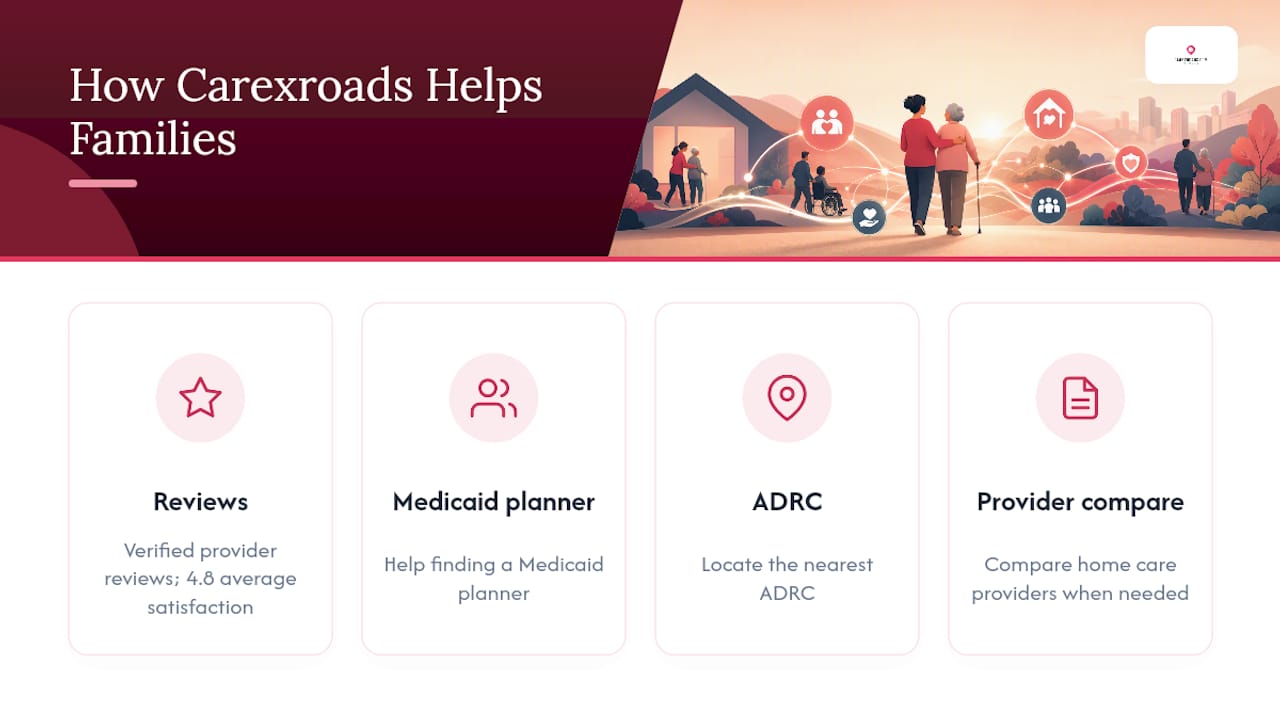
Carexroads built its directory around verified provider reviews and a 4.8 average family satisfaction rating, specifically because families researching Medicaid caregiver pay need trustworthy, current information, not guesswork. Beyond program mechanics, families often need help finding a Medicaid planner, locating their nearest ADRC, or comparing home care providers if paid family caregiving doesn't cover every need. Carexroads' guides, including the family guide to senior care decisions, model exactly that kind of local research.
What We Think Families Get Wrong About This Process
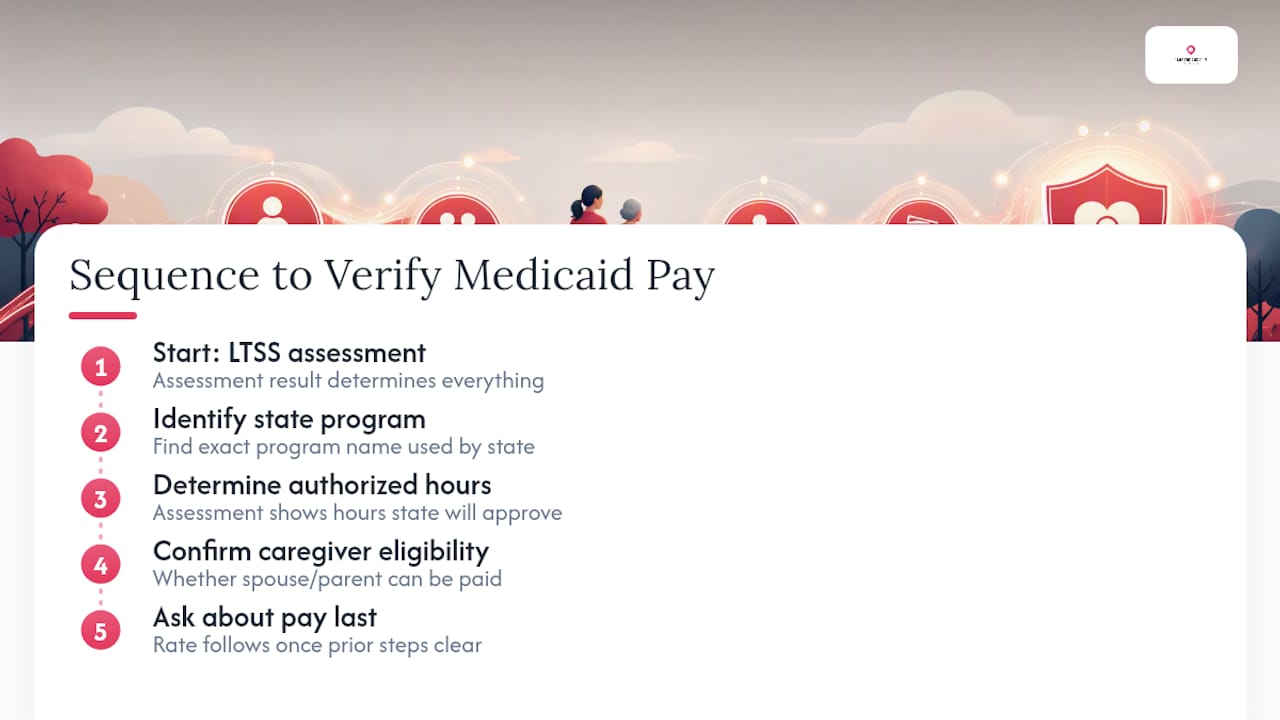
Most articles on this topic lead with pay rates, because that's the number everyone wants. That's backwards. The families who navigate this well start with the eligibility assessment and the state program name, then let the pay conversation follow, because the assessment result determines everything else: which program applies, how many hours get authorized, and whether a spouse or parent caregiver even qualifies.
The conventional advice also understates state variation. A neighbor in another state getting paid $28 an hour through a waiver tells you nothing about your own state's rate or program structure. Medicaid.gov's self-direction framework exists precisely so states can build programs around local workforce shortages and budgets, which means copying another family's experience across state lines usually leads to disappointment.
Prioritize the LTSS assessment first, confirm your state's exact program name second, and treat pay rate as the last question you answer, not the first.
— Care
Find Local Help Through Carexroads
Sorting out Medicaid's HCBS waivers, self-direction rules, and Structured Family Caregiving stipends is a lot to manage alone, especially while you're also providing care. Carexroads gives families a searchable directory of verified providers, real family reviews, and practical guides built specifically for this kind of decision, so you're not piecing together state rules from scattered forum posts.
If you're weighing whether paid family caregiving covers enough of your loved one's needs, or you need to compare it against home care agencies, Carexroads' directory lets you search local providers and read verified family experiences before you decide. Start there to find a Medicaid planner, an ADRC contact, or a home care option near you, and get a clearer picture of what fits your family's situation today.
Where to Confirm the Rules in Your State
- Medicaid connects you to your state Medicaid office directly.
- KFF's national caregiver survey breaks down state-by-state trends.
- Veterans should also check VA Veteran-Directed Care and consider Medicare enrollment support for related benefit questions.
This article is general information, not a substitute for advice from a qualified financial advisor. Consult a qualified financial professional about your own circumstances before acting on anything here.
Sources
- Medicaid’s home care support for family caregivers in 2025 | KFF
- Medicaid
- Usa
- Paying family caregivers: an effective policy option in the Arkansas Cash and Counseling demonstration and evaluation | PMC