

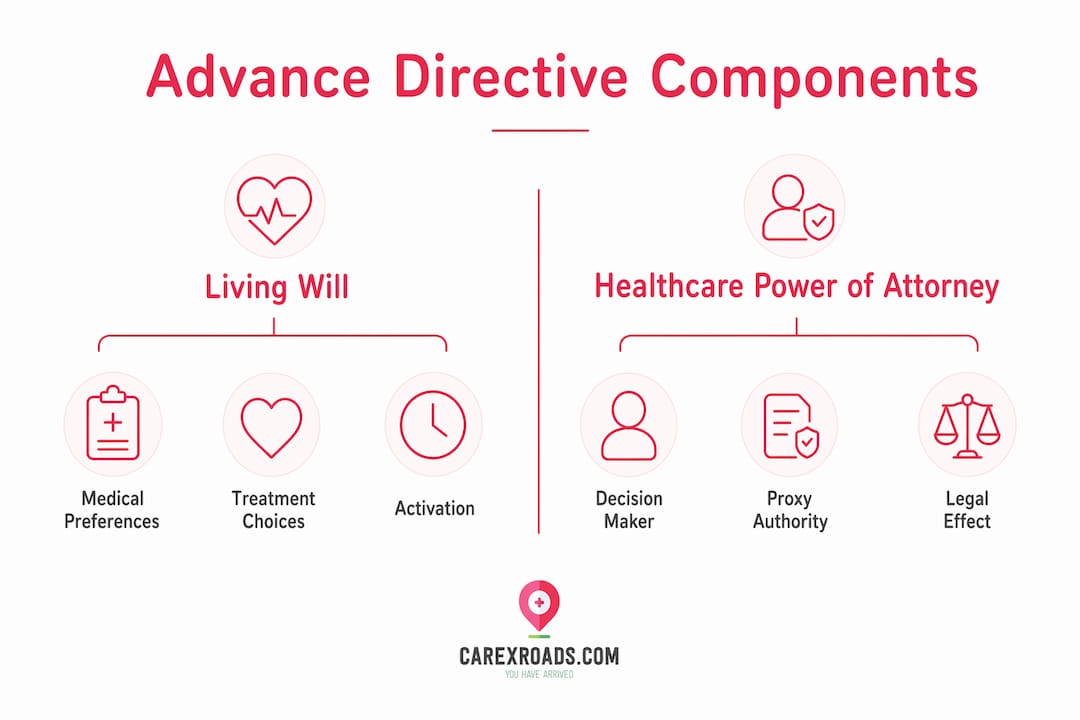
An advance directive is a legal document that states your parent's healthcare wishes and appoints a trusted person to make medical decisions if they cannot speak for themselves. Understanding what does advance directive mean for parents gives you the authority and clarity to act confidently during a medical crisis. These documents cover two core components: a living will and a healthcare power of attorney. Together, they protect your parent's autonomy and reduce the burden on your family when time-sensitive decisions must be made. Carexroads has helped thousands of families work through exactly this kind of planning.
What are the two main components of an advance directive for parents?
Advance directives generally consist of two parts: a living will and a healthcare power of attorney. Each serves a distinct purpose, and both work together to give your parent's medical wishes full legal weight.
The living will
A living will is a written record of your parent's specific medical preferences. It covers situations like whether they want CPR attempted, whether they would accept mechanical ventilation, and whether they want artificial nutrition if they are in a permanent vegetative state. The document speaks directly to medical teams when your parent cannot. Without it, doctors rely on family consensus, which often leads to conflict and delay.

The healthcare power of attorney
A healthcare power of attorney, sometimes called a healthcare proxy, appoints a named person to make medical decisions on your parent's behalf. That person is called a healthcare agent. The agent's authority activates only when your parent cannot communicate their own wishes. The living will guides the agent, but the agent also handles medical situations the living will did not anticipate. This flexibility is what makes the healthcare power of attorney so valuable.
Pro Tip: Assign the healthcare power of attorney and the financial power of attorney to different people. Splitting these roles matches each responsibility to the person best suited for it emotionally and practically.
| Document | What it does | When it activates |
|---|---|---|
| Living will | Records specific medical treatment preferences | When the parent cannot communicate |
| Healthcare power of attorney | Appoints an agent to make medical decisions | When the parent cannot communicate |
| Financial power of attorney | Appoints an agent to manage finances | As specified in the document |
The living will and healthcare power of attorney complement each other. The living will provides specific instructions. The healthcare agent fills in the gaps the document does not cover.
Why are advance directives important for adult children making decisions for parents?
Fewer than 1 in 3 adults nationwide have a completed advance directive. That means most families face medical emergencies without any documented guidance from their loved one.
The consequences are measurable. Older adults with advance directives documented in electronic health records experience fewer burdensome medical interventions: 19.9% compared to 26.8% for those without directives. Hospital death rates also drop significantly, from 32.1% to 23.2%. These numbers show that a completed directive does not just protect your parent's wishes. It changes the entire trajectory of their end-of-life care.
For adult children, the benefits go beyond statistics. Here is what a completed advance directive does for your family:
- Reduces conflict. When your parent's wishes are documented, siblings and other relatives cannot override the designated agent's decisions.
- Removes guesswork. You do not have to wonder what your parent would want during a crisis. The document tells you.
- Gives legal authority. Healthcare agents act as the ultimate authority over family disagreements when the directive is properly written.
- Reduces emotional burden. Families who have clear guidance report less guilt and stress around end-of-life decisions.
- Aligns care with values. Medical teams can honor your parent's personal, cultural, and spiritual preferences rather than defaulting to aggressive intervention.
Advance care planning for parents is not just paperwork. It is the clearest act of respect you can offer your parent's autonomy.
What are common challenges when creating advance directives for elderly parents?
The most common mistake families make is completing the documents and then storing them somewhere inaccessible. Keeping advance directives locked in a safe or buried in a filing cabinet makes them effectively useless in an emergency. Medical teams and healthcare agents need immediate access to these documents when decisions must be made quickly.
Accessibility is only one challenge. Here are others that families frequently encounter:
- State law differences. Healthcare laws vary by state. A directive completed in one state may need to be reviewed or updated if your parent moves or receives care across state lines.
- Outdated documents. Advance directives should be reviewed every 3–5 years or after major life changes such as a new diagnosis, a change in the designated agent's availability, or significant shifts in your parent's values.
- Agent unavailability. The person named as healthcare agent may become unable or unwilling to serve. Naming an alternate agent in the document prevents a gap in authority.
- Confusion with financial documents. Many families conflate the healthcare power of attorney with the financial power of attorney. They are separate documents with separate purposes. The healthcare proxy makes medical decisions. The financial agent manages money and property.
Pro Tip: Give copies of the advance directive to your parent's primary care physician, the designated healthcare agent, and at least one other trusted family member. Also ask whether your parent's healthcare system can store the document in their electronic health record for immediate access during hospitalizations.
Advance directives require ongoing attention, not a one-time completion. Treat them as living documents that reflect your parent's current wishes, not a task you check off and forget.
How can adult children start the conversation about advance directives with aging parents?
Many adult children avoid this conversation because they fear upsetting their parent or triggering anxiety about death. Framing the discussion as an act of love and personal control changes the dynamic entirely. Framing advance directives as autonomy helps parents see the document as a way to stay in charge of their own care, not a sign that the family is giving up on them.
One effective tactic is "flipping the script." Instead of asking your parent to think about dying, ask them what kind of care they would want if they were seriously ill and could not speak. This reframes the conversation around living well and being heard, rather than around death. Most parents respond more openly to that framing.
Primary care physicians are powerful allies in this process. Many parents trust their doctor more than their adult children on medical matters. Asking the physician to raise advance care planning during a routine visit normalizes the conversation and removes the emotional charge that family discussions can carry.
Practical conversation starters that work:
- "I want to make sure we always know how to honor your wishes if something happens."
- "Your doctor mentioned it would help the medical team to have your preferences on file."
- "Can you tell me what matters most to you about your care if you were ever seriously ill?"
Open conversations about values provide essential guidance even when formal documents are not yet finalized. The dialogue itself has value. If your parent resists completing the paperwork, keep talking. A family that understands a parent's values is still better prepared than one that has never discussed them.
You can also find practical support through resources like post-discharge planning guides that help families prepare for care transitions where advance directives become immediately relevant. For families thinking about longer-term care settings, understanding options like transitioning to assisted living can help frame the broader planning conversation with your parent.
Pro Tip: Pair the advance directive conversation with end-of-life pre-planning resources. Funeral pre-planning is another area where early decisions reduce family stress and honor your parent's wishes.
Key Takeaways
An advance directive for parents is the single most effective legal tool for protecting their medical wishes and reducing family conflict during a healthcare crisis.
| Point | Details |
|---|---|
| Two core documents | A living will records specific medical preferences; a healthcare power of attorney appoints a decision-making agent. |
| Low completion rates | Fewer than 1 in 3 adults have completed advance directives, leaving most families without legal guidance. |
| Measurable care impact | Documented directives reduce burdensome interventions from 26.8% to 19.9% and hospital deaths from 32.1% to 23.2%. |
| Accessibility matters | Store copies with the healthcare agent, primary physician, and in the electronic health record for emergency access. |
| Review regularly | Revisit the directive every 3–5 years and after any major health change or life event. |
Why I think families wait too long on this
Families tend to treat advance directives as a crisis document rather than a planning tool. I have seen this pattern repeatedly: a parent is hospitalized, the family scrambles to make decisions, and siblings disagree because no one ever asked the parent what they actually wanted. The legal authority of a healthcare agent resolves that conflict on paper, but the emotional damage from the disagreement lingers long after the medical situation resolves.
The harder truth is that the conversation is not actually about death. It is about control. Parents who complete advance directives are not accepting defeat. They are asserting that their values and preferences will be honored regardless of what happens to their ability to communicate. That reframe matters enormously when you are sitting across from a parent who changes the subject every time you bring it up.
Revisiting the document every few years is also non-negotiable. A directive written when your parent was 70 may not reflect what they want at 82 after a stroke or a cancer diagnosis. The document needs to grow with them. Treat it as an ongoing conversation, not a form you filed away. The families who do this consistently are the ones who feel prepared rather than blindsided when a crisis arrives. You can explore additional senior care planning resources to keep that planning conversation current.
— Care
Planning ahead with Carexroads
Advance care planning does not stop with a signed document. Families also need trusted support when a parent moves from a hospital to home care or into a senior living community.

Carexroads connects families with verified senior care providers, including home care, assisted living, and memory care options. With a 4.8 average family satisfaction rating, Carexroads makes it easier to find care that aligns with the wishes your parent has already documented. Whether you are coordinating a care transition or comparing long-term options, Carexroads senior care resources give you real family reviews and practical guides to support every step of the process.
FAQ
What does an advance directive include?
An advance directive includes a living will that records your parent's specific medical treatment preferences and a healthcare power of attorney that names a trusted person to make decisions when your parent cannot communicate.
Is an advance directive legally binding?
Yes. A properly completed advance directive is a legally binding document. Healthcare teams are required to follow its instructions, and the designated healthcare agent holds legal authority over family members who disagree.
What happens if my parent has no advance directive?
Without an advance directive, medical teams default to family consensus or state law to determine who makes decisions. This process is slower, more stressful, and often leads to care that does not reflect your parent's actual wishes.
How often should an advance directive be updated?
Advance directives should be reviewed every 3–5 years and after any major health change, move to a new state, or change in the designated agent's availability.
Can a healthcare agent override a doctor's recommendation?
A healthcare agent's decisions are prioritized by medical teams as long as they align with the patient's documented wishes and are not medically inappropriate. The agent does not have unlimited authority, but they do carry significant legal weight in most clinical situations.