

Original Medicare Part A can pay for short-term skilled nursing facility care, but only when three conditions line up: a qualifying 3-day inpatient hospital stay, timely admission to a Medicare-certified facility, and a physician order for daily skilled services. Coverage is provided for up to 100 days per benefit period, with daily coinsurance starting after the first 20 days. Before you assume your loved one is covered, confirm the hospital admitted them as an inpatient, verify the facility's Medicare certification, and if they're on a Medicare Advantage plan, pull up the Evidence of Coverage first.
TL;DR:
- Families must verify inpatient hospital classification and timely admission to a Medicare-certified facility to qualify for SNF coverage.
- Medicare covers only skilled care aimed at recovery, stopping coverage when daily therapy or nursing is no longer necessary, not for custodial assistance.
- The 100-day benefit resets if more than 60 days pass without inpatient care, and coverage often drops sharply after day 20 due to coinsurance.
- Many discharge decisions are influenced by the day-20 coinsurance trigger, causing families to plan admissions and discharges accordingly.
- Medicare Advantage plans may waive the inpatient requirement or impose network and prior authorization limits, so written confirmation is essential.
Table of Contents
- What Does Medicare SNF Coverage Actually Pay For?
- Who Qualifies for Medicare SNF Coverage?
- How Are the 100 Days of SNF Coverage Counted?
- What Are the Out-of-Pocket Costs for SNF Care?
- Why Does Day 20 Trigger So Many Discharge Decisions?
- How Does Medicare Advantage Change SNF Coverage Rules?
- What Happens If Medicare Stops Covering Your SNF Stay?
- Your Discharge-Day Checklist for SNF Coverage
- How Carexroads Helps Families Navigate SNF Coverage
- Where to Verify Current Medicare SNF Coverage Details
- The Rule Families Get Wrong Most Often
- Sources
What Does Medicare SNF Coverage Actually Pay For?
When a stay qualifies, Medicare Part A covers a defined bundle of services tied to recovery, not comfort or convenience. The facility bills nearly everything as one package, a practice called consolidated billing, so families rarely see separate charges for most of what's listed below.
- A semi-private room and meals
- Skilled nursing care provided by licensed staff
- Physical, occupational, and speech-language therapy
- Medical social services to coordinate care and discharge needs
- Medications administered during the stay
- Medical supplies and equipment used in the facility
- Ambulance transportation when medically necessary
Here's the catch families miss most often: Medicare pays for short-term skilled care aimed at recovery or maintaining a condition, never for long-term custodial help with bathing, dressing, or eating alone. If a resident no longer needs skilled nursing or therapy, Medicare stops paying even if they still need daily assistance. That gap is where a lot of families get blindsided by bills, and it's worth reading about the difference between skilled care and custodial support before you're in the middle of a discharge conversation.
Who Qualifies for Medicare SNF Coverage?
Eligibility hinges on paperwork most families never think to check until it's too late. Medicare requires a qualifying inpatient hospital stay of 3 consecutive days, and the admission date counts while the discharge day does not. That distinction trips up more families than any other rule in this system.
- The stay must be classified as inpatient, not observation
- A doctor must order daily skilled services requiring professional staff
- Admission to the SNF should generally happen within 30 days of hospital discharge
- The facility must be Medicare-certified
Observation status is the single biggest coverage trap in this whole process. Hospitals sometimes keep patients "under observation" for days without ever admitting them as inpatients, and those days don't count toward the 3-day requirement no matter how long the stay feels.
Pro Tip: Ask the hospital case manager directly, "Am I an inpatient or under observation?" If your status changes retroactively, you can appeal it, and doing so quickly can restore your SNF eligibility before you're stuck paying out of pocket.
How Are the 100 Days of SNF Coverage Counted?
A "benefit period" is the clock Medicare uses to track your coverage, and it resets in ways that surprise most families.
- A benefit period starts the day you're admitted as an inpatient and ends once you've gone 60 consecutive days without inpatient hospital or SNF care.
- Within that period, Medicare covers up to 100 days of SNF care, no more, regardless of how the days are split up.
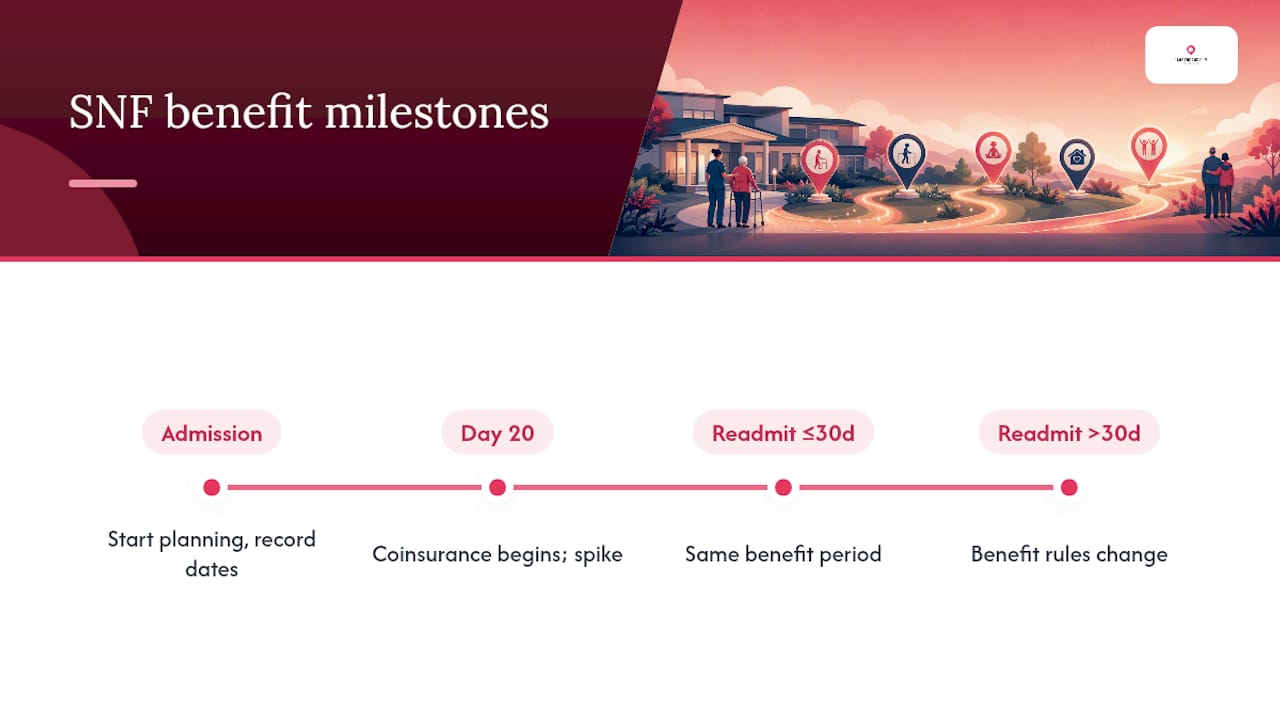
- If you're readmitted within 30 days of leaving the SNF, you continue in the same benefit period, and your remaining days pick up where you left off.
- If more than 60 days pass without inpatient care, a new benefit period begins, which means a fresh 100-day allowance but also a new Part A deductible.
That last point matters more than people expect. A new benefit period doesn't just reset your day count. It resets your financial obligation too.
What Are the Out-of-Pocket Costs for SNF Care?
Cost sharing follows a predictable structure, but the jump at day 21 catches families off guard almost every time.
- Days 1 to 20: Medicare covers the full cost, with no coinsurance after you meet the Part A deductible (which a hospital stay's deductible usually satisfies if in the same benefit period)
- Days 21 to 100: You owe a daily coinsurance amount that is adjusted annually by Medicare
- Day 101 and beyond: You are responsible for the full cost of your care
MedPAC's March 2026 report to Congress documents this coinsurance structure and its financial weight on beneficiaries starting day 21. The daily coinsurance amount changes annually, so confirm the current figure by calling 1-800-MEDICARE or checking Medicare.gov directly rather than relying on outdated numbers.
If cost is a concern, several avenues exist: Medicaid can cover coinsurance for dual-eligible beneficiaries, a Medigap policy can absorb the gap entirely, and some state programs and long-term care insurance policies help bridge the rest.
Why Does Day 20 Trigger So Many Discharge Decisions?
MedPAC's data shows a noticeable discharge spike right around day 20, and it's not a coincidence. That's the exact moment coinsurance begins, and both families and facilities respond to the financial shift.
If a resident is readmitted to a hospital and returns to the SNF within 30 days, they stay in the same benefit period and their day count picks up where it left off. Wait longer than that, and the rules change entirely.
Start discharge planning the day of admission, not the week before coverage runs out. Ask the facility's case manager for an estimated coverage end date early, and write down every key date: admission, expected discharge, and the day coinsurance begins.
Pro Tip: Keep a simple notebook or phone note with every date the hospital and SNF give you. When coverage disputes happen, and they do, the person with dates written down wins the appeal faster.
How Does Medicare Advantage Change SNF Coverage Rules?
Medicare Advantage plans play by different rules, and that flexibility cuts both ways.
- Many MA plans waive the 3-day inpatient requirement entirely, which can help patients get into a SNF faster
- In exchange, most plans limit you to a network of approved facilities and require prior authorization before admission
- Accountable Care Organizations and PACE programs sometimes offer their own waivers, but the rules live in your plan's Evidence of Coverage, not in general Medicare guidance
If your plan verbally confirms a waiver or authorization, get it in writing or by email. Verbal confirmations tend to disappear exactly when you need proof of them most.
What Happens If Medicare Stops Covering Your SNF Stay?
Two notices govern your rights when coverage ends or care is denied, and both come with strict timelines.
- The Notice of Medicare Non-Coverage (NOMNC) must be delivered at least 2 days before Medicare-covered services end, explaining the date coverage stops and how to appeal.
- The SNF Advance Beneficiary Notice (SNF ABN) applies when the facility believes Medicare won't cover a specific service, giving you the choice to accept the charge or decline the service.
- You can file an expedited appeal immediately after receiving a NOMNC, often within 24 hours, and a reviewer typically decides before your coverage actually ends.
- If you disagree with a facility's billing, request a "demand bill," which forces Medicare to formally review the claim rather than accept the facility's denial.
Save every notice, contact your State Health Insurance Assistance Program (SHIP) if you need a second opinion, and hold onto care documentation. It backs up your case if you escalate.
Your Discharge-Day Checklist for SNF Coverage
Print this or save it before you need it, because these questions rarely get asked at the right moment otherwise.
- Confirm the hospital classified the stay as inpatient, and keep copies of admission and discharge paperwork
- Verify the receiving facility is Medicare-certified and that a physician has ordered daily skilled services
- If coverage is ending, request the NOMNC or SNF ABN immediately and ask for the exact date coverage stops
- If enrolled in Medicare Advantage, get written confirmation of any 3-day waiver or required prior authorization
- Ask the facility's discharge planner for a written estimate of your remaining benefit days
A detailed discharge plan guide walks through each of these steps in more depth if you want a fuller framework to work from.
How Carexroads Helps Families Navigate SNF Coverage
Verifying Medicare SNF coverage rules is only half the battle. Finding the right facility, or the right alternative when SNF coverage runs out, is the other half, and that's where Carexroads was built to help.
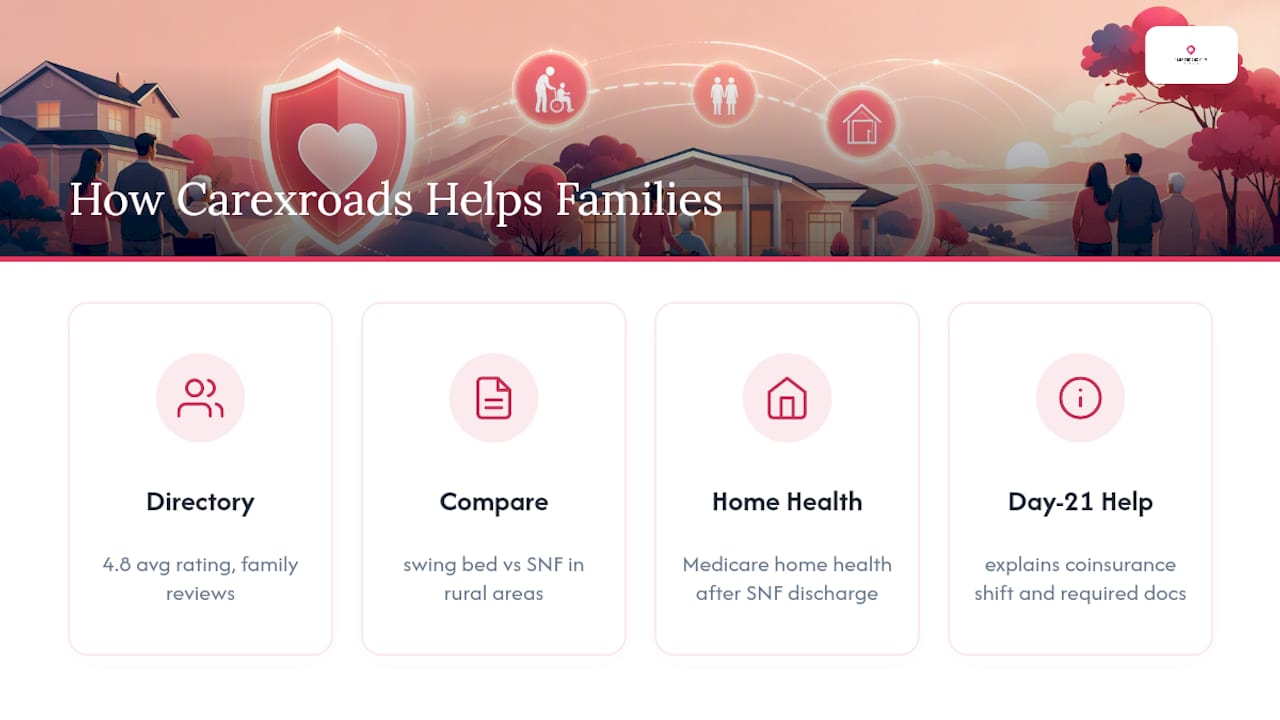
Carexroads maintains a verified directory of senior care providers backed by real family reviews, currently averaging a 4.8 satisfaction rating. Families researching post-acute options can compare swing bed and SNF admissions in rural areas, review Medicare home health coverage as a next step after SNF discharge, or read about preventing hospital readmissions once a resident returns home.
One recurring pattern in family reviews on Carexroads is relief at finally understanding why a facility said coverage was ending, once they had a clear explanation of the day-21 coinsurance shift and knew what documentation to ask for.
If your family is weighing whether ongoing skilled care or a return home makes more sense, Carexroads' guide on how home care helps seniors stay independent is a practical place to start comparing both paths.
Where to Verify Current Medicare SNF Coverage Details
- Medicare
- CMS MLN: SNF Billing Reference
- Medicare SNF Coverage Booklet (PDF)
- Medicaid for dual-eligibility questions
- Call 1-800-MEDICARE for current coinsurance figures
The Rule Families Get Wrong Most Often
The conventional advice on Medicare SNF coverage treats it like a simple countdown: you get 100 days, use them, and move on. That framing misses what actually determines outcomes, which is whether the hospital classified your loved one as an inpatient in the first place. Everything else, the 100-day cap, the coinsurance schedule, the appeals process, only matters once that first hurdle is cleared. Families spend enormous energy tracking benefit days while overlooking the single word on a hospital chart that decides whether any of it applies.
The other blind spot is treating day 21 as a cliff instead of a planning deadline. MedPAC's own data shows discharges spiking right at day 20, which tells you facilities and families are reacting to the coinsurance shift rather than anticipating it. The families who do best start discharge conversations at admission, not at day 18. Ask about inpatient status first. Ask about coverage end dates second. Everything else is detail work built on those two answers.
— Care
This article is general information, not a substitute for advice from a qualified doctor. Consult a qualified healthcare professional about your own circumstances before acting on anything here.
Sources
- Medicare
- Skilled Nursing Facility (SNF) — CMS Medicare Learning Network
- Medicare
- Chapter 7: Medicare Payment Policy — MedPAC (March 2026)