
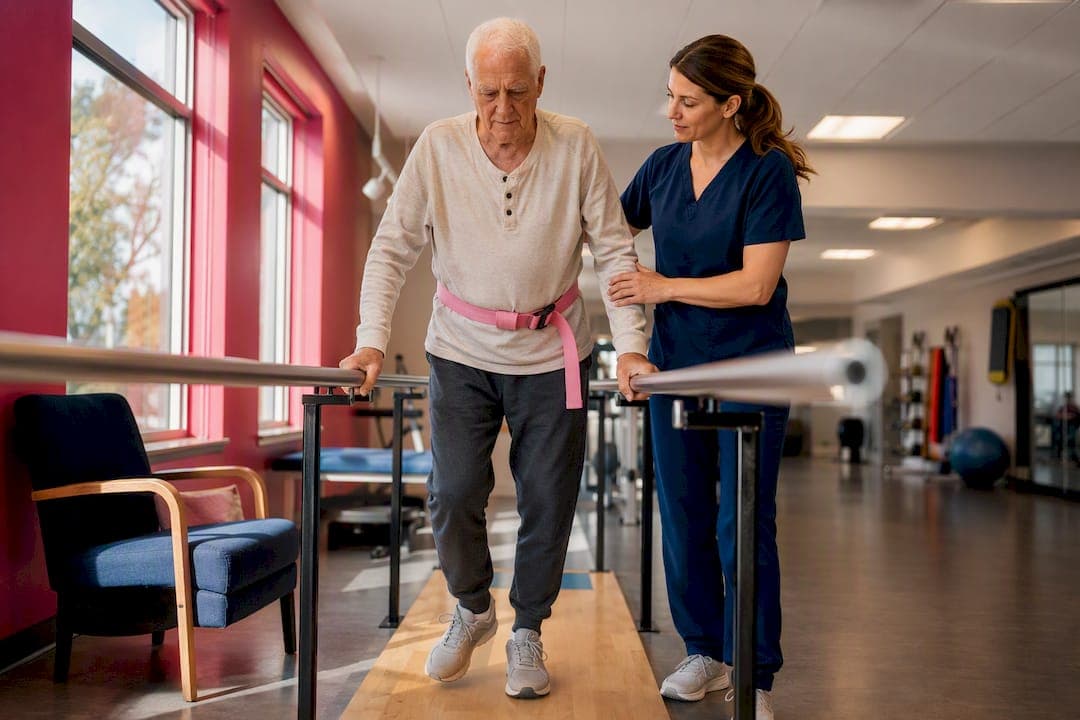
A swing bed is a hospital bed that "swings" from acute care to skilled nursing care without moving the patient anywhere; a skilled nursing facility (SNF) is a separate, freestanding facility built for that same level of care. When Medicare eligibility is met, the covered services are largely comparable between the two. The real decision hinges on setting, continuity with your existing care team, and whether a bed is even available. Medicare requires a 3-day qualifying inpatient hospital stay before either option is covered.
TL;DR:
- Swing beds are most commonly used in rural hospitals with limited capacity, and their availability can be a critical factor in discharge planning.
- Medicare covers swing bed and SNF stays under the same rules, requiring a prior inpatient stay of at least three days, with full coverage for days 1 to 20.
- Patients in swing beds benefit from continuous hospital-based care, which allows for quicker access to diagnostics and consistent medical oversight.
- Shorter stays in swing beds often suit patients with straightforward recovery needs, while complex cases may necessitate longer SNF stays.
- Bed availability limits local options, especially in small rural hospitals, making timely verification and planning essential.
Table of Contents
- Swing Bed vs SNF: What Each Option Actually Means
- How Do Medicare Coverage Rules Compare for Swing Bed vs SNF?
- What's the Real Difference in Day-to-Day Care?
- When Should You Choose a Swing Bed Over an SNF?
- Why Swing Beds Matter for Rural Access and Hospital Stability
- How Do Outcomes Compare Between Swing Beds and SNFs?
- Are Swing Beds and SNFs Held to the Same Quality Standards?
- Does Setting Affect Family Satisfaction and Trust?
- What Limits Swing Bed Availability, and Why It Matters
- Your Next Steps After a Swing Bed or SNF Recommendation
- The Carexroads Take: What Families Should Actually Prioritize
- Sources
Swing Bed vs SNF: What Each Option Actually Means
The word "swing" refers to a change in billing status, not a change in room. When the Centers for Medicare & Medicaid Services (CMS) designates a hospital bed as a swing bed, that hospital can shift a patient's care classification from acute inpatient to SNF-level care without a physical transfer. The patient stays in the same room, often with the same nurses, while the paperwork behind the scenes reclassifies the stay.
A skilled nursing facility, by contrast, is its own licensed and Medicare-certified building. It might sit next door to a hospital or across town, but it operates as an independent entity with its own staff, its own medical director, and its own admission process.
SNF-level care itself looks the same wherever it happens:
- Physical and occupational therapy tailored to mobility and daily function
- Wound care and IV therapy for patients still recovering from surgery or infection
- Skilled nursing oversight, including medication management and monitoring for complications
- Speech therapy for swallowing or communication issues after a stroke or major illness
Where a hospital can offer swing beds matters, too. Critical Access Hospitals (CAHs), typically small rural hospitals, use swing beds far more often than large urban Prospective Payment System (PPS) hospitals. That distinction isn't just geographic trivia. It shapes how the hospital gets paid, and in rural communities, it often determines whether skilled care is available locally at all.
How Do Medicare Coverage Rules Compare for Swing Bed vs SNF?
Medicare doesn't treat swing beds and SNFs as different benefits. It treats them as the same benefit delivered in different locations. Medicare Part A covers swing bed services under the identical rules that govern SNF stays, which means the coverage triggers and cost-sharing structure are worth memorizing before you need them.
Pro Tip: Ask the hospital discharge team to confirm, in writing, that your inpatient stay hit three full midnights. Observation status doesn't count toward the 3-day rule, and that single distinction trips up more families than any other Medicare technicality.
The framework breaks down like this:
- The 3-day rule: You need a prior inpatient hospital stay of at least three consecutive days (not counting the discharge day) within the same spell of illness before Medicare Part A will pay for either swing bed or SNF care.
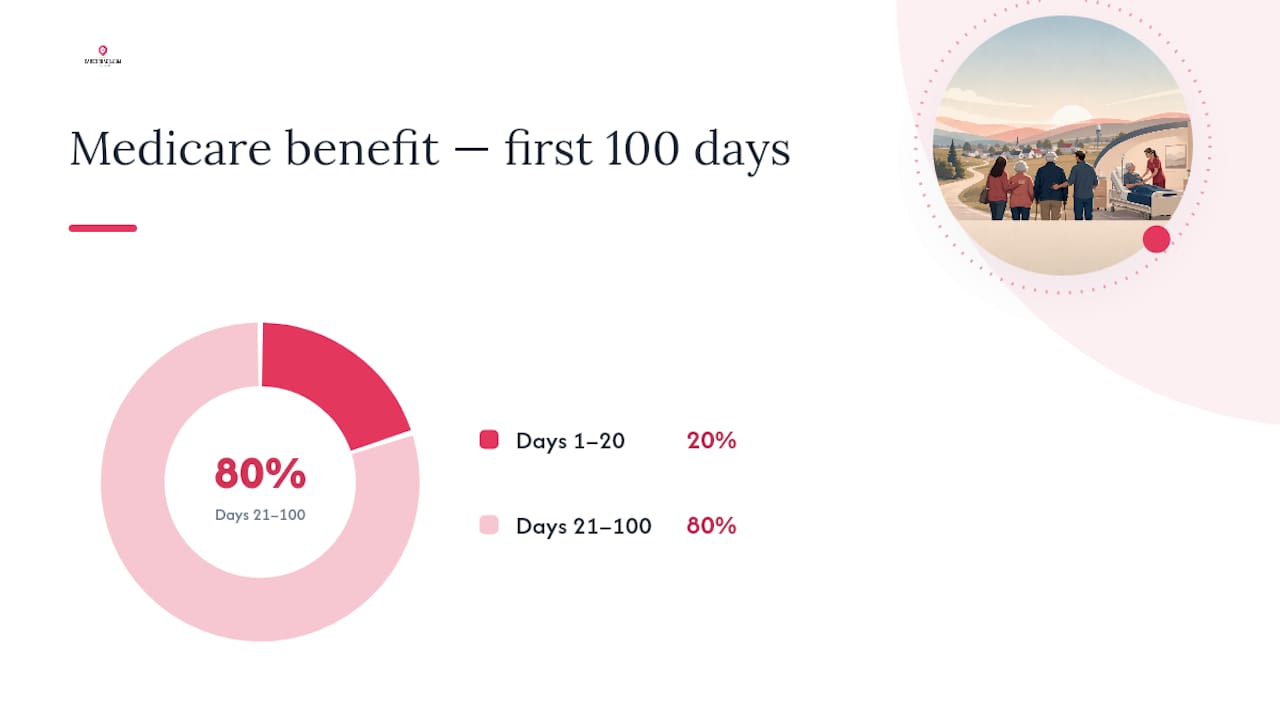
- Days 1 to 20: Medicare covers the full cost with no coinsurance, assuming continued SNF-level need.
- Days 21 to 100: A daily copay applies, and many families lean on supplemental insurance to cover it.
- Beyond day 100: Medicare stops paying altogether under the standard benefit.
Reimbursement mechanics diverge behind the scenes. Critical Access Hospitals get paid on a cost basis, roughly 101% of reasonable costs, for swing bed services, while PPS hospitals bill under the standard SNF Prospective Payment System. That gap doesn't change what the patient owes, but it does influence which hospitals can financially sustain a swing bed program.
One wrinkle families consistently miss: Medicare Advantage plans don't always mirror traditional Medicare's rules. Some MA plans waive the 3-day requirement; others apply different prior-authorization steps or network restrictions for swing beds specifically. Call the plan directly before assuming the standard rules apply.
What's the Real Difference in Day-to-Day Care?
The clinical service, on paper, looks nearly identical between a swing bed and an SNF. What changes is the environment around that service, and that environment affects recovery more than most families expect.
Staying in a swing bed means staying with the same hospital team that treated the acute illness. The nurses already know your history. The hospitalist who managed a pneumonia flare is often still the one checking in during recovery. That continuity reduces the disorientation and anxiety that come with a transfer, especially for older patients recovering from delirium, stroke, or major surgery.
Swing beds also sit inside a hospital, which means immediate access to imaging, lab work, and physician reassessment if something changes overnight. An SNF, especially a freestanding one, usually has to call an ambulance and send the patient back to a hospital for anything beyond routine skilled care.
A few other practical differences worth weighing:
- Therapy intensity in SNFs is often higher-volume, since larger facilities can dedicate more staff hours to rehab.
- Research from the Sheps Center shows swing bed stays tend to run shorter than SNF stays, which fits patients who need a short bridge to home rather than an extended rehab course.
- Rural hospitals lean on swing beds precisely because there's no SNF nearby, making the swing bed the only realistic post-acute option.
If your rehab goals are modest, regaining walking distance, managing a wound, tapering off IV antibiotics, a shorter swing bed stay may match your timeline better than a longer SNF admission built for heavier rehab caseloads.
When Should You Choose a Swing Bed Over an SNF?
Discharge decisions get made fast, sometimes within hours of a doctor clearing a patient for the "next level of care." A short mental checklist helps families and clinicians move through it without missing something that matters later.
- Match the clinical need first. If ongoing physician oversight or the possibility of a rapid medical setback is likely, a hospital-based swing bed keeps that safety net closer.
- Weigh caregiver logistics. A swing bed in the local hospital may mean shorter drives for family visits than an SNF across the region, particularly in rural areas where SNF options are sparse.
- Confirm payer rules before committing. Verify the 3-day qualifying stay, check whether a Medicare Advantage plan requires prior authorization, and ask what the expected daily copay looks like after day 20.
- Ask about bed availability honestly. Swing beds are often limited in number; if none are open, the SNF conversation happens by default, not by choice.
- Watch for red flags. If the care team can't clearly explain the expected length of stay, the therapy plan, or who's supervising daily care, that's a sign to ask more questions before signing discharge paperwork.
Why Swing Beds Matter for Rural Access and Hospital Stability
Carexroads spends a lot of time helping families navigate discharge decisions, and the swing bed conversation comes up disproportionately in rural cases. This is not a coincidence. In many small towns, the local Critical Access Hospital's swing bed program is the only post-acute skilled care option within an hour's drive.
Swing beds function as more than a billing mechanism in rural communities. They're often the difference between a patient recovering close to home and a family driving 60 miles each way for visits, and between a small hospital staying financially viable or losing a core revenue stream. Some rural hospital networks report swing bed revenue accounting for more than 20% of inpatient revenue for a subset of facilities.
That financial reality matters to families even if it feels abstract at discharge time. A hospital that keeps its swing bed program full and well-run is a hospital more likely to keep other services running, too. If you're weighing local options for the next step after discharge, Carexroads' guide on what a discharge plan should include walks through what to expect from your care team.
How Do Outcomes Compare Between Swing Beds and SNFs?
Families almost always ask the same underlying question, even when they phrase it differently: which option gets you home faster and keeps you out of the hospital? The honest answer is that outcomes track closely with the patient's condition, not the setting alone.
A peer-reviewed evaluation of the national swing bed program found clinical comparability between swing bed and SNF patients for short-term rehabilitation, with the main differences showing up in setting and access to hospital resources rather than in the quality of skilled therapy delivered. Patients receiving comparable nursing oversight and therapy hours tend to see similar functional gains regardless of which building they're in.
Length of stay is where the two paths diverge more visibly. Swing bed stays run shorter on average, which fits patients recovering from a single acute event with a clear rehab endpoint, like a hip fracture with an otherwise healthy baseline. Longer, more complex rehab courses, think multiple comorbidities or a slower neurological recovery, tend to land in SNFs simply because that's where the extended capacity exists.
Rehospitalization risk isn't a fixed number tied to the setting itself. It's tied more to continuity of physician oversight, medication reconciliation, and how quickly a change in condition gets caught. That's precisely why hospital-based swing beds have an edge for patients whose stability is still uncertain: the same team that managed the acute illness is right there to catch a setback early.
Are Swing Beds and SNFs Held to the Same Quality Standards?
Both swing beds and SNFs operate under Medicare's certification requirements, but the accreditation picture looks different depending on which one you're evaluating.
SNFs receive individual star ratings through Medicare's Care Compare tool, covering health inspections, staffing levels, and quality measures like rehospitalization and fall rates. Families can look up a specific facility and compare it against others in the region before making a decision.
Swing beds don't get a separate star rating of their own. Since the bed is part of a certified hospital, its quality oversight runs through the hospital's own accreditation and CMS survey process, guided in part by CMS's SOM Appendix T, which spells out the specific conditions a hospital must meet to offer swing bed services. That means a hospital with strong overall accreditation and a clean survey history is generally a reasonable proxy for swing bed quality, even without a distinct star rating for that unit.
For families used to comparing SNF ratings side by side, this can feel like an information gap. The practical workaround is asking the hospital directly about its most recent CMS survey results and any cited deficiencies tied to the swing bed unit specifically, rather than assuming the absence of a rating means an absence of oversight.
Does Setting Affect Family Satisfaction and Trust?
Satisfaction data on post-acute care rarely separates "swing bed" from "SNF" as a category, but the underlying drivers of family trust show up consistently across both settings: communication frequency, staff familiarity, and how much the family feels included in decisions.
Swing beds tend to score well on the continuity piece almost by design. A study on rural swing bed care found that keeping the original hospital team involved reduces the anxiety that often comes with transferring to an unfamiliar building and an unfamiliar staff roster. Families report fewer moments of "who do I even call with a question," because the phone number hasn't changed.
SNFs can deliver that same trust, but it usually takes longer to build. New staff, a new building layout, and a new point of contact all add a short adjustment period before families feel as comfortable asking questions. Larger SNFs sometimes offset this with dedicated family liaisons or care coordinators, which can narrow the gap quickly.
The location factor matters here too. A swing bed inside the local hospital often means shorter, more frequent family visits, especially in rural areas where the nearest SNF might be 40 minutes away. More frequent visits generally correlate with higher family confidence in the care being delivered, independent of which setting is technically providing it.
What Limits Swing Bed Availability, and Why It Matters
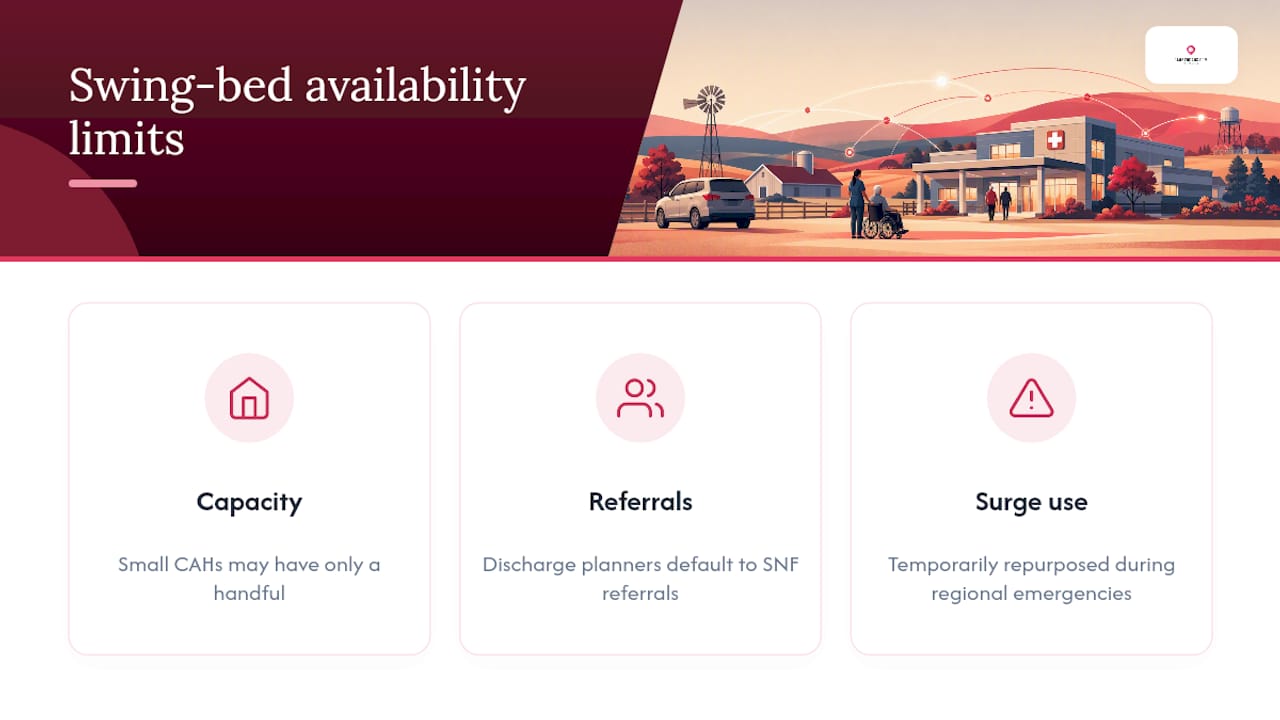
The biggest practical obstacle with swing beds isn't clinical, it's logistical: there often aren't enough of them. Swing bed capacity is tied directly to a hospital's total bed count, and a small Critical Access Hospital might have only a handful of beds it can designate for swing use at any given time. If those beds are full, the swing bed option disappears regardless of how well it would otherwise fit the patient.
Referral patterns compound the problem. Research on program utilization points to a persistent perception gap where hospitals underuse their own swing bed capacity because discharge planners default to SNF referrals out of habit, even when a swing bed would serve the patient just as well. Hospitals that actively integrate swing beds into discharge planning tend to see both better utilization and stronger financial return from the program.
There's also a surge-capacity dimension worth knowing about. During regional public health emergencies or periods of high inpatient demand, swing beds sometimes get repurposed to manage acute overflow across a hospital network, temporarily reducing the beds available for standard post-acute care. That's rare, but it's a real constraint families in tightly networked rural regions should ask about if timing is tight.
Your Next Steps After a Swing Bed or SNF Recommendation
Before agreeing to either placement, run through a short verification pass with the discharge team.
- Confirm the 3-day inpatient stay actually counted as inpatient, not observation.
- Ask your Medicare Advantage plan directly about swing bed authorization rules.
- Get the expected therapy plan and projected length of stay in writing.
- Ask who provides physician oversight and how quickly they respond to changes.
| Question to ask | Why it matters |
|---|---|
| Did my stay meet the 3-day inpatient rule? | Determines if Medicare covers either option at all |
| Does my MA plan require prior authorization? | MA rules can differ from traditional Medicare |
| What's the expected length of stay? | Swing beds often run shorter; plan accordingly |
| Who covers physician oversight daily? | Affects how fast a setback gets caught |
If placement feels unclear or coverage gets denied, ask the hospital's case manager about the appeal process, and lean on resources like Carexroads' discharge documentation guide to keep the paperwork organized while you push back.
The Carexroads Take: What Families Should Actually Prioritize
The swing bed versus SNF debate gets treated like a quality contest when it's really a logistics and continuity question. Both settings can deliver comparable skilled care under Medicare's rules. What conventional advice underweights is how much a familiar care team reduces the quiet, hard-to-measure stress of recovery, particularly for older patients already disoriented by illness.
Where the standard advice falls short is treating bed availability as a footnote. In rural America, it's often the entire decision. If a swing bed isn't open, the SNF conversation happens whether or not it's the better clinical fit.
Prioritize three things in order: confirm Medicare eligibility first, ask about realistic bed availability second, and only then weigh the softer factors like distance and staff familiarity. Skipping straight to preference without checking availability wastes precious discharge-day hours.
Families who want a broader view of local post-acute options, including therapy resources and community support like balance training programs for fall prevention, can start with Carexroads' hospital-to-home resources to compare what's actually available nearby before decisions get made under pressure.
— Care
This article is general information, not a substitute for advice from a qualified doctor. Consult a qualified healthcare professional about your own circumstances before acting on anything here.