

Insurance authorization is the formal process by which an insurer approves or denies coverage for a hospital stay and any post-discharge care, and it directly controls when and where your loved one leaves the hospital. For families of seniors, understanding the role of insurance authorization in discharge is not optional. It is the difference between a smooth care transition and a stressful, costly delay. Three distinct processes shape this: prior authorization before post-acute care begins, concurrent review during the hospital stay, and the appeal process when coverage is denied. Each one affects discharge timing in a different way.
How does prior authorization affect post-acute care discharge for seniors?
Prior authorization is the insurer's formal approval required before a senior can be transferred to a skilled nursing facility (SNF), inpatient rehabilitation facility (IRF), or long-term acute care hospital (LTACH). Without that approval, the receiving facility will not accept the patient, and discharge stalls.
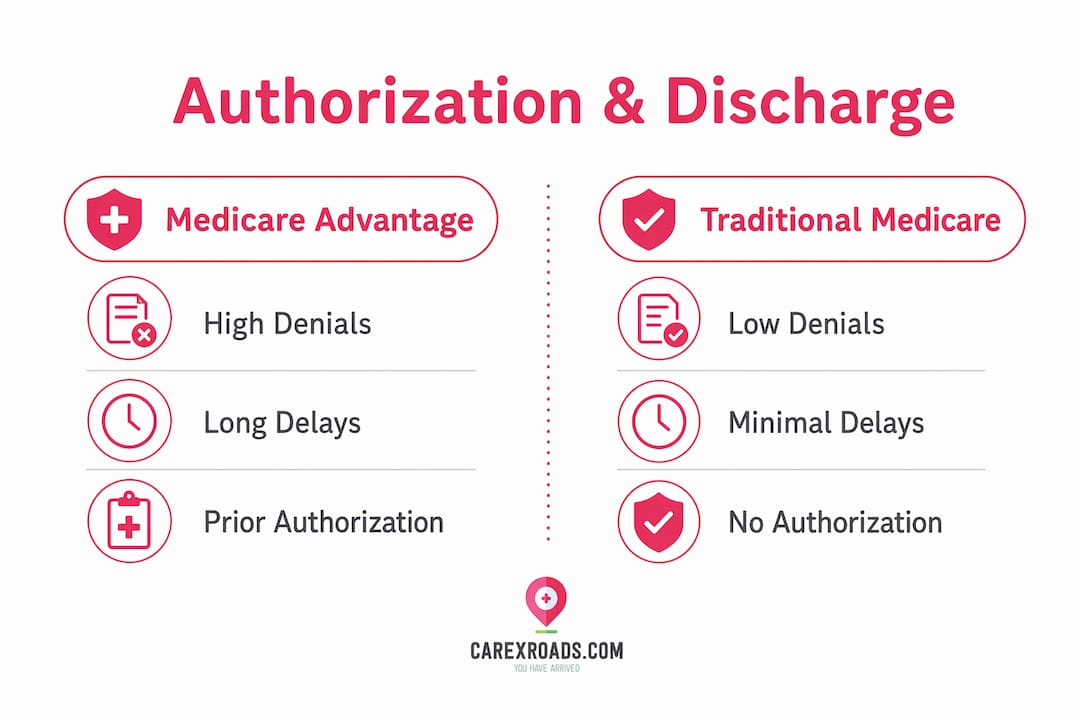
The numbers here are striking. Denial rates under Medicare Advantage were 20% for SNFs, 70% for IRFs, and 85% for LTACHs in 2022. That 85% denial rate for long-term acute care means nearly nine out of ten requests are initially refused. These are not final decisions, but each denial adds time to the process.

Those delays are measurable. Medicare Advantage plans processed 53 million authorizations in 2024, and initial denials push average care transitions back by 5–6 days. For a senior recovering from a hip fracture or stroke, five days in a hospital bed waiting for paperwork approval can mean lost mobility and increased infection risk.
Traditional Medicare works differently. It does not require prior authorization for most post-acute care placements, which means discharge to a SNF or IRF can happen faster. Families whose loved ones hold Medicare Advantage plans face a significantly more complex insurance approval process than those on traditional Medicare.
| Post-acute care type | Medicare Advantage denial rate | Average delay impact |
|---|---|---|
| Skilled nursing facility (SNF) | 20% | Moderate |
| Inpatient rehab facility (IRF) | 70% | Significant |
| Long-term acute care hospital (LTACH) | 85% | Severe |
Pro Tip: Ask the hospital case manager on day one whether your loved one's Medicare Advantage plan requires prior authorization for the expected discharge destination. Starting that request early cuts waiting time significantly.
What is concurrent review and how does it influence hospital discharge planning?
Concurrent review is the insurance approval process that happens in real time, while your loved one is still in the hospital. It is different from prior authorization, which happens before a transfer. Concurrent review is the insurer's ongoing check that the hospital stay itself remains medically necessary.
Hospitals must notify insurers within 24 hours of patient admission, and insurers then authorize coverage in limited windows, often just three days at a time. After that initial window, the hospital must submit updated clinical documentation to justify continued coverage. This cycle repeats throughout the stay.
Concurrent review acts as a forcing function for earlier discharge planning. Because the care team must justify every additional day to the insurer, case managers and social workers begin coordinating post-discharge options far sooner than they might otherwise. That pressure, while sometimes frustrating, often produces faster, better-organized care transitions.
The risk comes when documentation lapses. Missing or inaccurate clinical documentation can trigger a sudden denial of coverage mid-hospitalization, even when the patient genuinely needs continued care. That denial is unrelated to medical necessity. It is a paperwork failure, and families rarely see it coming.
Here is what families can do to support the concurrent review process:
- Ask the case manager which insurer is conducting the concurrent review and what documentation is being submitted.
- Confirm that the care team is submitting daily clinical updates on time.
- Request written notice if the insurer signals any concern about continued coverage.
- Keep a personal log of your loved one's daily condition to support the medical necessity record.
- Ask the discharge planner what the next authorization window is and when the next review is scheduled.
Pro Tip: If the hospital social worker mentions a "utilization review," that is the internal team managing concurrent review documentation. Introduce yourself to them early. They are your most direct contact for authorization status.
What role do administrative hospital processes play alongside insurance authorization in discharge delays?
Not every discharge delay comes from the insurer. Hospital administrative processes carry significant weight. Administrative discharge policies show a strong statistical correlation of r=0.866 with timely discharge, meaning internal hospital workflows often shape discharge speed more than insurance authorization does.
Clearance signatures, billing department sign-offs, pharmacy reconciliation, and physician order completion all must happen before a patient physically leaves. Any one of these steps can stall discharge by hours or even a full day. The insurance authorization may be approved and waiting while the hospital's own paperwork catches up.
Families frequently misinterpret hospital administrative delays as insurance problems. A simple question to the case manager, "Is the insurance approved, or is this a hospital process issue?" can clarify the real cause and point you toward the right person to follow up with.
Common administrative lags include:
- Physician discharge orders not signed until late in the day
- Pharmacy medication reconciliation taking several hours
- Billing department holds for insurance verification
- Transportation coordination not started until authorization is confirmed
- Missing signatures from specialists involved in the patient's care
| Cause of delay | Source | Who to contact |
|---|---|---|
| Prior authorization pending | Insurance plan | Case manager or insurer directly |
| Concurrent review documentation gap | Hospital and insurer | Utilization review team |
| Physician order not signed | Hospital | Attending physician or nurse |
| Billing or insurance verification hold | Hospital | Patient financial services |
| Transportation not arranged | Hospital or family | Social worker or discharge planner |
How can families and caregivers navigate insurance authorization challenges during discharge?
Families are not passive observers in the authorization process. You have rights, and using them early makes a real difference. The hospital case manager or social worker typically submits authorization requests on the patient's behalf, but you can and should stay informed at every step.
When an insurer denies a prior authorization request, the denial is not final. Appeals overturn rates reach 95% for SNF denials, 43% for IRF denials, and 36% for LTACH denials. That 95% figure for skilled nursing facilities is remarkable. It means the vast majority of initial SNF denials are reversed when families push back. Filing an appeal is worth the effort.
The type of insurance plan greatly influences available post-acute care options, and Medicare Advantage plans present higher regulatory challenges than traditional Medicare. Knowing your plan type before a hospitalization occurs gives you a head start on understanding what approvals will be needed.
Practical steps for families navigating authorization challenges:
- Ask the case manager for the current authorization status every day, not just at discharge.
- Request a copy of any denial letter in writing so you can understand the stated reason.
- Ask whether an expedited appeal is available, especially if discharge is imminent.
- Contact your insurer's member services line directly to confirm what post-acute care settings are covered under your plan.
- If your loved one is transitioning to assisted living after a hospital stay, review the senior care transition process to understand what insurance typically covers and what it does not.
Pro Tip: Medicare Advantage members have the right to request an expedited appeal, which must be decided within 72 hours. Use this option when a delay poses a risk to your loved one's health.
Key Takeaways
Insurance authorization directly controls discharge timing, and families who understand the process can reduce delays and advocate effectively for their loved ones.
| Point | Details |
|---|---|
| Prior authorization causes real delays | Medicare Advantage denials add an average of 5–6 days to post-acute care transitions. |
| Concurrent review requires daily documentation | Hospitals must justify continued stays to insurers in short windows, often every 3 days. |
| Appeals succeed at high rates | Up to 95% of SNF prior authorization denials are reversed on appeal. |
| Administrative delays are separate from insurance | Hospital paperwork and signatures often stall discharge even after insurance approves. |
| Families have direct advocacy rights | Asking for daily authorization status and filing expedited appeals can shorten delays. |
What I've learned about insurance authorization and discharge planning
Working with families through hospital discharge is rarely straightforward. The part that surprises most people is how much of the delay has nothing to do with the insurer at all. A physician order sitting unsigned at 4:00 PM, a pharmacy hold that nobody flagged, a social worker managing 30 cases at once. These are the real friction points, and they sit entirely inside the hospital.
That said, Medicare Advantage prior authorization has become a genuine obstacle for seniors needing inpatient rehabilitation or long-term acute care. A 70% initial denial rate for IRF placements is not a minor inconvenience. It is a structural barrier that forces families to become advocates whether they feel ready or not. The good news is that the appeal process works. A 95% overturn rate for SNF denials tells you that initial denials are often reflexive, not clinical.
My honest advice: treat the case manager as your partner, not just a hospital employee. They hold the most current information on authorization status, and they can escalate when documentation is lagging. Families who check in daily, ask direct questions, and file appeals without hesitation consistently see better outcomes than those who wait for the system to move on its own. Understanding the insurance discharge requirements your loved one faces is not about becoming an expert. It is about knowing enough to ask the right questions at the right time.
— Care
Carexroads resources for families navigating discharge
Discharge planning for a senior loved one involves more moving parts than most families expect, and insurance authorization is only one of them.
Carexroads brings together verified provider reviews, practical guides, and real family insights to help you make confident decisions at every stage of the care transition. Whether you are weighing home care, a skilled nursing facility, or assisted living after a hospital stay, Carexroads offers the clarity you need. The site holds a 4.8 average family satisfaction rating because it focuses on what families actually need: honest information and trusted options. Visit Carexroads to find senior care resources built for moments exactly like this one.
FAQ
What is the role of insurance authorization in discharge?
Insurance authorization determines whether an insurer will cover a patient's continued hospital stay or transfer to post-acute care. Without approval, discharge to a skilled nursing facility, rehabilitation center, or long-term acute care hospital cannot proceed.
Why does Medicare Advantage cause more discharge delays than traditional Medicare?
Medicare Advantage plans require prior authorization for most post-acute care placements, while traditional Medicare does not. This extra approval step adds an average of 5–6 days to care transitions when denials occur.
What happens if my loved one's prior authorization is denied?
A denial is not final. Families can file an appeal, and overturn rates are high, reaching 95% for skilled nursing facility denials. Requesting an expedited appeal can resolve the issue within 72 hours when health is at risk.
What is concurrent review in a hospital stay?
Concurrent review is the ongoing process by which an insurer approves coverage for each portion of an active hospital stay. Hospitals must submit updated clinical documentation regularly, and gaps in that documentation can trigger unexpected coverage denials.
How can I tell if a discharge delay is caused by insurance or the hospital?
Ask the case manager directly whether the insurance authorization has been approved. Administrative factors such as unsigned physician orders, billing holds, and pharmacy reconciliation frequently delay discharge even after insurance approval is in place.