
When touring a memory care community, prioritize six things: staffing and dementia training, safety and exit security, activity programs, dining and daily routines, costs and contracts, and outside verification through inspection records. The checklist below turns each of those categories into specific memory care questions you can ask on a tour, in writing, and before you sign anything.
TL;DR:
- Staffing ratios and dementia-specific training vary widely; always verify the posted shift sheet and ask multiple staff members the same questions on different days.
- Exit security protocols and wandering prevention measures must be explicitly confirmed, including notification procedures and outdoor access restrictions.
- Observation during multiple visits, including unannounced ones at different times, reveals true staffing levels, activity engagement, and resident safety conditions better than scheduled tours.
- Memory care funding generally relies on private pay, Medicaid, or insurance, with few communities accepting Medicare, and detailed, itemized rate sheets are essential before signing a contract.
- Outside inspection records and complaint histories from state agencies are more reliable indicators of quality than federal ratings, so request recent inspection reports and speak with current families.
Table of Contents
- Memory Care Questions to Ask Staff, Directors, and Clinicians
- How to Turn This Checklist Into a Real Tour Strategy
- What Medicare, Medicaid, and Insurance Actually Cover
- Verifying a Community's Inspection History and Complaint Record
- Red Flags and Contract Terms Worth Rejecting
- How Carexroads Helps You Confirm What You Find
- Staff Qualifications and Ongoing Training That Actually Matter
- How Individualized Care Plans Handle Behavior Changes
- Emergency Preparedness and Medical Response Protocols
- End-of-Life Care and Palliative Support
- Transportation and Staying Connected to the Wider Community
- Technology for Monitoring, Safety, and Engagement
- A Family's Perspective on Using This Checklist
- Sources
Memory Care Questions to Ask Staff, Directors, and Clinicians
A good tour conversation moves through categories systematically rather than following whatever the sales director wants to highlight. Memory care provides a secure, routine-focused living environment with staff trained specifically in dementia care and activities built around cognitive ability rather than a general activities calendar, according to Harvard Health. That distinction between a general senior living label and true dementia-specific programming is exactly what this checklist is designed to expose.
1. Staffing and training questions
- What is the caregiver-to-resident ratio during the day shift, evening shift, and overnight shift?
- How many hours of dementia-specific training does each caregiver complete before working unsupervised, and how many hours annually after that?
- Is a nurse on-site 24 hours a day, or on-call, and how far away is the nearest one when off-site?
- What is the staff turnover rate for this specific memory care unit over the past year?
- Will my loved one have the same small group of caregivers regularly, or does staffing rotate unpredictably?
Staffing ratios in memory care tend to run lower during the day than in general assisted living, with overnight coverage typically thinner across the industry, but the exact numbers vary so much by state and community that no single ratio should be assumed without confirmation. Ask to see the posted shift sheet, not just a verbal answer.
2. Safety and wandering protocol questions
Many people living with dementia will wander at least once, which makes exit security one of the highest-stakes categories on this list, according to the Alzheimer's Association. Ask directly:
- How are exits secured, and what specifically prevents a resident from leaving unnoticed?
- What is the written protocol when a resident is discovered missing, including timeline and notification steps?
- Is there secured outdoor courtyard access residents can use independently, or only with staff supervision?
- What fall-prevention measures are in place in resident rooms, bathrooms, and hallways?
Fall risk deserves its own line of questioning since older adults face elevated injury risk regardless of dementia status, and the CDC recommends facilities maintain active fall-prevention strategies rather than reactive ones.
3. Programs and activities questions
- Can I see a sample weekly activity schedule for this specific unit, not the broader community?
- How are activities adjusted for residents at different cognitive stages, from early to advanced dementia?
- What specific therapies are offered, such as music therapy, reminiscence therapy, or sensory stimulation?
- How many hours per day involve structured engagement versus unstructured time?
4. Dining and nutrition questions
- Can I see a sample week of menus, and how often does the menu rotate?
- How does the kitchen handle texture-modified diets for residents with swallowing difficulty?
- Is hand-over-hand or full assisted feeding available for residents who need it, and how is that determined?
- Is a registered dietitian involved in menu planning and individual dietary reviews?
- What does the dining room environment look like during a meal, and is it calm or chaotic?
5. Rooms and living environment questions
- Are private rooms available, and how does pricing compare to companion or shared rooms?
- What is the aging-in-place policy if my loved one's needs increase significantly?
- How is the layout designed to reduce disorientation, such as color-coded hallways or memory boxes outside doors?
6. Admissions and care planning questions
- What does the initial assessment involve, and who conducts it?
- How often is the individualized care plan reviewed and updated, and who is included in that review?
- What specific behaviors or health changes would trigger a discharge or a move to a higher level of care?
- Is there a waitlist, and how is priority determined?
7. Family communication questions
- How and when will I be notified of a change in condition, a fall, or a behavioral incident?
- Am I invited to care plan meetings, and how often do they happen?
- What is the process if I disagree with a change to the care plan?
8. Contracts and fee questions
- Can I get an itemized rate sheet showing the base rate and every add-on charge separately?
- Are there entrance fees or community fees beyond the monthly rate?
- How are care-level surcharges determined, and can that level change without my agreement?
- What is the policy on annual rate increases, and how much notice will I receive?
- What are the exact refund and discharge terms if my loved one leaves the community?
Because a facility's advertised memory care label alone doesn't guarantee dementia-specific protocols, the Alzheimer's Association recommends requesting written disclosures on training, wandering response, and aging-in-place policy rather than accepting a verbal assurance.
Pro Tip: Ask the same memory care questions to two different staff members on two different days. Consistent answers suggest real policy. Contradictory answers suggest a sales script.
How to Turn This Checklist Into a Real Tour Strategy
A single scheduled tour tells you how a community performs when it knows you're watching. You need to see it when it doesn't.
Visit more than once, and vary the timing deliberately. A weekday mid-morning tour, arranged in advance, shows you the best-case version of the community. Come back unannounced during a mealtime, in the late afternoon when sundowning behaviors often peak, or right around a shift change when staffing gaps are most likely to show. The differences between those visits tell you more than any brochure.
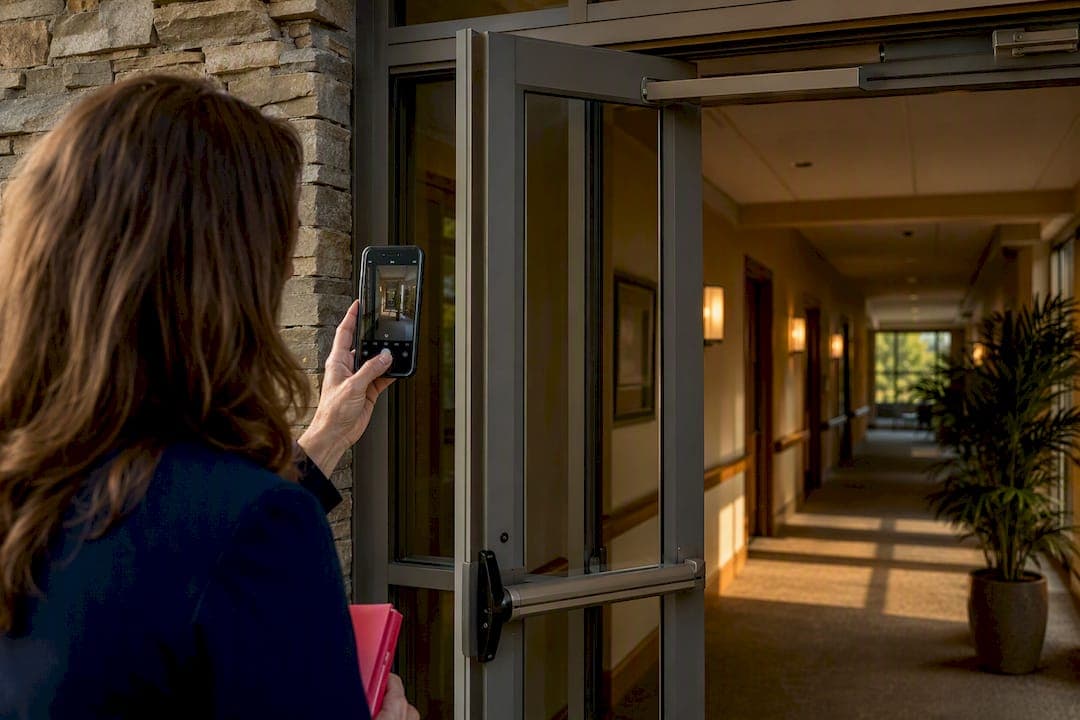
Photograph everything you can legally and respectfully capture. That includes the posted staffing sheet for the day, the hardware on exit doors, the activity board, posted menus, and every page of the rate sheet. Tour checklists built for families specifically recommend this documentation step because it creates a record you can compare later against what staff told you verbally, according to HelpDementia's memory care tour checklist.
While you're there, watch more than listen:
- Are residents engaged during activities, or is the "activity" a television left on in an empty room?
- Do caregivers respond to a resident's request within a minute or two, or does someone wait a long while for help?
- Does the posted activity schedule match what's actually happening at that hour?
- Do staff members make eye contact and speak directly to residents, or talk over them?
Pro Tip: Ask to see the same day's staffing log after your tour and compare it to the posted sheet. A mismatch between the two is one of the clearest signs a community stages its staffing for visitors.
What Medicare, Medicaid, and Insurance Actually Cover
Cost conversations go sideways fast when families assume Medicare will cover the bulk of memory care. It generally does not. Medicare covers certain medical services, like doctor visits, physical therapy, and specific equipment, but it does not pay for the custodial, room-and-board portion of long-term memory care, according to Medicare.
That gap is exactly why the most common funding paths for memory care are private pay, long-term care insurance, Medicaid where a resident qualifies, and veterans' benefits for those who are eligible. Medicaid coverage for memory care varies significantly by state, and long-term care insurance policies differ in what triggers coverage and how much they pay out, so neither should be assumed without direct confirmation from the policy or state agency.
Ask the facility directly which payers they accept and what's actually included in the base monthly fee versus billed separately. Then take these steps before signing anything:
- Request a fully itemized written rate sheet, not a verbal quote.
- Ask for written definitions of each care level and what triggers a move between them.
- Photograph every page of the contract, including fine print on fees and terms.
- Ask specifically how rate increases work: how often, by how much, and with what notice.
Many people with dementia wander at some point, and that safety reality shapes staffing costs too, since overnight and wandering-prevention coverage tends to raise a community's base rate compared to standard assisted living.
Verifying a Community's Inspection History and Complaint Record
A polished tour and a clean inspection history are two different things, and only one of them is verifiable from outside the building.
Federal five-star ratings from CMS were built primarily around nursing homes and have real limitations when applied to standalone assisted living or memory care communities, which often fall outside that rating system entirely. That means the more useful oversight record usually sits with your state's Department of Health or licensing agency, not a national ratings tool, according to the Alzheimer's Association's guidance on choosing residential care.
Run these checks before you commit:
- Search your state's health department or licensing board website for the community's most recent survey and any cited deficiencies.
- Call your state's Long-Term Care Ombudsman program and ask whether complaints have been filed against the community.
- Request the community's most recent inspection report directly and ask them to walk you through any deficiencies and how they were corrected.
While you're on the phone or in person, ask these three memory care questions directly: Can I see your last inspection report? Where were any deficiencies corrected, and how? May I speak with a few current resident families for their honest experience?
A community that hesitates on any of these three is telling you something, even if the words that come out are reassuring.
Red Flags and Contract Terms Worth Rejecting
Some warning signs show up in conversation, others hide in the fine print. Both deserve the same level of scrutiny.
On the behavioral side, be cautious of evasive answers to direct staffing questions, refusal to show you the actual staffing sheet, visible signs of neglect like unkempt residents or unpleasant odors, unexplained high staff turnover, and locked doors with no clear explanation of the emergency protocol behind them.
On the contract side, watch for vague discharge language that doesn't specify concrete triggers, rate increase clauses with no cap or notice period, added obligations for services that were never clearly described upfront, and any clause that limits your access to your loved one or restricts your right to file a grievance.
- Get every verbal commitment written into the contract before you sign.
- Ask whether a trial period is available before committing long-term.
- Have an elder law attorney or a trusted advocate review any contract with unclear or dense legal language.
Contracts favor whoever wrote them. A short pause to get a second set of eyes on the document costs far less than discovering a bad clause after your loved one has already moved in.
How Carexroads Helps You Confirm What You Find
Everything on this checklist gets stronger when it's checked against real family experience, not just a facility's own marketing. Carexroads aggregates verified family reviews and provider-verified profiles specifically so you can see patterns other families noticed, like staffing consistency and communication reliability, before you ever schedule a tour.
A few ways to use Carexroads alongside this checklist:
- Read the What to Know About Memory Care guide for a fuller breakdown of program types and what "memory care" actually means at different communities.
- Watch the 5 Must-Ask Questions video before your first tour so the questions feel natural instead of scripted.
- Compare what you observed on-site against Carexroads' verified family reviews, which reflect a 4.8 average family satisfaction rating across the platform.
Pro Tip: Save every photograph and note from your tour in one folder, then cross-reference it against the community's Carexroads reviews the same week, while the details are still fresh.
Once you've toured, photographed, and verified, the next step is simple: request to speak with a current resident's family directly. Nothing you read online replaces that conversation.
Staff Qualifications and Ongoing Training That Actually Matter
A certificate on the wall tells you a caregiver completed a course once. It doesn't tell you what happens six months later.
Ask what specific credential or training program each direct caregiver completes before working independently with memory care residents, and how many continuing education hours are required annually after that. Some states mandate a set number of dementia-training hours for special-care-unit staff; others leave it almost entirely to the operator's discretion. That gap is exactly why you need to ask the community directly rather than assume any baseline applies.
Beyond hours, ask who delivers the training. A structured curriculum led by a gerontologist or dementia-care specialist looks very different from a video module employees click through during onboarding. Ask whether nurses, aides, and activity staff all receive the same dementia training or whether it's tiered by role. Ask how new hires are supervised and evaluated during their first weeks on a memory care unit specifically, since general senior living experience doesn't automatically translate to dementia care competence.
How Individualized Care Plans Handle Behavior Changes
Dementia behavior isn't static, and a community's approach to it shouldn't be either. Ask how the community distinguishes between a resident having a difficult day and a genuine shift in condition that requires a care plan update.
The strongest communities build behavior management around each resident's specific triggers, history, and preferences rather than applying a blanket protocol to every agitated moment. Ask what non-pharmacological approaches are tried first, such as redirection, music, or environmental changes, and under what circumstances medication becomes part of the plan. Ask who is involved in that decision, and whether you as the family member are consulted before a medication change takes effect. A community that treats behavior management as a one-size response, rather than a personalized plan tied to your loved one's specific history, is one worth questioning further.
Emergency Preparedness and Medical Response Protocols
Ask what happens medically before you need the answer in a crisis. What is the protocol when a resident falls, and how quickly is a nurse or physician notified? Is there a written emergency evacuation plan specific to residents with cognitive impairment, since standard evacuation drills don't account for confusion or resistance to leaving a familiar space?
Ask how the community handles power outages, severe weather events, and other facility-wide emergencies, including whether backup generators support medical equipment. Ask what arrangement exists with a local hospital or emergency medical service, and how quickly a resident in acute distress can be transported. These questions rarely come up on a standard tour, which is exactly why you should raise them yourself.
End-of-Life Care and Palliative Support
Not every memory care community offers hospice or palliative support on-site, and the difference matters more than most families realize until they need it. Ask directly whether the community partners with a hospice agency and whether residents can receive end-of-life care in their own room rather than being transferred elsewhere during their final weeks.
Ask how the staff supports pain management, comfort care, and family presence during that period, and whether staff receive any specific training in end-of-life dementia care. A community with a clear, practiced answer to this question has almost certainly walked a family through it before.
Transportation and Staying Connected to the Wider Community
Ask what transportation the community provides for medical appointments, and whether that service is included in the base fee or billed separately. Ask how often residents leave the building for outings, and how those outings are adapted for cognitive ability, since a crowded shopping trip may overwhelm a resident who would enjoy a quiet drive or a small group outing instead.
Ask whether the community invites outside visitors, volunteers, or local school and community groups in for events, since that kind of connection to the wider world can meaningfully affect a resident's quality of life beyond the building's walls.
Technology for Monitoring, Safety, and Engagement
Ask what technology the community uses to track residents who may wander, such as wearable sensors or door alarms tied to specific residents rather than a blanket building-wide system. Ask how that technology integrates with staff response time, since a sensor that alerts no one quickly is not a safety feature.
On the engagement side, ask whether the community uses tablets, interactive screens, or virtual reality tools for cognitive stimulation and how staff are trained to use them appropriately with residents at different cognitive stages. Ask, too, how the community keeps you updated between visits, whether through a family portal, a care app, or simple scheduled phone updates. Some families find that consistency of communication matters more day to day than any single piece of technology in the building.
A Family's Perspective on Using This Checklist
One family we heard about walked into a tour charmed by a beautifully staged common room, only to return unannounced a week later and find that same room empty and the activity board untouched for days. The checklist gave them permission to ask the harder follow-up questions instead of trusting the first impression.
Pace this decision when you can, and don't do it alone. A second family member on the tour, or even a friend who's been through it before, catches details exhaustion makes easy to miss.
— Care
This article is general information, not a substitute for advice from a qualified doctor. Consult a qualified healthcare professional about your own circumstances before acting on anything here.
Sources
- Medicare - Nursing home care coverage
- Memory care: A senior living option for those with dementia or Alzheimer's disease - Harvard Health
- Helpdementia
- Wandering - Alzheimer's Association