
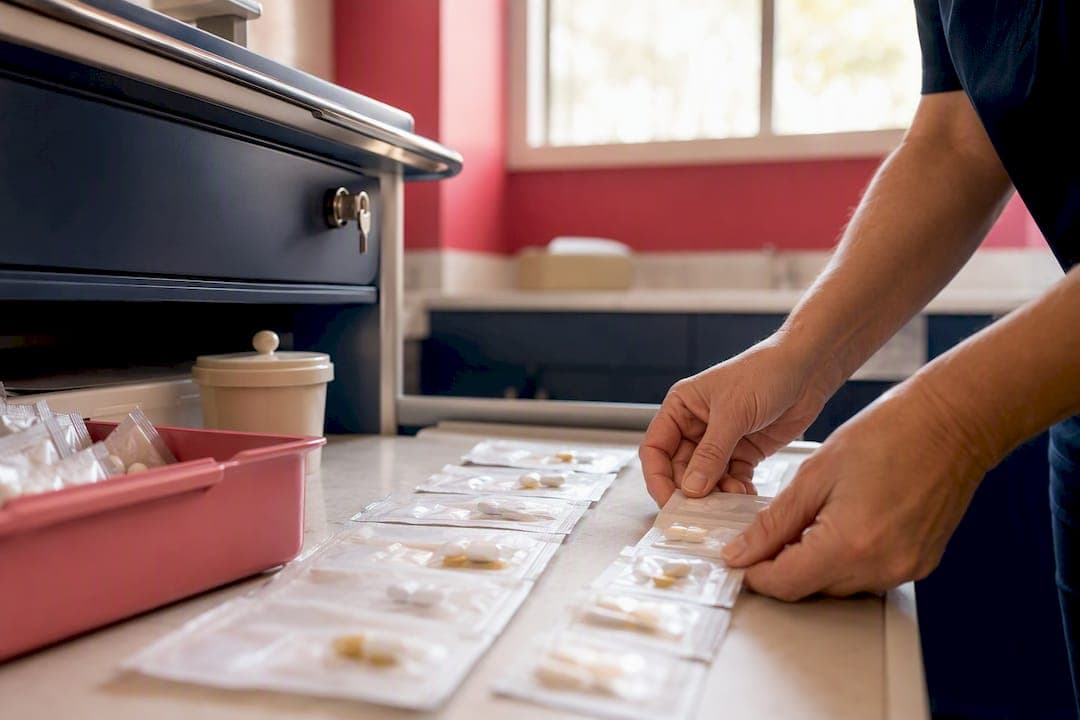
Assisted living medication management covers four operational phases: procurement, storage, administration, and documentation. Who is legally allowed to handle each phase depends on state rules and how much a resident can safely do independently. Before choosing a community, ask specifically about staff credentials, the pharmacy arrangement, and whether families can access the Medication Administration Record.
TL;DR:
- Families should verify if assisted living communities use blister packs or unit-dose medication packaging to reduce errors during medication passes.
- States differentiate assistance from administration tasks, requiring licensed staff for the latter, and families must confirm staff credentials and training levels.
- Medication reconciliation after hospital discharges is critical to prevent duplicate or conflicting prescriptions, especially when medications come from multiple sources.
- Communities with dedicated medication pass staff, proper storage protocols, and routine pharmacist reviews tend to have fewer medication errors.
- Families need to ask specific questions about pharmacy arrangements, staff training, and error reporting processes to gauge a community's medication safety standards.
Table of Contents
- How Medication Management Works in Assisted Living
- Why State Rules Decide Who Can Handle Your Parent's Medications
- Staff Roles and How to Verify They're Actually Trained
- The Safety Controls That Actually Prevent Errors
- How Communities Decide If Your Parent Can Self-Administer
- The Medication Errors That Happen Most, and How Good Communities Prevent Them
- Questions to Ask on a Tour
- Carexroads Resources for Evaluating Medication Programs
- What I've Learned Watching Families Navigate This
- How Carexroads Helps You Compare Medication Programs Before You Choose
- Sources
How Medication Management Works in Assisted Living
Every dose a resident takes travels through a chain of hands before it reaches them, and understanding that chain helps you spot where things can go wrong. The process starts with a prescriber's order, moves through a pharmacy, gets organized by facility staff, sits in secure storage, and finally reaches the resident during a scheduled medication pass. Each step gets logged.
Here's the typical flow, in order:
- Prescriber order. A physician, nurse practitioner, or physician assistant writes or electronically transmits the prescription.
- Pharmacy coordination. Most communities work with a contracted long-term care pharmacy rather than a standard retail pharmacy, though some allow mail-order or the resident's existing pharmacy.
- Intake and packaging. The pharmacy fills the order, often in unit-dose or blister-pack form organized by date and time rather than in standard prescription bottles.
- Secure storage. Medications go into a locked cart or medication room, sorted by resident.
- Medication pass. Trained staff distribute doses at scheduled times, verifying the resident's identity before administering.
- Documentation. The dose gets recorded on the Medication Administration Record, commonly called the MAR or, in its digital form, the eMAR.
Move-in day is where this system gets tested. If the pharmacy transition isn't coordinated before a resident arrives, doses can get missed in the first day or two simply because the facility doesn't yet have the medication in hand or hasn't finished processing the new resident's regimen. This is one of the most common, and most preventable, gaps in senior care. Ask your chosen community, well before move-in, exactly when they need the current prescriptions and whether they'll coordinate directly with your parent's existing pharmacy or require a switch. Carexroads' guide to transitioning a senior to assisted living walks through the reconciliation steps that prevent this exact problem.
Blister packs and unit-dose packaging exist for a reason: they reduce the chance a staff member grabs the wrong pill or miscounts a dose from a shared bottle. The tradeoff is flexibility. A resident who wants to keep a familiar over-the-counter supplement in their own bottle may not be able to, depending on the community's packaging policy. It's a small friction point, but it matters to residents who value routine.
The MAR or eMAR is the paper trail that shows whether the system is actually working. A properly kept record shows the drug, dose, time, and the staff member's initials, entered immediately after administration, not at the end of a shift. If a resident refuses a dose or a dose gets skipped for any reason, that has to be documented too, with a reason noted. Families should be able to review this record. If a community hesitates to show you the MAR for your parent, treat that as a serious red flag.
Why State Rules Decide Who Can Handle Your Parent's Medications
Assisted living isn't regulated by the federal government the way nursing homes are. States write their own rules, which is why medication policies can look completely different between a community in one state and a similar one across the border.
The regulatory distinction that matters most is between assistance and administration. Assistance typically means reminding a resident to take a pill, opening a childproof cap, or reading the label aloud, tasks many states allow unlicensed staff to perform with minimal training. Administration means physically placing a pill in someone's mouth, drawing up an injection, or applying a topical medication, tasks that generally require a licensed nurse or a staff member with specific state certification, most commonly a Certified Medication Aide or medication technician.
State health departments publish these rules directly. Wisconsin's Department of Health Services, for example, lays out detailed requirements for medication management and administration in assisted living, covering staff training, documented competencies, resident self-management options, and recordkeeping standards. Most states organize similar information under a "residential care" or "assisted living licensing" section of their health or social services department website.
A few patterns repeat across state lines, even though the specific requirements vary:
- Many states require a consultant pharmacist to periodically review resident medication regimens for safety and interaction risks.
- Controlled substances almost universally require double-lock storage and a separate count log, regardless of state.
- CMA or medication technician certification typically involves a state-approved training course, a competency exam, and periodic renewal.
- States that permit resident self-administration usually require a documented capacity assessment first.
Statistic to know: Research examining medication management across six assisted living settings found substantial variability in how communities structure these practices, and residents in assisted living take an average of around 6.2 medications, often while managing some degree of cognitive impairment. That combination of medication complexity and cognitive vulnerability is precisely why the assistance/administration distinction carries so much weight.
To check your own state's rules, search "[your state] assisted living medication administration regulations" or go directly to your state's Department of Health and Human Services, Department of Social Services, or equivalent licensing agency. Look for terms like "residential care facility," "personal care home," or "assisted living licensing rules," since terminology differs by state.
Staff Roles and How to Verify They're Actually Trained
Three categories of staff typically touch medications in assisted living, and the gap between them is bigger than most families realize. Registered nurses and licensed practical nurses can administer medications, delegate certain tasks, and are accountable for overseeing the process. Certified Medication Aides, sometimes called medication technicians, complete state-approved training specifically to administer medications under nursing supervision or delegation. Unlicensed staff, often the aides who help residents with daily living, are usually limited to assistance tasks unless they've completed additional certification.
Nurse delegation is the legal mechanism that lets a CMA or trained aide administer medications at all. A licensed nurse evaluates the task, the resident, and the staff member's competency before delegating that specific responsibility, and remains accountable for it. This isn't a formality. It's the accountability structure that's supposed to catch problems before they happen.
When you're evaluating a community, ask for specifics rather than general reassurances:
- What certification do the staff administering medications hold, and how many training hours did it require?
- How often is competency reassessed, and is that documented?
- Who supervises medication passes, and how frequently?
- Does a consultant pharmacist review resident regimens, and how often?
Pro Tip: Ask to see a redacted sample of a training log or competency checklist, not just a verbal answer. A community with a genuinely strong program will have this documentation ready and won't hesitate to show you the format, even without resident-specific details.
Vague answers are the biggest warning sign here. If a staff member says "oh, whoever's on shift helps with meds" without naming a credential, or if the community can't tell you when the last pharmacist review happened, that's worth taking seriously before you sign anything.
The Safety Controls That Actually Prevent Errors
Storage, documentation, and disposal policies sound like paperwork until you realize they're the difference between a near-miss and a genuine adverse event. Good communities build in redundancy at every step.
Storage starts with a locked medication room or cart, but the details matter more than the lock itself. Medications requiring refrigeration need a separate, monitored cold-storage unit, not a shared staff refrigerator. Topical medications get stored apart from oral ones to prevent mix-ups. Controlled substances require double-lock storage, meaning two separate locking mechanisms or a locked box inside a locked cabinet, along with a count log that two staff members verify at shift changes.

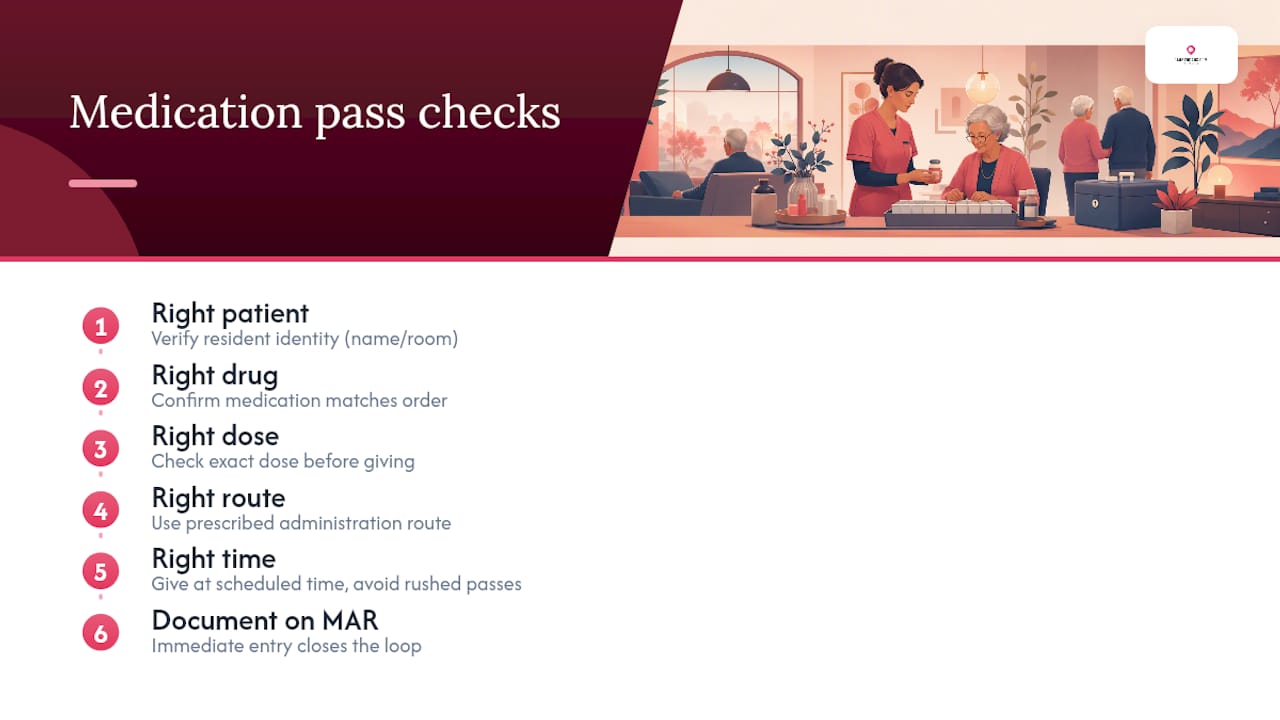
Administration follows what nursing programs call the "five rights": the right patient, the right drug, the right dose, the right route, and the right time. It sounds obvious, but most medication errors happen when one of these five gets skipped under time pressure, most often the "right patient" check when a facility has residents with similar names or room numbers. Immediate documentation on the MAR closes the loop. A dose that's given but not recorded right away creates a gap where a second staff member might administer it again, or where a missed dose looks like a completed one.
Disposal of expired or discontinued medications follows protocols aligned with DEA guidance, particularly for controlled substances, which typically require documented destruction witnessed by two staff members rather than simply being thrown away.
Statistic to know: system-level factors, rather than individual carelessness, are major contributors to medication errors in long-term care settings. Analyses of medication safety in these settings point to inconsistent packaging, rushed handoffs between shifts, and fragmented pharmacy arrangements as the recurring culprits, not isolated staff mistakes.
That finding has a practical implication for families: staffing levels and workflow design matter as much as any individual employee's competence. Communities that build dedicated medication-pass windows, rather than asking overstretched aides to squeeze medication administration between other duties, tend to have fewer errors. Ask whether medication passes are handled by a dedicated staff member or folded into general caregiving shifts.
How Communities Decide If Your Parent Can Self-Administer
Not every resident needs staff to handle their medications, and preserving that independence matters for quality of life. Communities determine self-administration capacity through a formal assessment, usually conducted by a nurse, that evaluates a few specific things.
- Vision and dexterity, to confirm the resident can read labels and physically manage pill bottles or organizers.
- Cognitive function, to check whether the resident can reliably remember dosing schedules and recognize their own medications.
- Judgment around safety, including whether the resident would report side effects or know when to ask for help.
- Documentation of the outcome in the resident's individualized service plan, specifying exactly which medications, if any, they can self-manage.
Assessment tools developed by pharmacy programs, including instruments used by clinicians to evaluate self-administration capacity, give nurses a structured way to make this call rather than relying on a general impression.
Residents cleared for self-administration typically keep medications in a lockable in-room cabinet rather than the central medication room, still subject to periodic checks. Reassessment isn't a one-time event. Most states expect it at least annually, and any clinical change, a fall, a new diagnosis, a hospital stay, should trigger a fresh look. Families can support this by signing required consent forms promptly, keeping an updated medication list on hand, and, where appropriate, designating a healthcare power of attorney so decisions can move quickly if capacity changes.
The Medication Errors That Happen Most, and How Good Communities Prevent Them
Wrong time, missed doses, duplicate doses, wrong dosage amounts, and overlooked drug interactions account for the bulk of medication errors in assisted living. None of these typically stem from one careless person. They stem from systems with gaps.
Poor packaging is one gap. If a pharmacy doesn't use organized unit-dose or blister packaging, staff working through a med pass under time pressure are more likely to grab the wrong pill. Fragmented pharmacy arrangements are another. When a resident's medications come from three different sources instead of one contracted long-term care pharmacy, reconciling the full list becomes harder, and interaction checks can slip through. Rushed med passes and thin documentation round out the list. A staff member covering too many residents in too short a window is the setup for a missed or duplicated dose.
The prevention side has real evidence behind it. Consultant pharmacist review, where a pharmacist periodically audits each resident's full regimen, catches unnecessary or conflicting medications before they cause harm. Guidance on medication optimization in assisted living frames this as more than simple deprescribing. Optimization can mean starting or adjusting a medication just as often as stopping one, with the goal of matching the regimen to what actually helps the resident.
Reconciling medications at every transition, admission, hospital discharge, or a change in care level, closes another major gap. So does routine MAR auditing, where a supervisor checks documentation for patterns like consistently late doses or unexplained gaps.
Pro Tip: If your parent has been hospitalized, ask specifically whether the assisted living community reconciled the discharge medication list against what they were taking before admission. This single step catches a surprising number of duplicate or conflicting prescriptions. Carexroads' guide to discharge planning and readmissions covers exactly this handoff.
On the technology side, blister packs, eMAR systems, and automated dispensers that lock until the correct time all reduce human error by removing steps where judgment can slip. None of them replace trained staff, but paired with adequate staffing, they measurably tighten the process.
Questions to Ask on a Tour
Bring this list with you, or send it ahead by email if you're doing a phone screening before a visit.
- Who administers medications here, and what certification or license do they hold?
- Which pharmacy do you work with, and is medication supplied in blister packs or unit-dose packaging?
- How often does a consultant pharmacist review resident medication regimens?
- Can families access the MAR or eMAR for their own family member?
- How are medication errors or adverse reactions reported, and are families notified?
- What's your policy on controlled substances and PRN (as-needed) medications?
- If my parent refuses a dose, how is that documented and communicated to me?
A community that answers these clearly and specifically, without hedging, is telling you something important about how seriously it takes this part of care.
Carexroads Resources for Evaluating Medication Programs
Carexroads carries a 4.8 average family satisfaction rating built on verified reviews from families who've actually lived through these decisions, not marketing copy. When you search a community on Carexroads, look for review notes that mention medication programs specifically, families often flag whether staff were responsive about prescription changes or vague about who handles med passes.
Pair that with Carexroads' practical guides. The transition guide walks through medication reconciliation at move-in, and the discharge documentation guide gives you a template for keeping an accurate, current medication list your parent's care team can actually use.
What I've Learned Watching Families Navigate This
A family I think about often moved their mother into assisted living on a Friday afternoon, and by Sunday she'd missed two doses of a heart medication because the new pharmacy hadn't processed the transfer yet. Nobody was negligent. The system just had a gap, and it landed on a weekend when nobody was around to catch it fast.
That's the pattern worth remembering: most medication problems in assisted living aren't about bad actors, they're about handoffs nobody double-checked. Before move-in, compile a complete, current medication list yourself. Confirm the pharmacy plan in writing, not verbally. Ask for MAR access up front, not after a concern arises. Request the schedule for consultant pharmacist reviews, and note when your parent's next capacity reassessment is due. None of this requires confrontation. Staff generally welcome a family that's organized and engaged, and that engagement is exactly what preserves your parent's independence instead of undermining it.
— Care
How Carexroads Helps You Compare Medication Programs Before You Choose
Touring five communities and asking the same seven questions five times is exhausting, and it's easy to lose track of who actually gave a straight answer about their pharmacy arrangement or pharmacist review schedule. Carexroads solves that upfront by putting verified family reviews, many of which specifically mention medication programs, next to community profiles you can compare side by side.

Search by location on Carexroads to pull up assisted living communities near your family, then cross-reference what you find on tour against reviews from families who've already asked the hard questions. If you're still working through the move-in logistics, the transition guide covers the medication reconciliation steps that prevent those first-week missed doses. Start your search on Carexroads today, and go into your next tour already knowing which communities are worth your time.
Sources
- “Meds Are a Real Tricky Area”: Examining Medication Management and Regulation in Assisted Living
- Assisted Living: Medication Management and Administration | Wisconsin Department of Health Services
This article is general information, not a substitute for advice from a qualified doctor. Consult a qualified healthcare professional about your own circumstances before acting on anything here.