

Timely discharge planning is defined as a coordinated clinical intervention that begins at hospital admission and systematically prepares patients for safe transitions home. This process, formally recognized by the Agency for Healthcare Research and Quality (AHRQ) and the Joint Commission as a patient safety standard, does far more than generate paperwork. When discharge planning starts early and includes risk stratification, medication reconciliation, and structured follow-up, it directly reduces the rate of preventable hospital readmissions. For healthcare professionals, discharge planners, and families caring for elderly loved ones, understanding why timely discharge planning reduces readmissions is the first step toward acting on it.
How does starting discharge planning at admission impact readmission rates?
Discharge planning that begins at admission gives care teams the time to identify high-risk patients before a crisis develops. Good discharge planning must be anticipatory and dynamic, coordinating equipment, transportation, and follow-up care from day one. That early start changes the entire trajectory of a patient's recovery.
Risk stratification at admission is the core of this approach. Patients with polypharmacy, prior hospitalizations, cognitive impairment, or weak social support are the most likely to return to the hospital within 30 days. Identifying these factors on day one, rather than the day before discharge, gives the team time to arrange home health services, durable medical equipment, and specialist follow-up before the patient ever leaves the building.
The practical logistics matter just as much as the clinical assessment. Transportation barriers, lack of a caregiver at home, and inability to fill prescriptions are all predictable obstacles. A discharge planner who surfaces these issues on day two can solve them. One who surfaces them on the morning of discharge cannot.
Key risk factors to assess at admission include:
- Polypharmacy (five or more medications)
- History of two or more hospitalizations in the past year
- Cognitive impairment or dementia diagnosis
- Limited social support or living alone
- Low health literacy or language barriers
- Uncontrolled chronic conditions such as heart failure or COPD
Pro Tip: Ask the patient and a family caregiver together during the admission assessment. Patients often underreport social and functional limitations when asked alone.
What role does patient education play in preventing readmissions?
Communication gaps are a primary driver of avoidable readmissions. Patients who leave the hospital without a clear understanding of their medications, warning signs, or follow-up schedule are at significant risk of returning within 30 days. Structured discharge education directly addresses this gap.
Patient-Oriented Discharge Summaries (PODS) improve patient comprehension and discharge readiness. The evidence is clear, however, that written documents alone are not enough. Relational teaching during hospitalization, where a clinician walks through the care plan with the patient and caregiver, produces better outcomes than handing over a printed sheet at the door.
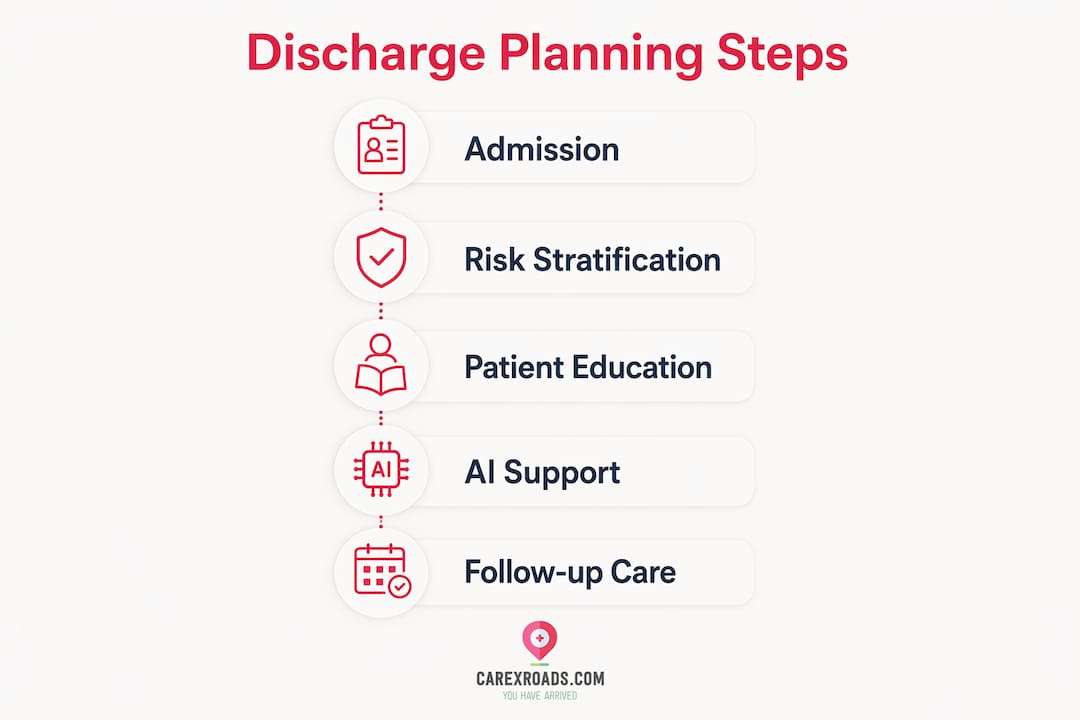
The teach-back method is the most reliable way to confirm understanding. Medication reconciliation failures and the absence of teach-back sessions contribute heavily to post-discharge medication errors that lead directly to readmissions. Teach-back requires the patient or caregiver to explain the medication regimen back to the clinician in their own words. If they cannot, the teaching continues.
A structured discharge education process includes these steps:
- Review all medications by name, dose, purpose, and timing with the patient and caregiver present.
- Explain the two or three warning signs that require an immediate call to the provider or a return to the emergency department.
- Confirm the date, time, and location of the first follow-up appointment before the patient leaves.
- Use teach-back to verify understanding of each medication and at least one key warning sign.
- Provide a written summary in plain language at a sixth-grade reading level, using the patient's preferred language.
Pro Tip: Target teach-back at the caregiver, not just the patient. Family members manage most post-discharge medication routines for elderly patients, and their understanding is equally critical.
How do AI tools and predictive analytics improve discharge planning?
Predictive analytics and AI-supported tools are changing how hospitals identify which patients need the most intensive discharge planning. Rather than relying on clinical intuition alone, these systems analyze electronic health record (EHR) data to flag high-risk patients early in the admission.

AI-augmented transitional care management programs reduce 30-day rehospitalizations by 21% through early identification of high-risk patients. That reduction holds across diverse patient populations with 95% confidence. The mechanism is straightforward: when the system flags a patient as high-risk on day one, the care team can assign a dedicated transitional care nurse, schedule a post-discharge home visit, and alert the primary care provider before discharge rather than after a readmission.
High-intensity, targeted discharge interventions show the strongest evidence for reducing readmissions and medication discrepancies. Standardized interventions with risk stratification allow hospitals to direct limited nursing and social work resources toward the patients who need them most. This is not about replacing clinical judgment. It is about giving clinicians better information faster.
| Approach | Mechanism | Evidence |
|---|---|---|
| AI-augmented transitional care | Flags high-risk patients via EHR data | 21% reduction in 30-day rehospitalization |
| Risk stratification at admission | Identifies polypharmacy, social risk, prior admissions | Earlier resource allocation and care coordination |
| Targeted pharmacist intervention | Medication reconciliation for low-adherence patients | Improved outcomes in high-risk subgroups |
| Post-discharge follow-up within 24 hours | Early warning sign detection | 38% reduction in 30-day emergency readmissions |
The table above reflects a consistent pattern: targeted, early interventions outperform general discharge processes. Hospitals that adopt predictive tools report better allocation of social work, pharmacy, and nursing resources across the board.
What post-discharge steps reduce the risk of returning to the hospital?
The first 24–72 hours after discharge represent the highest-risk window for readmission. Community health services contact within 24 hours post-discharge reduces 30-day emergency readmissions by 38%. Earlier contact produces stronger protective effects than contact made later in the post-discharge period. That single data point should drive every hospital's follow-up protocol.
Medication reconciliation is the most common failure point in this window. Providing a medication list is insufficient without patient and caregiver teach-back to confirm understanding. A follow-up call that reviews each medication, checks for side effects, and confirms the patient filled all prescriptions catches errors before they escalate.
Practical post-discharge actions that reduce readmission risk include:
- Schedule a follow-up call or home visit within 24 hours of discharge, prioritizing patients flagged as high-risk.
- Confirm the patient filled all prescriptions and review any new symptoms or side effects.
- Verify the patient attended or has a confirmed appointment with their primary care provider within seven days.
- Contact the receiving home health agency or subacute rehabilitation facility to confirm the care plan was received and understood.
- Ask the family caregiver directly whether they feel prepared to manage the care plan at home.
Multidisciplinary coordination between the hospital team, primary care provider, home health agency, and family caregiver is not optional. Gaps between these groups are where readmissions happen. A discharge planner who closes those gaps with direct phone calls and confirmed handoffs prevents the errors that bring patients back.
Families managing a post-discharge follow-up for an elderly parent benefit from having a written checklist of these steps. Clear roles and a defined timeline reduce the confusion that leads to missed medications and delayed warning signs.
Key Takeaways
Timely discharge planning reduces readmissions because it identifies patient risk early, closes communication gaps, and coordinates follow-up care before problems escalate into emergencies.
| Point | Details |
|---|---|
| Start planning at admission | Risk stratification on day one allows time to arrange equipment, transport, and follow-up before discharge. |
| Use teach-back for every medication | Verbal confirmation from the patient or caregiver prevents the medication errors that drive most readmissions. |
| Follow up within 24 hours | Community health contact within 24 hours post-discharge reduces 30-day emergency readmissions by 38%. |
| Apply AI tools to flag high-risk patients | AI-augmented programs reduce 30-day rehospitalization by 21% by targeting intensive care to those who need it most. |
| Coordinate across all care settings | Confirmed handoffs between hospital, home health, and primary care close the gaps where readmissions occur. |
What I've learned about discharge planning that most teams overlook
Discharge planning is treated as a final step in too many hospitals. The chart gets reviewed, the summary gets printed, and the patient leaves. That sequence is exactly backward, and it costs patients their safety and families their peace of mind.
The most preventable readmissions I have seen share a common thread: nobody asked the right questions at the beginning. A patient with five medications, no car, and a spouse with dementia at home is a readmission waiting to happen if the discharge plan is built on the day of discharge. That same patient, identified on day one, can have home health arranged, a medication blister pack organized, and a neighbor confirmed as a backup caregiver before they ever leave the building.
The second thing teams consistently underestimate is the family caregiver's role. Clinicians teach the patient. The patient goes home and hands the medication list to their daughter, who has never heard of half the drugs on it. Teach-back with the caregiver present is not a courtesy. It is a clinical necessity.
Technology helps, but it does not replace the conversation. AI tools that flag high-risk patients are only as useful as the follow-up they trigger. A risk score sitting in an EHR that no one acts on is not a discharge plan. The teams that reduce readmissions most consistently are the ones who treat the risk score as the beginning of a conversation, not the end of a workflow.
Families navigating a hospital-to-home transition for an elderly parent deserve the same level of coordination that clinical teams receive. Carexroads exists precisely to support that gap, connecting families with verified providers and practical guides that make the transition safer and less confusing.
— Care
Carexroads resources for hospital-to-home transitions
Families and discharge planners looking for practical support after a hospital stay will find Carexroads a reliable starting point.
Carexroads offers senior care transition guides built specifically for families managing hospital-to-home moves, including resources on home care, assisted living, and memory care options. The site carries a 4.8 average family satisfaction rating and connects families with verified providers who understand the complexity of post-discharge care. Whether you are coordinating care for a parent leaving a rehabilitation facility or arranging home health services after a cardiac event, Carexroads provides the clarity and trusted guidance that makes the difference between a safe recovery and a return trip to the emergency department.
FAQ
What is discharge planning and why does it matter?
Discharge planning is a clinical process that prepares patients for safe transitions from the hospital to home or another care setting. It reduces readmissions by coordinating medications, follow-up care, and patient education before the patient leaves the hospital.
When should discharge planning begin?
Discharge planning should begin at hospital admission, not on the day of discharge. Early initiation allows care teams to identify high-risk patients and arrange necessary services, equipment, and follow-up appointments in time.
How does the teach-back method reduce readmissions?
Teach-back requires patients or caregivers to repeat medication instructions and care plans in their own words, confirming real understanding. Medication reconciliation failures without teach-back are a leading cause of post-discharge medication errors and preventable readmissions.
How quickly should follow-up occur after discharge?
Follow-up contact within 24 hours of discharge reduces 30-day emergency readmissions by 38%. The first 24–72 hours post-discharge are the highest-risk period, making early contact the single most protective step a care team or family can take.
Can AI tools really improve discharge planning outcomes?
Yes. AI-augmented transitional care programs reduce 30-day rehospitalizations by 21% by identifying high-risk patients early and directing intensive follow-up to those who need it most. The benefit holds across diverse patient populations.