

The CMS Five-Star Quality Rating System gives every certified nursing home an overall score plus three component ratings for health inspections, staffing, and quality measures. Treat that star rating as a screening tool, not a final verdict. Look up the facility on Medicare's Care Compare, read its recent inspection history, then schedule an in-person visit and, if concerns remain, call your state long-term care ombudsman.
TL;DR:
- Most star ratings do not reflect short-term staffing fluctuations, visit frequency, or the emotional quality of care, which family visits and proximity can reveal.
- Regularly review inspection reports over multiple survey cycles to identify patterns of persistent deficiencies, especially for serious citations like immediate jeopardy codes J, K, or L.
- Call facilities before visiting to ask about recent deficiencies, staffing levels, staff turnover, and acceptability of payment methods, then verify these details during the tour.
- Weekend staffing gaps are a common problem that scheduled visits may not reveal, making unannounced weekend visits essential for an accurate assessment.
- Verified family reviews often reveal day-to-day care quality and culture, filling gaps left by official ratings and inspection data, especially regarding staff responsiveness and resident satisfaction.
Table of Contents
- What Does the CMS Five-Star Rating Actually Measure?
- What Do Star Scores Show, and What Do They Miss?
- How Do You Read Inspection Reports and Spot Red Flags?
- What Should You Ask by Phone and Check on a Tour?
- Care's Perspective: Why Family Reviews Fill the Gaps Ratings Leave Behind
- Let Carexroads Help You Turn Ratings Into a Real Decision
- Sources
- FAQ
What Does the CMS Five-Star Rating Actually Measure?
The overall star rating you see is built from three separate scores, and each one tells you something different. Health inspections reflect deficiencies found during state surveys over the past three years, weighted toward the most recent and most serious findings. Staffing measures nursing hours per resident per day, drawn from payroll-based data the facility reports to the Centers for Medicare & Medicaid Services. Quality measures track clinical outcomes: falls, pressure sores, hospital readmissions, and similar indicators pulled from resident assessments and claims data.
CMS combines these into the overall star you see first, but a facility can score well on one category and poorly on another. Staffing turnover and weekend staffing levels now factor more heavily into how that component score is calculated, since thin weekend coverage has historically hidden behind decent weekday averages.
Before you compare facilities, pull up Medicare's Care Compare tool and search by location or facility name. Every certified nursing home in the country has a detail page there, and it's the same government data feeding every third-party nursing home comparison site you'll find elsewhere.
What Do Star Scores Show, and What Do They Miss?
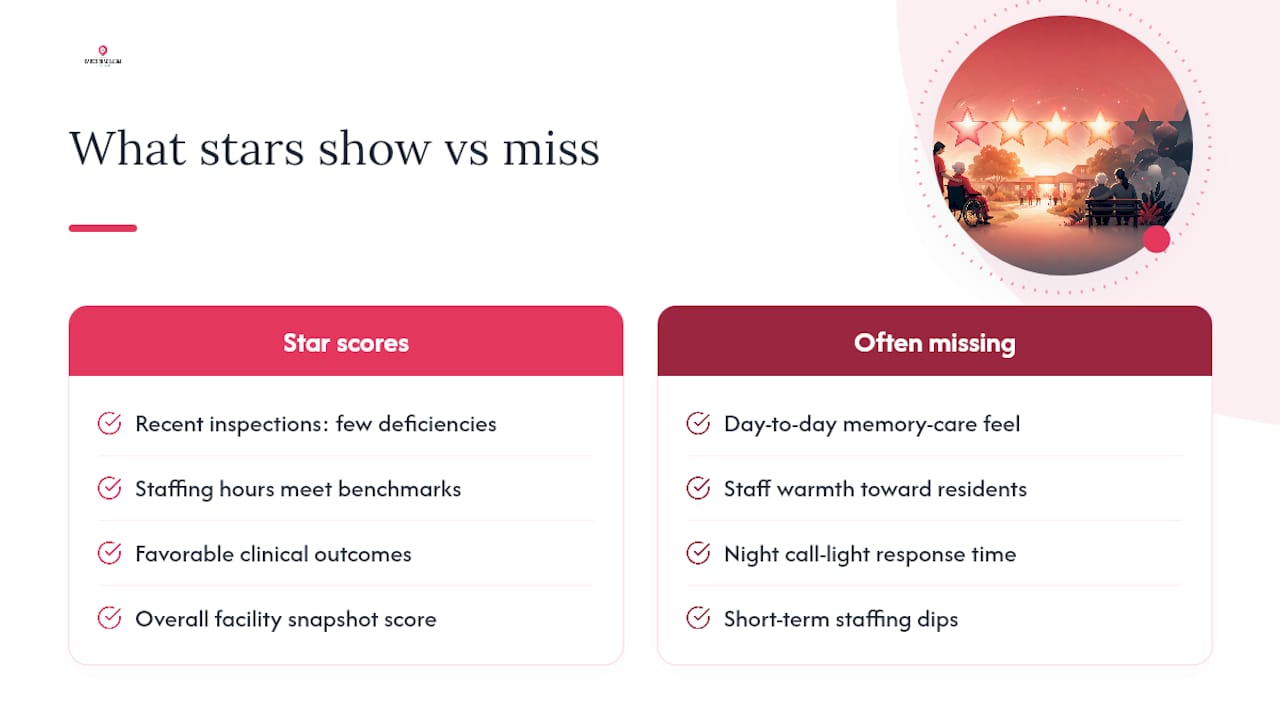
A 5-star facility generally means recent inspections turned up few serious deficiencies, staffing hours meet or exceed typical benchmarks, and clinical outcomes trend favorably. A 1-star facility usually carries a heavier deficiency history, thinner staffing, or weaker outcome data, sometimes all three. That gap is real, and it matters. But the star score alone leaves out a lot that families care about most.
Ratings don't capture the day-to-day feel of a memory care unit, the warmth of staff toward confused or frightened residents, or how quickly someone answers a call light at 2 a.m. They also smooth over short-term staffing dips that a snapshot inspection might miss entirely. A facility can carry a strong overall score while cycling through three different administrators in a year, something no star reflects.
Distance and visit frequency matter more than most families expect. A 3-star facility fifteen minutes from home, where you can drop in unannounced twice a week, often serves your loved one better than a 5-star facility ninety minutes away that you'll see once a month. Frequent family visits are themselves one of the strongest informal checks on care quality, and proximity is what makes them possible.
A few practical habits help here. Check the date of the facility's most recent inspection before trusting the star, since a rating built on a survey from two years ago carries less weight than one updated last quarter. Ratings refresh regularly as new inspection and staffing data come in, so a facility's score today may not match what it showed six months ago.
How Do You Read Inspection Reports and Spot Red Flags?
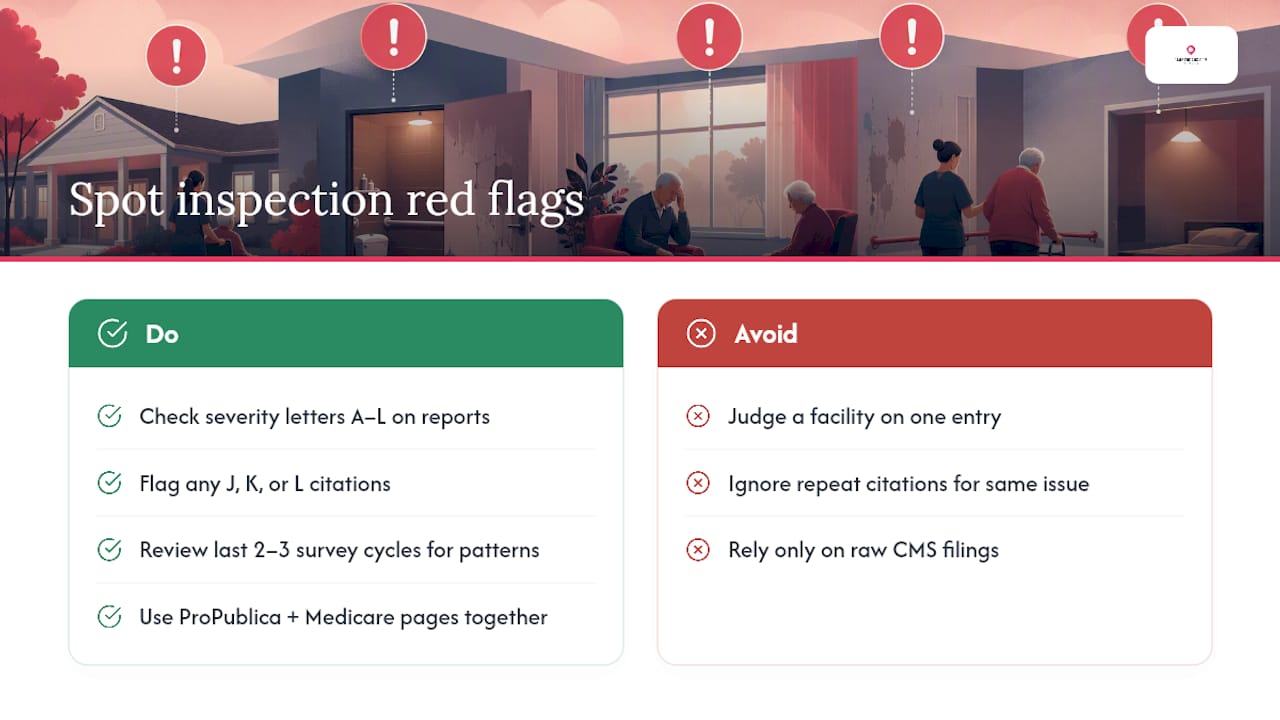
Every deficiency cited during a state survey gets a severity letter from A to L. The first few letters mark minor, isolated issues with little or no actual harm. As you move up the scale, severity and scope both increase, and the letters J, K, and L specifically signal immediate jeopardy to resident health or safety, the most serious classification CMS uses. A facility that has landed a J, K, or L citation in the past cycle deserves a much closer look than one with a handful of low-level paperwork deficiencies.
Don't judge a facility on a single inspection entry. Look across the last two or three survey cycles for patterns. A repeat citation for the same problem, say, medication errors or inadequate wound care, signals a persistent issue rather than a one-time lapse that got corrected. ProPublica's Nursing Home Inspect tool makes this kind of trend-spotting far easier than scrolling through raw CMS filings, since it aggregates deficiency letters, fines, and complaint histories in one searchable database.
Medicare's own inspection pages list deficiency summaries and link to full survey reports for each facility. Pair that with ProPublica's trend view, and you get both the official record and the pattern behind it. A facility with three consecutive clean surveys tells a very different story than one with a single clean year sandwiched between two rough ones.
What Should You Ask by Phone and Check on a Tour?
Ratings and inspection reports get you a shortlist. Turning that shortlist into a real decision takes a phone call and a visit.
Before you visit, call and ask:
- Has the facility had any deficiencies cited in the last twelve months, and what were they?
- What's the registered nurse coverage like, especially overnight and on weekends?
- Does the facility accept both Medicare and Medicaid, and how would a payment source change affect your loved one's bed?
- What's the current staff turnover rate, and how long has the director of nursing been in the role?
During the tour, look for:
- How staff talk to residents, not just to you. Rushed, impatient interactions are a warning sign no star rating captures.
- The posted state inspection report, which every certified facility must display. If you can't find it, ask directly.
- Cleanliness and odor in resident hallways and bathrooms, not just the lobby.
- A sample care plan and current staffing schedule, which a good facility will show you without hesitation.
Bring your phone and photograph the posted inspection report, the staffing schedule if it's shared, and any written answers to your questions. Ask specifically about rehospitalization rates and how the facility handles resident transfers back to the hospital, since frequent avoidable transfers often point to gaps in on-site clinical care.
Pro Tip: Visit on a weekend afternoon at least once, not just during a scheduled weekday tour. Weekend staffing gaps are one of the most common problems families discover only after move-in, and it's the one variable a scheduled tour is least likely to show you honestly.
For families weighing a short-term rehab stay after a hospital discharge, confirm whether the facility runs true acute rehab or primarily subacute care, since the two differ meaningfully in therapy intensity and expected length of stay.
Care's Perspective: Why Family Reviews Fill the Gaps Ratings Leave Behind
Official ratings tell you what inspectors and payroll data captured. They rarely tell you how a facility feels to the people living there. That's the gap Carexroads exists to close, pairing verified family reviews, currently averaging 4.8 out of 5 across the platform, with the directory data families already use to narrow their search.
Family comments tend to surface exactly what star scores miss: whether staff return calls, whether the culture feels warm or clinical, whether promises made at admission hold up six months later. Read our guide on touring questions that avoid costly mistakes alongside a facility's official rating, and you'll walk into that visit with a far more complete picture than either source gives you alone.
— Care
Let Carexroads Help You Turn Ratings Into a Real Decision
Reading star ratings and inspection letters gets you halfway there. Carexroads gets you the rest of the way with a searchable directory of senior care providers and verified family reviews that show what actually happened after move-in, not just what a government audit recorded.

Family reviews available on the platform reflect experiences from those who have already navigated care decisions, comparing home care, assisted living, memory care, and post-acute options. Search local listings on Carexroads to see facilities near you alongside real family feedback, or start with our guide on choosing the right assisted living facility if you're still narrowing your options. If home care might be a better fit than a facility move, our resource on how home care helps seniors stay independent is a good next stop. Carexroads won't replace your own visit, but it will make sure you walk in with better information than the star rating alone provides.
This article is general information, not a substitute for advice from a qualified doctor. Consult a qualified healthcare professional about your own circumstances before acting on anything here.
Sources
- Nursing Home Inspect — ProPublica
- Five-Star Quality Rating System | CMS
- Find Healthcare Providers: Compare Care Near You | Medicare
FAQ
What Is a Good Nursing Home Rating?
A 4 or 5 star overall rating on Medicare's Care Compare generally reflects fewer serious deficiencies, adequate staffing, and favorable quality outcomes, but always check the component scores and recent inspection dates individually.
How Often Are Nursing Home Ratings Updated?
CMS refreshes staffing and quality measure scores quarterly and updates health inspection ratings after each new state survey, so a facility's rating can shift several times a year.
What Do J, K, and L Deficiency Codes Mean?
These letters mark immediate jeopardy citations, the most serious deficiency category CMS uses, meaning inspectors found conditions likely to cause serious harm or death to a resident.
Can a Low-Rated Facility Still Be a Good Choice?
Sometimes, especially when proximity allows frequent family visits or the facility specializes in a specific need like memory care that stars don't measure well; pair the rating with a personal visit and verified family reviews on sites like Carexroads before deciding.
Where Can I Read Real Family Experiences With a Facility?
Government sources like Care Compare show inspection and staffing data, while Carexroads publishes verified family reviews averaging 4.8 out of 5 that describe day-to-day culture, communication, and responsiveness official ratings don't capture.