

Most families in the United States pay between $90 and $250 an hour for a geriatric care manager, with initial comprehensive assessments running $300 to $2,000 depending on complexity. Rates shift based on location, credentials, and how much coordination your loved one needs. Medicare typically will not cover these fees, so check your long-term care insurance policy before assuming this cost falls entirely on your family.
TL;DR:
- Geriatric care managers typically charge between $90 and $250 per hour, with initial assessments costing $300 to $2,000 depending on complexity.
- Monthly retainer packages can provide predictable costs for ongoing support, often covering 12 to over 40 hours based on medical needs.
- Medicare generally does not cover these fees, but long-term care insurance and VA benefits may offset certain costs if policies include care coordination clauses.
- Clarifying each manager’s included services and requesting sample invoices helps avoid unexpected expenses and hidden charges.
- Converting hourly rates into estimated monthly costs based on your expected hours is essential for accurate budgeting.
Table of Contents
- How Much Does Geriatric Care Management Cost?
- How Do Billing Models Work for Geriatric Care Managers?
- Will Medicare or Insurance Cover a Geriatric Care Manager?
- What Should You Ask Before Hiring a Geriatric Care Manager?
- Where Do You Find a Legitimate Geriatric Care Manager?
- How Can You Reduce Geriatric Care Management Costs?
- What Carexroads Sees Across Regional Care Costs
- Is a Geriatric Care Manager Worth the Cost?
- Find Vetted, Local Care Options With Carexroads
- Where to Verify These Figures Yourself
- Sources
- FAQ
How Much Does Geriatric Care Management Cost?
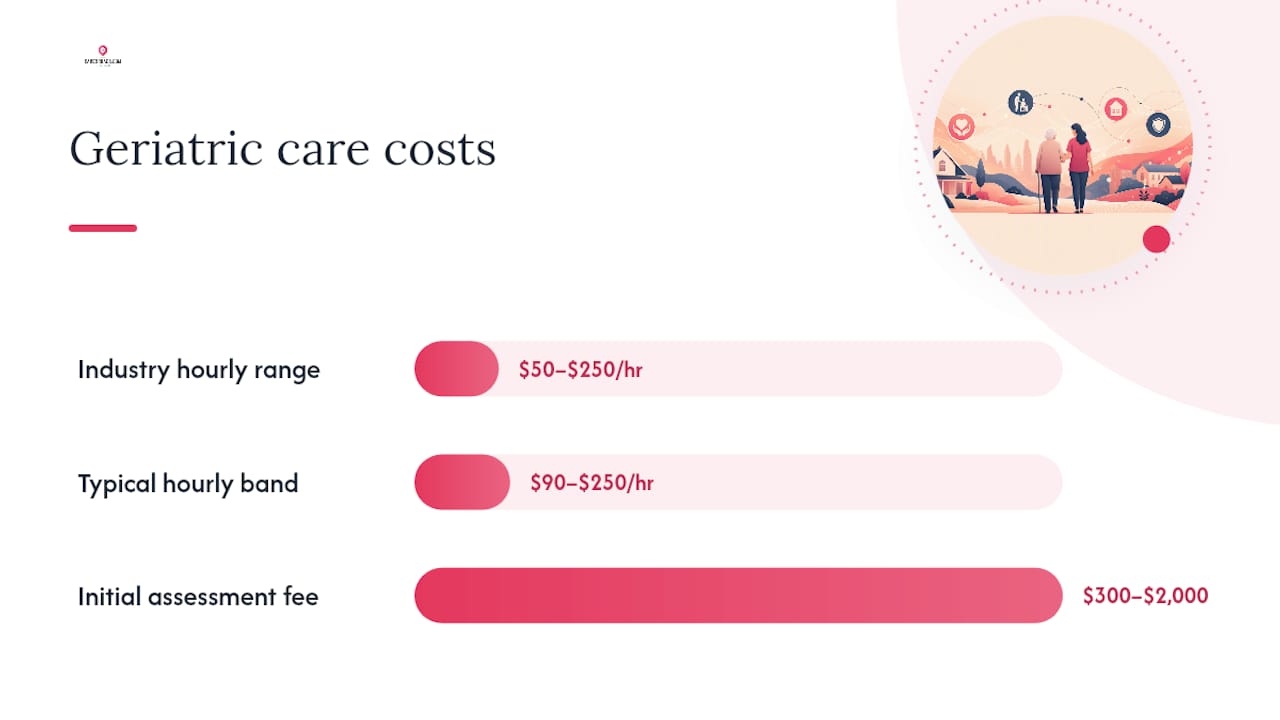
The range families encounter reflects real differences in training, location, and workload, not arbitrary pricing. Cost guides across the industry commonly place hourly rates between $50 and $250, with a more typical band sitting between $90 and $250 depending on your region and the manager's credentials.
Pro Tip: Ask for the manager's average hours-per-month for cases similar to yours before signing anything. That single number turns a vague hourly rate into a real monthly budget you can plan around.
The initial assessment is usually a separate, one-time fee. It covers a home visit, a review of medical records, interviews with family, and a written care plan. Guides report this fee ranging roughly from $300 to $2,000, with the wider end reflecting complex medical histories or multiple family stakeholders who need to be looped in.
Monthly retainer packages exist too, and they can save money for families who need steady, predictable support rather than occasional check-ins. A retainer bundles a set number of hours into one flat monthly fee, which protects you from hourly overages during a busy month.
Watch for extras that inflate the final bill:
- Mileage or travel time to appointments and facility visits
- After-hours or emergency response fees, often billed at a premium rate
- Report writing and documentation time, sometimes billed separately from consultation hours
- Coordination calls with doctors, pharmacists, or insurance companies
Translating an hourly quote into a monthly number is the single most useful exercise you can do before hiring. A triage-only arrangement might run 4 to 6 hours a month, moderate coordination often lands between 12 and 20 hours, and high-touch case management for a medically complex parent can exceed 40 hours monthly, according to cost breakdowns from SeniorsProTalk.
How Do Billing Models Work for Geriatric Care Managers?
Understanding the billing structure matters as much as the number itself, because two managers quoting similar rates can end up costing very different amounts once you see what is included.
- Hourly billing charges only for time worked, which suits families who need occasional guidance rather than constant oversight.
- Flat-fee assessments cover the initial evaluation and care plan for one predictable price, with no surprises at the end of the visit.
- Monthly retainers bundle a fixed number of hours into one recurring charge, better suited for ongoing, complex cases.
Some managers include phone calls and follow-ups in their base rate; others bill every email and check-in separately. Ask specifically whether report writing, care-plan updates, and calls to physicians count toward billable hours.
Pro Tip: Request a sample invoice from a past client (with identifying details removed) before signing a service agreement. Seeing an actual bill tells you far more than a rate sheet ever will.
Will Medicare or Insurance Cover a Geriatric Care Manager?
The short answer is usually no, at least not directly. Medicare and Medicaid generally don't pay for private geriatric care manager fees, according to AARP's caregiving guidance. This surprises a lot of families who assume Medicare's Chronic Care Management benefit covers the same ground. It doesn't. Chronic Care Management is a clinician-based coordination service delivered through a doctor's office, not the independent, private-pay case management a geriatric care manager provides.
A few paths can still offset the cost:
- Long-term care insurance sometimes covers care coordination. Call your insurer and ask specifically about "care coordination" or "case management" language in your policy, since these clauses hide easily in dense contracts.
- VA benefits, including Veteran-Directed Care and Aid and Attendance, can help cover home and community support costs for eligible veterans and spouses, per the Department of Veterans Affairs.
- Tax deductibility is possible in some cases where care management qualifies as a medical expense, but rules are specific. Talk to a tax professional before assuming a deduction applies.
What Should You Ask Before Hiring a Geriatric Care Manager?
Credentials drive cost more than almost any other factor. A registered nurse or licensed clinical social worker with gerontology certification typically charges more than a generalist, and usually for good reason: their training lets them catch medical red flags a less credentialed manager might miss.
Bring these questions to every interview:
- Can you provide a written fee schedule covering hourly rates, the assessment fee, and any retainer options?
- What's included in your base rate, and what triggers an extra charge?
- How many hours per month does a case like mine typically require?
- What happens if I need to cancel or reduce services after 30 days?
To compare two estimates fairly, convert both into a projected monthly cost using the same estimated hours. A manager quoting $120 an hour at 15 hours monthly costs less than one quoting $95 an hour at 25 hours.
- Get the hourly rate and the assessment fee from each candidate.
- Ask each for their honest hours-per-month estimate for your specific situation.
- Multiply rate by hours, add the one-time assessment, and compare totals side by side.
Watch for red flags: vague billing with no written schedule, or a manager who is also paid by a placement agency to steer families toward specific facilities. That conflict of interest can quietly cost you more than a higher hourly rate ever would.
Where Do You Find a Legitimate Geriatric Care Manager?
Start with sources built for exactly this search. The Aging Life Care Association maintains a national directory of credentialed professionals, and membership there is a meaningful trust signal worth checking. The Eldercare Locator connects you to your local Area Agency on Aging, which can offer referrals or lower-cost coordination options.
- Ask hospital discharge planners or your loved one's primary care physician for names they trust.
- Verify state licensure and any RN or LCSW credentials directly, not just through the manager's own website.
- Confirm active ALCA membership if listed, since directory status can lapse.
How Can You Reduce Geriatric Care Management Costs?
Full-time case management isn't the only option, and it's rarely the first step families should take.
- Start with a one-time assessment and revisit ongoing help only if needed.
- Check long-term care insurance and VA benefits before paying out of pocket.
- Negotiate a limited-scope, phone-only package for lighter cases.
- Use hospital or community case management as a free interim bridge while you decide.
Pro Tip: If your situation is transitional, like a recent hospital discharge, negotiate a short-term retainer for 30 to 90 days instead of committing to an open-ended hourly arrangement. Most transitions stabilize well within that window.
What Carexroads Sees Across Regional Care Costs
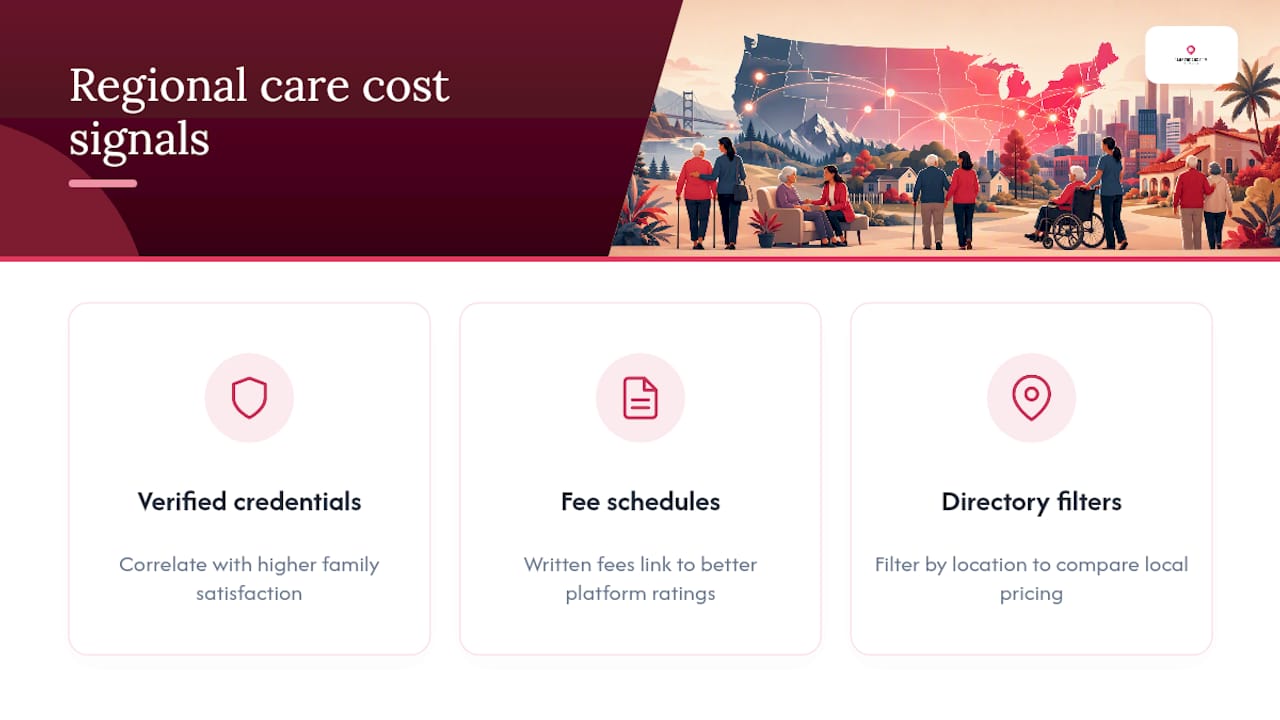
Family feedback across the country shows a pattern: written fee schedules and verified credentials correlate with higher satisfaction, sometimes reflected in high average family ratings on senior care platforms. Families can filter by location on senior care directories to see how local providers' pricing and services compare before making a call.
Is a Geriatric Care Manager Worth the Cost?
A care manager usually earns its cost fastest for complex medical needs, frequent care transitions, or long-distance caregiving. For simpler situations, a lower-cost, short-term assessment often covers what you need.
— Care
Find Vetted, Local Care Options With Carexroads
Once you know your rough budget, the next challenge is finding a real person to hire, not just a price range. Senior care navigation platforms can serve as a practical next step: instead of cold-calling names off a search engine, users can browse verified family reviews and compare local providers side by side before committing to a written fee schedule.

If a care manager recommends home-based support alongside their coordination work, Carexroads' guide on how home care helps seniors stay independent walks through what that looks like day to day. And if long-term care insurance is part of your cost equation, the guide to using LTC insurance without delays or denials can help you avoid the paperwork traps that stall reimbursement. Run a local search on Carexroads, request written fees from two or three providers, and compare their references before you sign anything.
Where to Verify These Figures Yourself
- National Institute on Aging: background on what geriatric care managers do and how fees are typically structured.
- Eldercare Locator: find your local Area Agency on Aging for referrals and possible low-cost coordination.
- Aging Life Care Association: directory of credentialed professionals nationwide.
- AARP: coverage guidance on Medicare, Medicaid, and insurance realities.
This article is general information, not a substitute for advice from a qualified doctor. Consult a qualified healthcare professional about your own circumstances before acting on anything here.
Sources
- What Is a Geriatric Care Manager? (NIA)
- Eldercare Locator (ACL)
- Geriatric care managers (AARP)
- Geriatric Care Manager Cost: Fees, Insurance, and Alternatives (LegalClarity)
FAQ
How much does a geriatric care manager charge?
Most charge between $90 and $250 per hour, with initial assessments typically running $300 to $2,000 depending on case complexity and region.
Are geriatric care managers worth the money?
They tend to pay off most clearly for complex medical situations, frequent care transitions, or long-distance caregiving, where their coordination prevents costly missteps.
Does Medicare pay for a geriatric care manager?
No. Medicare generally does not cover private geriatric care manager fees, though its separate Chronic Care Management benefit covers a narrower, clinician-based coordination service.
How much should I charge my elderly mother to live with me?
This is a personal financial decision rather than a geriatric care management fee, and it typically depends on shared household costs and any caregiving hours involved rather than professional billing rates.