

A Medicaid spend-down lets you use qualified medical expenses or a pay-in option to reduce excess income or assets until you meet your state's Medicaid limits. It typically helps people 65 and older, adults with disabilities, or anyone facing high medical bills who earns slightly too much to qualify outright. The first move: contact your state Medicaid office to ask about its "medically needy" or "excess income" program and your specific budget period.
TL;DR:
- The spend-down process varies widely by state, with budget periods lasting from one to six months and different methods for income and asset reduction.
- Qualifying expenses include premiums, copays, prescriptions, home healthcare, hospital charges, medical equipment, and even home modifications, with proper documentation needed for approval.
- Using the pay-in option works best for predictable income, while the incurred-expense method requires submitting bills matching your spend-down amount for that period.
- Family care payments must be well-documented to avoid being classified as gifts and triggering penalties, especially due to the five-year look-back period.
- Proactive organization, timely medical appointments, and professional guidance are crucial to navigating complex rules and avoiding common pitfalls during spend-down.
Table of Contents
- How Medicaid Spend-Down Works: Income vs. Asset Spend-Down
- What Expenses and Payments Count Toward Your Spend-Down
- State Rules That Commonly Differ: Budget Periods, Pay-In Options, and 209(b) Cases
- How to Apply: A Step-by-Step Checklist for Caregivers
- Common Strategies, Pitfalls, and Planning Risks
- Your 30/60/90-Day Spend-Down Checklist
- Carexroads Perspective: Real-Family Patterns and When to Call a Professional
- Finding Vetted Care and Planning Help Through Carexroads
- Sources
How Medicaid Spend-Down Works: Income vs. Asset Spend-Down
Medicaid spend-down comes in two forms, and families often confuse them. Income spend-down applies to ongoing monthly earnings above your state's limit. Asset spend-down applies to countable resources like savings above the limit, usually relevant when someone is entering long-term care or a nursing home.
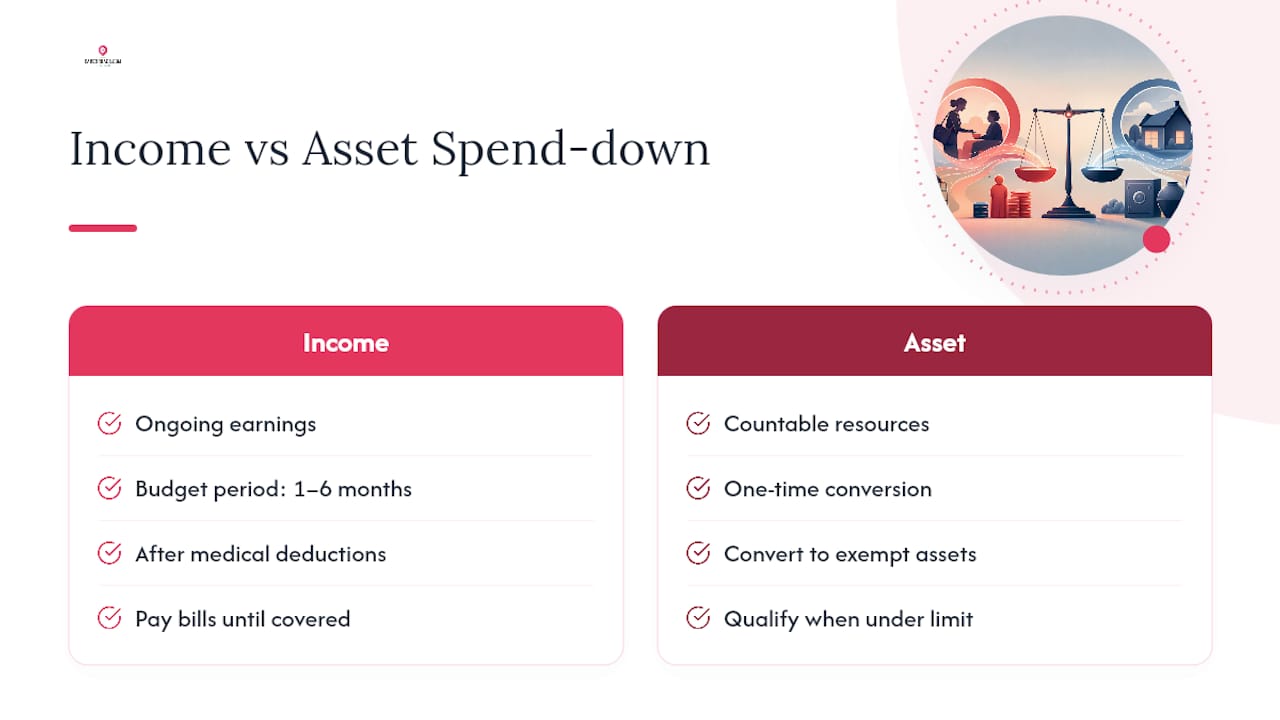
Income spend-down works on a budget period, a stretch of time your state uses to measure your countable income against allowable medical costs. Federal guidance requires states to deduct health insurance premiums, cost-sharing, and necessary medical or remedial care from countable income before deciding if you owe a spend-down amount, though states set the order and add categories beyond those required deductions. Once your medical bills or payments equal the excess amount for that period, Medicaid coverage kicks in for the rest of it.
Budget periods vary widely. The National Council on Aging notes that periods typically run one to six months depending on the state. New York, for example, uses a one-month period for outpatient care but stretches to six months for inpatient stays, according to the New York State Department of Health. Iowa uses a simpler two-month cycle, illustrated in Iowa HHS guidance with sample calculations covering medications, nursing home costs, and home modifications.
Asset spend-down works differently. Instead of matching bills to a recurring period, you convert countable cash into exempt resources one time, things like paying off a real mortgage, buying an irrevocable burial plan, or fixing a home's accessibility issues. Once your countable assets drop below the state limit, you qualify. This route matters most for long-term care Medicaid, where the asset ceiling is often just $2,000 for an individual in many states.
Not every state runs a traditional spend-down program. Federal law lets states choose the "medically needy" option, and 209(b) states (a small group that opted to keep pre-1972 eligibility rules) apply their own income and resource tests, sometimes with more generous deductions than the standard federal formula. If your state isn't listed as medically needy, ask your caseworker whether a Medicaid Buy-In program or another pathway exists instead. Skipping this check is one of the most common reasons families assume they're ineligible when they aren't.
What Expenses and Payments Count Toward Your Spend-Down
Most people picture doctor visits and prescriptions when they think about medical spend-down. The list is broader than that, and knowing its full scope often shortens how long a spend-down period takes to clear.
Standard qualifying expenses include:
- Medicare Part B, Part D, and supplemental insurance premiums
- Copays and deductibles for doctor visits, hospital stays, and specialists
- Prescription medications, even ones not fully covered by insurance
- Home health aide services and skilled nursing care
- Nursing home or assisted living charges tied to medical need
- Medical equipment like wheelchairs, hospital beds, or oxygen supplies
Less obvious but frequently accepted items include home modifications for accessibility (grab bars, ramps, stairlifts), transportation costs to medical appointments, and both paid and unpaid medical bills. According to LegalClarity's review of allowable spend-down expenses, prepaid irrevocable funeral plans and payments toward legitimate existing debts also count in many states when properly documented. Even old, unpaid hospital bills from months earlier can sometimes apply toward a current spend-down period.
Documentation makes or breaks this process. Keep every receipt, invoice, and provider statement, and note the date of service, not just the payment date, since some states track bills chronologically. The Illinois Department of Healthcare and Family Services allows unpaid bills to carry forward for a limited window and typically confirms a caseworker decision within two working days of submission. Ask your local office directly how far back your state allows carryover, since this window differs by jurisdiction and can make or break whether an old bill still counts.
State Rules That Commonly Differ: Budget Periods, Pay-In Options, and 209(b) Cases
Every state names its program differently. Some call it "excess income," others "medically needy," others "surplus income." Before you do anything else, search your state's Medicaid or Department of Human Services site for these exact terms, or call the office directly, because the eligibility math and required forms change based on which program your state runs.
Two payment methods typically exist once you know your spend-down amount: incurred expenses and pay-in. The incurred-expense method has you submit medical bills, paid or unpaid, equal to your excess amount for that period. The pay-in method lets you write a check or make an electronic payment directly to the state for that same amount, effectively purchasing coverage for the month without waiting on medical bills to accumulate. CMS guidance notes that pay-in tends to work better for people with steady, predictable excess income, since it avoids the paperwork chase of collecting small receipts month after month.
209(b) states deserve a separate mention. These states chose to retain more restrictive 1972-era eligibility criteria instead of adopting the federal Supplemental Security Income standard, but as a tradeoff they must let residents spend down to qualify even when the federal standard wouldn't require it. If you live in a 209(b) state, your caseworker may apply different income disregards or resource exclusions than a neighboring state would, so a generic online spend-down calculator can produce a misleading number. This is exactly the kind of detail where a state-specific phone call beats a search engine.
How to Apply: A Step-by-Step Checklist for Caregivers
Turning spend-down rules into an actual application is where most families stall. The rules make sense on paper; the paperwork is where the confusion starts.
- Verify your state's income and asset limits by calling the local Medicaid office or checking its medically needy program page.
- Calculate your excess amount for the relevant budget period, using your gross income minus allowable deductions.
- Gather bills and receipts covering medical costs, premiums, and any other allowable expenses for that period.
- Submit your application and supporting claims to the local office, either in person, by mail, or through the state's online portal.
- Confirm your coverage period with your caseworker once your spend-down amount is met, and ask whether retroactive coverage applies to bills from before your approval date.
The checklist of medical documents matters as much as the steps. Collect recent pay stubs, Social Security award letters, bank statements for the past several months, paid and unpaid medical bills, insurance premium receipts, and, if you're using debt payments toward an asset spend-down, mortgage or loan statements showing the payoff. Signed contracts, canceled checks, and provider statements reduce the number of follow-up requests a caseworker sends back, based on documentation standards described in Illinois's HFS 591SP brochure.
Pro Tip: Timing your medical appointments and prescription refills early in the budget period, rather than late, can speed up when your coverage actually starts, since some states count bills in the order they occur rather than the order you submit them.
Ask specifically about retroactive coverage. Many states will cover medical bills from up to three months before your application date if you were eligible during that window, but this benefit is easy to miss if you don't ask directly.
Common Strategies, Pitfalls, and Planning Risks
The five-year look-back period is the single biggest trap for families doing asset spend-down for long-term care. Medicaid reviews financial transfers made in the 60 months before application, and gifting money to family members, or paying a relative for "care" without a real paper trail, can trigger a penalty period during which Medicaid won't pay for nursing home costs. A detailed guide to the Medicaid look-back period walks through how transfer penalties are calculated.
Personal-care agreements sit in a gray zone that trips up a lot of families. Paying a family member to provide care can be a legitimate spend-down strategy, but only if the arrangement is documented like any other employment relationship: a signed contract, a reasonable hourly rate matched to local market pay, and detailed time sheets showing hours worked. Without those records, a caseworker may treat the payments as disguised gifts. A guide on Medicaid paying family caregivers breaks down what documentation holds up.
Safer conversion options include paying down a real mortgage or auto loan, funding an irrevocable prepaid funeral arrangement, or making documented home accessibility repairs like a wheelchair ramp or bathroom grab bars. Keep every invoice and contractor receipt, since these purchases get scrutinized during the look-back review.

Your 30/60/90-Day Spend-Down Checklist
Breaking the process into time blocks keeps a complicated system from feeling impossible to start.
Within 30 days:
- Call your local Medicaid office and ask for your household's exact spend-down amount.
- Request the medically needy or excess income program name your state uses.
- Pull together the last two to three months of income statements and medical bills.
Within 60 days:
- Organize every bill and receipt in chronological order by date of service.
- Decide whether the pay-in option or incurred-expense method fits your situation better.
- Schedule a meeting or call with your assigned caseworker to review your documents.
Within 90 days and beyond:
- Consult an elder law attorney or certified Medicaid planner if asset spend-down or long-term care eligibility is involved.
- Keep every financial record for at least five years to cover the look-back review window.
Carexroads Perspective: Real-Family Patterns and When to Call a Professional
Across the families Carexroads works with, the same three problems surface again and again: missing receipts, bills submitted for the wrong month, and confusion over whether pay-in is even offered locally. None of these are legal complexities. They're organizational ones, and they're preventable with an early system for tracking paperwork.
Asset conversions and personal-care agreements are a different story. That's where the look-back period and improper documentation create real financial risk, and where a qualified elder law attorney earns their fee. Experts consistently recommend professional guidance for exactly this reason: online calculators estimate, but they don't replace someone who knows your state's specific rules.
— Care
Finding Vetted Care and Planning Help Through Carexroads
You can sort through senior care options without guessing which providers are actually reliable, using real family reviews instead of paid listings alone. If your spend-down plan involves finding home health support, an assisted living community, or help managing a hospital discharge, the platform's directory lets you compare verified providers by location and service type.
Families researching whether home care can help a loved one stay independent often find that spend-down eligibility and care planning need to happen at the same time, not one after the other. The platform connects you to that information and to providers, but it doesn't offer legal advice. For anything involving asset transfers, look-back exposure, or complex eligibility questions, pair Carexroads' resources with a licensed elder law attorney or Medicaid planner. If you're ready to start comparing home care options for a parent or spouse, visit the home care resource page to see providers near you and request more information today.
This article is general information, not a substitute for advice from a qualified financial advisor. Consult a qualified financial professional about your own circumstances before acting on anything here.
Sources
- What Is a Medicaid Spend Down? | NCOA
- MACPro: Handling of excess income (spenddown) — CMS/Medicaid
- Medicaid Excess Income (Spenddown) program — NY State Department of Health