

A safe discharge checklist is a standardized tool that confirms every medical, medication, equipment, and follow-up need is arranged before a patient leaves the hospital, reducing preventable readmissions and giving families a clear path forward at home. The Medicare discharge planning checklist describes it as a shared resource for patients, caregivers, and hospital staff to prepare together, covering reconciled medication lists, daily care instructions, follow-up schedules, and post-discharge contact information. Clinical research by Soong et al. identified seven core domains that any credible checklist must address, and the AHRQ IDEAL discharge framework gives patients and families a practical, step-by-step process for using it.
A well-used discharge checklist delivers concrete benefits for everyone involved:
- Patients leave with a written medication list, clear instructions, and named contacts, reducing confusion at home.
- Caregivers know which tasks they are responsible for, what equipment to expect, and exactly when to call for help.
- Clinicians have documented confirmation that every safety item was addressed and that the patient demonstrated understanding before leaving.
- All parties share a common record that travels to follow-up appointments and post-acute care providers.
Table of Contents
- What should be in a discharge checklist?
- How do patients and caregivers use the checklist?
- Ready-to-use discharge checklist template
- Who is responsible for each discharge task?
- What criteria determine whether a discharge is safe?
- What warning signs should every checklist include?
- Why do discharge checklists sometimes fail, and how can you prevent it?
- How do hospitals implement safe discharge checklists effectively?
- Practical adaptations for older adults and patients with complex needs
- Key Takeaways
- Why the discharge checklist deserves more respect than it gets
- Carexroads helps families plan the transition home
- Useful sources and downloadable templates
What should be in a discharge checklist?
Clinical research developed through a multidisciplinary collaboration of hospitalists, primary care physicians, home care nurses, and pharmacists identifies seven domains that every safe discharge checklist must cover. Each one addresses a specific failure point that commonly leads to post-discharge complications or readmission.
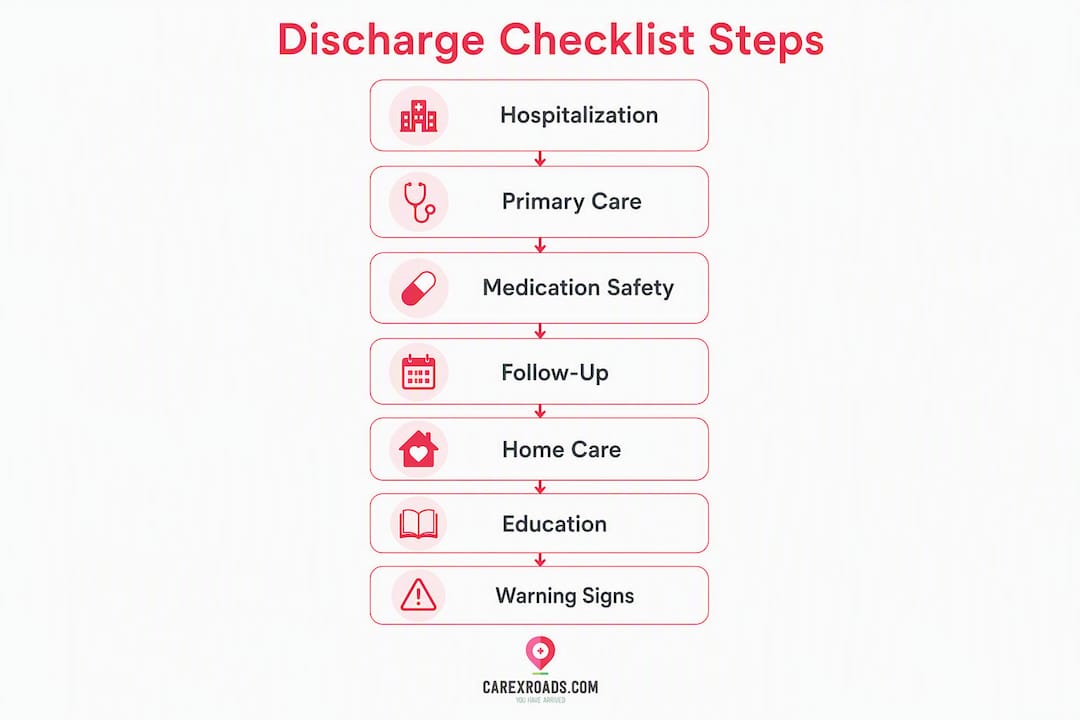
1. Indication for hospitalization
Document the primary diagnosis and a plain-language summary of what happened and why the patient was admitted. Patients who understand their own condition are better equipped to recognize when something is wrong at home.
2. Primary care communication
The attending team must send a discharge summary to the patient's primary care clinician (PCP) before or on the day of discharge, including diagnosis, procedures, medication changes, and pending test results. A checklist item here confirms that communication happened, not just that it was planned.
3. Medication safety and reconciliation
This is the highest-stakes domain. Every medication the patient will take at home must be listed with the dose, frequency, and purpose, and any changes from pre-admission medications must be clearly flagged. A pharmacist or nurse reviews the full list with the patient before discharge.

Pro Tip: Ask the pharmacist to walk through each new or changed medication one at a time and explain what it replaces. Then repeat it back. This teach-back step catches misunderstandings before they become emergencies.
4. Follow-up plans
The checklist should include the date, time, location, and phone number for every scheduled follow-up appointment, including specialist visits and lab work. Leaving the hospital without a confirmed appointment is one of the most common and preventable gaps.
5. Home-care referral and coordination
If the patient needs home health services, physical therapy, wound care, or durable medical equipment (DME), those referrals must be placed and confirmed before discharge, not after. Equipment delivery timelines should be documented on the checklist.
6. Patient and caregiver education
The IDEAL framework from AHRQ asks clinicians to describe what daily life at home will look like, review medications, explain test results, and walk through warning signs. Patients and caregivers should be able to explain care tasks back to the team before leaving.
7. Red-flag symptoms
Every checklist must include a plain-language list of symptoms that require immediate action, paired with the correct phone number or instruction (call the nurse line, go to the emergency department). This section is covered in detail later in this article.
How do patients and caregivers use the checklist?
The discharge checklist is not a form you fill out on the last day. Medicare guidance recommends starting it at admission and updating it throughout the stay, so gaps can be addressed while the care team is still available.
Stage 1: At admission
Ask the nurse or discharge planner for the hospital's discharge checklist on day one. If none is offered, use the Medicare or AHRQ IDEAL version. Identify a named caregiver who will be part of planning conversations and write their contact information on the checklist immediately.
Stage 2: During the hospital stay
Update the checklist as decisions are made. When a new medication is added, note it. When a follow-up appointment is scheduled, record the date and number. Use the hospital room whiteboard to track open items so the whole care team can see what is still pending.
Stage 3: The day of discharge
Before signing any discharge paperwork, work through the checklist item by item with the nurse or discharge planner. The numbered questions below are the ones every patient or caregiver should ask:
- Can you give me a complete, written list of all my medications with doses and instructions?
- Which medications are new or changed from what I was taking before?
- When is my first follow-up appointment, and who do I call if I need to reschedule?
- Has my primary care doctor received my discharge summary?
- What equipment or supplies will be delivered to my home, and when?
- What are the warning signs I should watch for, and who do I call first?
- Is there a 24-hour number I can call if I have questions after I leave?
Pro Tip: Use the teach-back method before you leave. Tell the nurse: "I want to make sure I understood everything correctly. Can I explain it back to you?" This one step catches more misunderstandings than any written instruction sheet.
Stage 4: After discharge
Bring the completed checklist to every follow-up appointment. If a 48–72 hour follow-up call from the hospital team is offered, accept it. For families managing a senior's care, the post-discharge follow-up protocol guide from Carexroads walks through how to track appointments and check-ins systematically.
Ready-to-use discharge checklist template
Print or save this template and bring it to the hospital. Check and date each item as it is completed.
| Checklist Item | Completed | Date | Notes / Contact |
|---|---|---|---|
| Primary diagnosis explained in plain language | ☐ | ||
| Medication list reviewed and reconciled | ☐ | Pharmacist name: | |
| New or changed medications flagged | ☐ | ||
| Equipment / DME ordered and delivery confirmed | ☐ | Delivery date: | |
| Daily care instructions received (wound, diet, activity) | ☐ | ||
| Follow-up appointment scheduled | ☐ | Date / location: | |
| PCP notified with discharge summary | ☐ | ||
| Red-flag symptoms listed with action steps | ☐ | ||
| 24-hour contact number written down | ☐ | Number: | |
| Transport home arranged | ☐ | ||
| Pharmacy visit planned (new prescriptions) | ☐ | ||
| Teach-back completed with nurse or clinician | ☐ | Staff initials: | |
| Caregiver trained on required care tasks | ☐ |
Clinician sign-off: ____________________ Date: _________
Patient / caregiver teach-back confirmed: ☐ Yes
A few accessibility notes worth keeping in mind:
- Print in at least 14-point font for older adults or anyone with vision changes.
- Use plain language throughout; avoid medical abbreviations.
- Bring this checklist to every follow-up visit so providers can see what was documented at discharge.
- If English is not the primary language at home, ask the hospital for a translated version or a medical interpreter.
Who is responsible for each discharge task?
Confusion about responsibility is one of the most common reasons discharge plans fall apart. The table below maps each core task to the responsible party and the verification step.
| Task | Responsible Party | Verification |
|---|---|---|
| Medication reconciliation | Pharmacist and primary nurse | Patient teach-back |
| Discharge summary to PCP | Attending physician or team | Documented in chart |
| Equipment / DME referral | Discharge planner or social worker | Delivery confirmation |
| Follow-up appointment scheduling | Discharge planner or unit clerk | Written date given to patient |
| Patient and caregiver education | Primary nurse and therapy team | Teach-back completed |
| Home health referral | Social worker or discharge planner | Agency contact confirmed |
| Red-flag instruction | Primary nurse | Patient can name symptoms and actions |
| Transport coordination | Patient, caregiver, or social worker | Confirmed before discharge |
Beyond the table, every patient has the right to ask for a named contact person for post-discharge questions. That name and direct phone number belong on the checklist before the patient leaves. For families who want more detail on discharge documentation best practices, Carexroads has a dedicated guide covering how to record conversations and verify that each item was completed.
Key responsibilities for each role, briefly stated:
- Discharge planner or social worker: — Arranges home health, DME, community services, and follow-up appointments.
What criteria determine whether a discharge is safe?
Safe discharge is both a clinical and a practical determination. Clinical stability alone is not enough if the patient has no reliable caregiver, no working equipment at home, or no way to fill prescriptions.
Federal regulation under 42 CFR 482.43 requires hospitals to have an effective discharge planning process that centers on the patient's goals and treatment preferences, identifies patients at risk of adverse outcomes early, and ensures that necessary medical information is transmitted to post-acute care providers at the time of discharge.
Common clinical criteria that clinicians assess before approving discharge:
- Vital signs stable and within acceptable range for the patient's condition
- Pain managed adequately on oral medications
- Wound or surgical site stable, with no signs of active infection
- Mobility and ADL function sufficient for the planned home environment
- No pending test results that could change the care plan
Practical readiness checks that are equally important:
- Home is physically accessible (stairs, bathroom, doorways) for the patient's current mobility level
- Reliable transport to follow-up appointments is confirmed
- Durable medical equipment is ordered and a delivery date is set
- A capable caregiver is available and trained, or home health services are arranged
- Prescriptions can be filled before or immediately after discharge
When any of these practical conditions cannot be met, discharge may be deferred. A patient who is clinically ready but whose home oxygen concentrator has not yet been delivered, for example, should not be sent home until delivery is confirmed. Assessing functional status early in the stay gives the team time to arrange support before the clinical picture clears.
What warning signs should every checklist include?
Red-flag instructions are not optional. Every patient discharge checklist must include a plain-language list of symptoms that require immediate action, written in short, direct sentences with the correct contact number beside each one.
Common red-flag symptoms to include:
- Sudden shortness of breath or difficulty breathing: Call 911
- Chest pain or pressure: Call 911
- Fever above 101.5°F: Call your doctor or nurse line
- Uncontrolled bleeding or wound opening: Call 911 or go to the ED
- Sudden confusion, inability to wake, or slurred speech: Call 911
- Severe or worsening pain not relieved by prescribed medication: Call your doctor
- Signs of infection at a wound site (redness, warmth, discharge): Call your doctor
- Inability to keep fluids down for more than 24 hours: Call your doctor or nurse line
A sample red-flag entry on the checklist might read:
If I develop a fever above 101.5°F: Call Dr. [Name] at [phone number] during office hours, or call the after-hours nurse line at [number]. If I cannot reach anyone within 30 minutes, go to the nearest emergency department.
The distinction between "call the nurse line" and "call 911" matters. Patients and caregivers should understand that certain symptoms, particularly chest pain, stroke symptoms, and severe breathing difficulty, require emergency services immediately, not a phone call first.
Why do discharge checklists sometimes fail, and how can you prevent it?
A checklist sitting in a folder that no one reviews is not a safety tool. The most common breakdown points are predictable, and most can be prevented with early action.
Barrier: Planning starts too late. When discharge planning begins on the day of discharge, there is no time to arrange equipment, train caregivers, or schedule follow-up. The fix is straightforward: start the checklist on the day of admission. Medicare guidance is explicit that updating the checklist "early and often" throughout the stay prevents last-minute gaps.
Barrier: Incomplete medication lists. CMS has identified missing or incomplete medication information as one of the most common and harmful omissions in discharge documentation. Request a pharmacist-led reconciliation, not just a printed list from the electronic record.
Barrier: Poor communication with post-acute providers. When the receiving home health agency or rehabilitation facility does not receive a complete transfer summary, care continuity breaks down. The CMS QSO-23-16 memorandum recommends using standardized transfer forms and collaborating with post-acute providers on their content.
Barrier: Caregiver unreadiness. A caregiver who has not practiced wound care, medication administration, or mobility assistance before discharge is a safety risk. Require a teach-back session for every complex care task, and document it with a signed checkbox.
Barrier: Home-environment gaps. Practical home checks are often skipped. Staff should confirm that the home has reliable electricity for any powered equipment, safe pathways for mobility aids, and access to clean water. These details can change a discharge decision.
Pro Tip: For high-risk patients, a follow-up phone call within 48–72 hours of discharge catches problems before they become readmissions. Ask the discharge planner whether the hospital offers this service, and if not, arrange a check-in call with the patient's PCP.
How do hospitals implement safe discharge checklists effectively?
For clinical teams and administrators, a checklist is only as effective as the workflow built around it. Adopting a standardized tool is step one; embedding it into daily practice is what produces measurable results.
A practical implementation path follows a clear sequence: adopt a validated checklist (IDEAL, Medicare, or a locally adapted version), train all relevant staff on their role in completing it, embed the checklist into the electronic health record (EHR) workflow so it is visible at every daily round, assign clear ownership for each item, and audit completion rates regularly.
The AHRQ IDEAL framework recommends at least one scheduled discharge planning meeting that includes the patient, a named caregiver, and key members of the care team. For high-risk patients, scheduling this meeting within 24–48 hours of admission reduces last-minute gaps significantly.
Operational tips for clinical teams:
- Conduct daily discharge readiness reviews during multidisciplinary rounds.
- Identify high-risk patients (complex medication regimens, limited caregiver support, prior readmissions) within 24 hours of admission.
- Use standardized transfer forms when communicating with home health agencies or post-acute care facilities.
- Track three core process measures: percentage of discharges with completed medication reconciliation, percentage with documented teach-back, and rate of timely follow-up appointment completion.
- Audit a sample of discharges monthly and share results with the unit team.
The NHS England Model Discharge Pathway offers an internationally recognized model that aligns closely with AHRQ and CMS practices, emphasizing early senior clinical decision-making, medicines reconciliation within 24 hours of admission, and daily multidisciplinary review. While designed for the UK system, its core principles translate directly to U.S. hospital workflows. For a deeper look at how early planning connects to readmission outcomes, the Carexroads guide on timely discharge planning covers the evidence and operational steps in detail.
Practical adaptations for older adults and patients with complex needs
Older adults, patients with dementia, and those managing multiple chronic conditions often need a discharge checklist that goes beyond the standard template. The standard domains still apply, but the execution requires more time, more repetition, and more coordination.
Practical adjustments that make a real difference:
- Longer teach-back sessions: Older adults may need information repeated across two or three sessions rather than one. Schedule a teach-back session the day before discharge, not the morning of.
- Named caregiver backup: Identify a primary caregiver and at least one backup. Document both names and phone numbers on the checklist. If neither is available, home health services must be arranged before discharge.
- Medication packaging aids: Pill organizers, blister packs, or medication management apps reduce errors for patients managing five or more medications. Ask the pharmacist to set this up before discharge.
- Home safety assessment: For patients with mobility changes or cognitive decline, a home safety walkthrough by an occupational therapist before discharge can identify fall hazards, inaccessible bathrooms, or equipment placement issues.
- Early equipment staging: Order mobility aids, hospital beds, or oxygen equipment at least 48 hours before the anticipated discharge date to allow for delivery and setup.
Common senior-focused checklist entries worth adding:
- Mobility aid confirmed and patient trained on use (walker, cane, wheelchair)
- Cognitive support plan documented (medication reminders, daily check-in contact)
- Meal delivery or grocery support arranged if cooking is not safe
- Transportation to follow-up confirmed (not assumed)
When a patient's care needs exceed what can safely be managed at home, even with support, the discharge team should discuss short-term rehabilitation as an alternative. The Carexroads guide on subacute rehabilitation explains when that option fits and what families should ask. For caregivers managing the emotional weight of a complex discharge, documenting a brief respite plan, including who to call and what services are available locally, belongs on the checklist alongside the clinical items.
Key Takeaways
A safe discharge checklist works only when it is started at admission, completed with teach-back verification, and carried through every follow-up appointment.
| Point | Details |
|---|---|
| Start at admission | Begin the discharge checklist on day one; gaps identified early can be resolved before discharge day. |
| Medication reconciliation is non-negotiable | A pharmacist-reviewed, patient-verified medication list is the single most critical safety item on any discharge checklist. |
| Teach-back confirms understanding | Patients and caregivers must demonstrate understanding of medications, care tasks, and red-flag symptoms before leaving. |
| Red flags need numbers, not just symptoms | Every warning sign on the checklist must be paired with a specific phone number or instruction (call 911, call nurse line). |
| Carexroads supports the transition home | Carexroads offers a searchable directory of verified home care and post-acute providers to help families arrange support after discharge. |
Why the discharge checklist deserves more respect than it gets
Most families arrive at discharge day focused on getting home. The checklist feels like paperwork standing between them and the door. That framing is understandable, and it is also the reason so many preventable readmissions happen within the first week.
What the research actually shows is that the checklist is not administrative overhead. It is the moment when a care plan that existed only in a chart becomes something a real person can act on at home. The AHRQ IDEAL framework, the Medicare discharge planning checklist, and the Soong 2013 peer-reviewed domains all point to the same conclusion: the domains that get skipped under time pressure, specifically caregiver education, home-environment checks, and red-flag instruction, are the ones most likely to produce a 3 AM emergency room visit.
For families navigating a senior's discharge, the stakes are higher still. An older adult with multiple medications, limited mobility, and a caregiver who has never managed wound care is not ready to go home just because the clinical criteria are met. Readiness is clinical and practical, and the checklist is the only tool that forces both conversations to happen before the patient walks out the door.
The families who use it consistently, who ask the teach-back questions and bring the completed form to follow-up visits, tend to feel more confident and less reactive in the weeks after discharge. That is not a small thing.
Carexroads helps families plan the transition home
Leaving the hospital with a completed discharge checklist is a strong start. Finding the right home care provider, home health agency, or post-acute support to make that plan work is the next step, and that search can feel like a full-time job on top of an already stressful situation.

Carexroads makes that search faster and more reliable. The platform offers a searchable directory of verified home care and home health providers, with real family reviews that reflect actual care experiences rather than marketing copy. Families can search by location, filter by service type (home health, personal care, memory care, hospice), and compare providers based on verified feedback. The site holds a 4.8 average family satisfaction rating because it prioritizes transparency over volume.
If you are coordinating a discharge right now, start with your hospital's discharge planner to confirm clinical arrangements, then use Carexroads to find and compare local home care or post-acute providers who can support the transition. The directory is free to search, and the reviews come from families who have been in exactly the position you are in now.
Useful sources and downloadable templates
These are the primary authoritative resources referenced throughout this article. Clinicians can use them as implementation references; patients and caregivers can print the templates and bring them to discharge planning conversations.
- Your Discharge Planning Checklist (Medicare / CMS): A printable, patient-facing checklist covering medications, equipment, follow-up, and contacts. The most accessible starting point for patients and caregivers.
- IDEAL Discharge Planning Checklist (AHRQ): The AHRQ patient-and-family engagement checklist built around the Include, Discuss, Educate, Assess, Listen framework. Best used by clinical teams to structure discharge planning meetings.
- Development of a Checklist of Safe Discharge Practices (Soong et al., PubMed): The peer-reviewed study that identified the seven core domains of a safe discharge checklist through multidisciplinary collaboration. Useful for clinicians designing or auditing their own tools.
- CMS QSO-23-16 Memorandum (Hospitals): CMS regulatory guidance identifying common discharge documentation failures and recommending the AHRQ Re-Engineered Discharge (RED) Toolkit and standardized transfer forms.
- 42 CFR 482.43 — Condition of Participation: Discharge Planning: The federal regulation governing hospital discharge planning requirements, including early identification of at-risk patients and transmission of medical information to post-acute providers.
- Model Discharge Pathway (NHS England): An internationally recognized model emphasizing clinically led, criteria-driven discharge with daily multidisciplinary review. Useful as a comparative framework for U.S. clinical teams.
- Leaving the Hospital: Your Discharge Plan (MedlinePlus): A plain-language patient guide from the National Library of Medicine covering what to expect and what to ask before leaving the hospital.
This article provides general information about discharge planning and is not a substitute for professional medical or legal advice. Confirm current guidelines and your specific care needs with your hospital team or a qualified healthcare professional.