

What does functional status mean in a hospital discharge?
Functional status at discharge describes a patient's ability to perform the daily activities necessary for independent living, from bathing and dressing to managing medications and preparing meals. It goes well beyond a diagnosis or a lab result. Functional status encompasses physical, cognitive, emotional, social, and environmental factors, reflecting the whole person rather than just the condition being treated.
For families navigating a loved one's hospital discharge, this concept carries real weight. The care team uses functional status to decide whether a patient goes home safely, moves to a rehabilitation facility, or needs skilled nursing support. A patient who recovers medically but cannot yet dress independently or walk safely to the bathroom may not be ready for home, regardless of what their bloodwork shows.
Key aspects of functional status relevant to discharge include:
- Activities of daily living (ADLs): Bathing, dressing, eating, toileting, transferring, and continence
- Instrumental activities of daily living (IADLs): Cooking, managing finances, taking medications, using transportation, and housekeeping
- Cognitive function: Orientation, memory, and the ability to follow instructions
- Emotional and psychological readiness: Motivation, mood, and coping capacity
- Social and environmental context: Caregiver availability, home layout, and community support
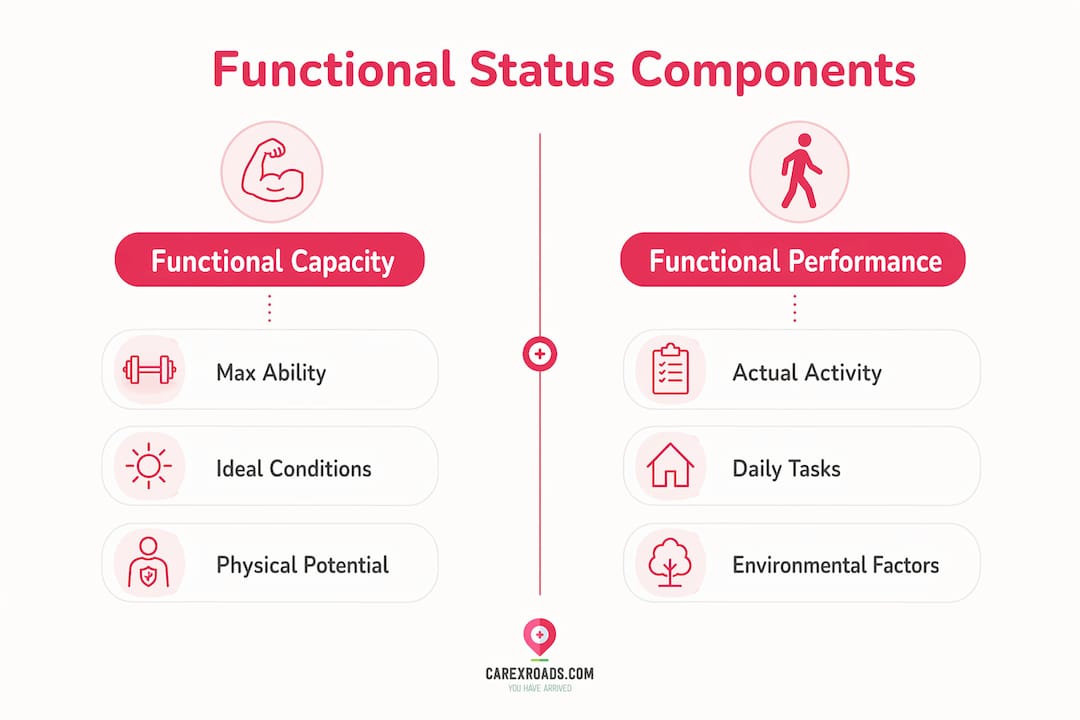
- Functional capacity vs. performance: What a patient can do under ideal conditions versus what they actually do day to day
Understanding what does functional status mean in discharge is the first step toward making a safe, informed care decision for your family.
The components that make up functional status at discharge
Clinicians assess functional status along two distinct dimensions: functional capacity and functional performance. Functional capacity refers to a patient's maximum potential ability, what they could do under optimal conditions. Functional performance reflects what they actually do in their daily life. Both matter at discharge, but they often tell different stories.
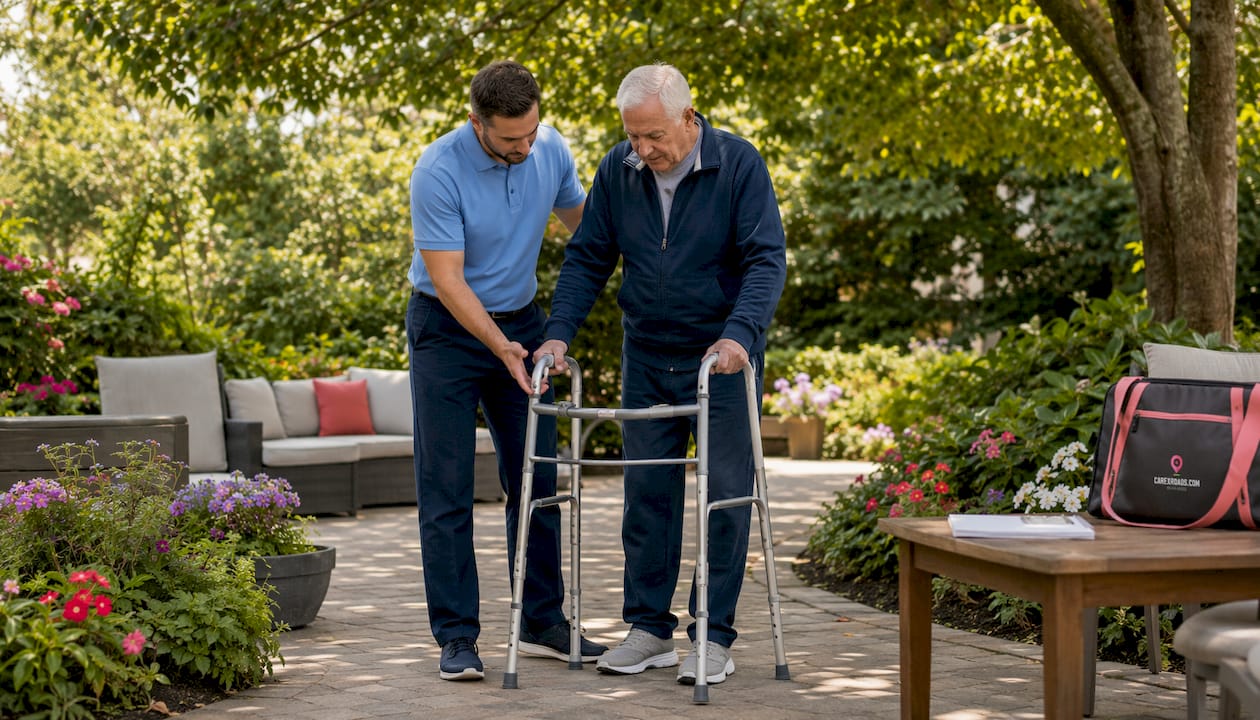
A patient recovering from hip surgery might have the physical capacity to walk with a walker, yet lack the confidence or home environment to do so safely. That gap between capacity and performance is exactly what discharge teams try to close before a patient leaves the hospital.
| Term | Definition | Discharge relevance |
|---|---|---|
| Functional capacity | Maximum ability under ideal conditions | Determines rehabilitation potential |
| Functional performance | Actual daily activity level | Reflects real-world independence |
| ADLs | Basic self-care tasks (bathing, dressing, eating) | Core safety threshold for discharge |
| IADLs | Complex daily tasks (cooking, finances, medications) | Determines level of home support needed |
| Cognitive function | Memory, orientation, decision-making | Affects ability to follow discharge instructions |
| Social participation | Engagement in life roles and community | Influences long-term recovery and well-being |
Physical function gets the most attention at discharge, but cognitive and social dimensions are equally telling. A patient who cannot reliably remember to take medications, or who lives alone with no caregiver support, faces a very different risk profile than someone with the same ADL score who has family nearby. Functional limitations are shaped not just by health conditions but also by social and environmental factors, which is why a thorough discharge assessment looks at the full picture.
Why functional status at discharge predicts so much more than recovery
Functional status is sometimes called the "sixth vital sign" in geriatric medicine, and the clinical evidence behind that label is compelling. The American Geriatrics Society recognizes it as a predictor of survival, hospital readmission, and quality of life, often outperforming traditional metrics like blood pressure or age alone.
The numbers are striking. About 30% of patients over 70 hospitalized for a medical illness are discharged with new or worsened difficulties in ADLs. That functional decline strongly predicts hospital readmission, nursing home placement, and mortality. For families, that statistic reframes discharge as a critical transition point, not just a paperwork milestone.
Clinical research finding: A systematic review published in PMC found that lower functional status during acute hospital care was associated with increased readmission risk, lower likelihood of discharge to home, increased mortality, and poorer functional status after acute care, across multiple study populations and functional measures.
Gait speed adds another layer of precision. A gait speed below 0.6 m/s at discharge is a strong predictor of future functional decline, falls, and mortality in older adults. Many families never hear this number mentioned, yet it can signal that a patient needs more intensive post-discharge support than the care team initially planned.
Functional decline detected at discharge also has downstream consequences for families. When a loved one leaves the hospital less capable than when they arrived, the burden of care shifts significantly to family members who may not be prepared for it. Recognizing this early, before discharge, gives families time to arrange the right level of support.
How clinicians measure and describe functional abilities in discharge planning
Standardized assessment tools translate clinical observations into consistent, comparable scores that follow a patient across care settings. Three tools dominate current practice.
- Barthel Index (BI): Measures independence across ten ADL categories, including feeding, bathing, grooming, and mobility. Scores range from 0 (fully dependent) to 100 (fully independent). Widely used in rehabilitation and acute care settings.
- Functional Independence Measure (FIM): Covers 18 items across motor and cognitive domains. Requires trained raters and takes longer to administer, but provides detailed insight into both physical and cognitive function.
- AM-PAC 6-Clicks: A newer adaptive tool that uses algorithms to adjust questions based on patient responses. AM-PAC 6-Clicks provides faster, validated measures and is increasingly adopted by major health systems for its efficiency.
Each tool has trade-offs. The Barthel Index and FIM are well-validated but require training and time, which can limit their use in busy acute care settings. The AM-PAC 6-Clicks addresses that gap by reducing administrative burden without sacrificing clinical accuracy.
Assessment results feed directly into discharge summaries. Functional status descriptions in these summaries help families and receiving providers coordinate appropriate rehabilitation, home health, or inpatient care. They may appear as numeric scores, standardized codes, or narrative descriptions of specific abilities and limitations.
Challenges remain in this process. Assessment consistency varies across clinicians and settings. Patients who are fatigued, in pain, or anxious during evaluation may perform below their true capacity. And the timing of assessment matters: a score taken on the day of discharge may not reflect a patient's baseline or their likely trajectory one week later. Families should ask the care team not just for the score, but for what it means in practical terms.
Pro Tip: Ask the discharge nurse or physical therapist to walk you through the assessment results in plain language. Request a written summary of your loved one's functional abilities and any specific limitations noted, so you can share it with home health providers or the receiving facility.
How to interpret functional status at discharge and support your loved one's recovery
When a discharge summary references functional status, it typically uses one of several common frameworks. Patients may be described as independent, requiring supervision, needing minimal assistance, needing moderate assistance, or fully dependent for specific tasks. These categories are not permanent labels. They reflect a snapshot in time, often at the lowest point of a hospital stay.

Functional decline relative to a patient's pre-admission baseline drives most discharge destination decisions. A patient who managed independently at home before hospitalization but now needs help with bathing and transfers will likely be directed toward subacute rehabilitation or a skilled nursing facility rather than home. The goal is to match the level of support to the level of need, not to keep patients in facilities longer than necessary.
Discharge planning that incorporates functional status assessment reduces readmissions and improves patient outcomes. Effective communication between the hospital team, the patient, and the family is central to that process. When families understand what the functional status report actually says, they can make faster, more confident decisions about next steps.
For families weighing options after a functional decline, a few practical steps make a real difference:
- Compare the discharge status to the pre-admission baseline. Ask the team: "How does this compare to how they were functioning before they came in?"
- Clarify what "assistance" means in practice. Minimal assistance for dressing looks very different from moderate assistance for transfers. Get specifics.
- Assess the home environment honestly. Stairs, bathroom layout, and the availability of a caregiver all affect whether home is a safe option.
- Ask about trajectory. Is the patient expected to regain function with therapy, or is this likely a new baseline?
- Understand what services are authorized. Home health, outpatient therapy, and skilled nursing all require specific clinical justification tied to functional status.
If your loved one is being discharged with significant functional limitations, exploring assisted living options may be appropriate, particularly when the level of daily support needed exceeds what family members can realistically provide. Patients themselves often prioritize maintaining functional independence above other health goals, making this conversation one worth having openly and early.
Key Takeaways
Functional status at discharge is the single most reliable indicator of where a patient can safely recover and what level of support they will need.
| Point | Details |
|---|---|
| Functional status definition | Measures a patient's ability to perform ADLs and IADLs, incorporating physical, cognitive, and social factors. |
| Sixth vital sign | Recognized as a predictor of survival, readmission, and quality of life, often more telling than age or diagnosis alone. |
| Decline rate | About 30% of patients over 70 are discharged with new or worsened difficulties in activities of daily living (ADLs), raising readmission and nursing home risk. |
| Assessment tools | Barthel Index, FIM, and AM-PAC 6-Clicks translate clinical observations into scores that guide discharge destination decisions. |
| Family role | Families who understand functional status reports can advocate for appropriate post-discharge care and reduce recovery setbacks. |

Navigating a loved one's discharge is one of the most stressful moments a family faces. Carexroads offers trusted reviews, verified provider listings, and practical guides to help you find the right care setting based on your loved one's functional needs. Whether you are considering home care, rehabilitation, or a longer-term solution, Carexroads gives you the information you need to make a confident, informed choice.