

The Medicaid look-back period for long-term care is 60 months (five years) before your application date, and it applies almost everywhere in the country. Medicaid reviews every financial transaction your family made during that window. If you gave away money or sold something for less than it was worth, you can face a penalty period during which Medicaid won't pay for nursing home or in-home care, even though you otherwise qualify.
TL;DR:
- Transfers of assets made within 60 months before applying for Medicaid long-term care can result in penalty periods, delaying coverage even if eligible otherwise.
- Most states use a divisor around $9,900 to calculate penalty months, and the penalty begins only when the applicant is otherwise eligible, not at transfer time.
- Exemptions exist for transfers to spouses, disabled or blind children, and certain caregiver or sibling arrangements, but require proper documentation and state-specific rules.
- Applying for Medicaid early, at least five years before care is needed, is the most effective way to avoid penalties, with trusts and spend-down strategies offering legal protection.
- Families should gather five years of financial records, consult an elder law attorney, and avoid relying on gift tax exclusions or informal transfers that may trigger penalties.
Table of Contents
- What the Medicaid Look-Back Period Actually Covers
- Which Medicaid Programs and Applicants This Rule Affects
- Financial Transactions That Can Trigger a Penalty
- How Medicaid Calculates Your Penalty Period
- Exemptions That Let You Transfer Assets Without a Penalty
- How Look-Back Rules Differ by State, and What's Changing in California
- Planning Ahead: Strategies That Protect Assets Legally
- What to Do If Transfers Already Happened
- Carexroads' Take: The Cost of Waiting Is Always Higher Than the Cost of Planning
- Find an Elder Law Attorney and Care Planner Through Carexroads
- Sources
What the Medicaid Look-Back Period Actually Covers
The 60-month look-back period comes from federal law, specifically 42 U.S.C. §1396p(c), which Congress amended through the Deficit Reduction Act of 2005. Before that law, the look-back was only 36 months. The Deficit Reduction Act extended it to 60 months and also changed when penalties actually begin, a detail that trips up more families than the length of the window itself.
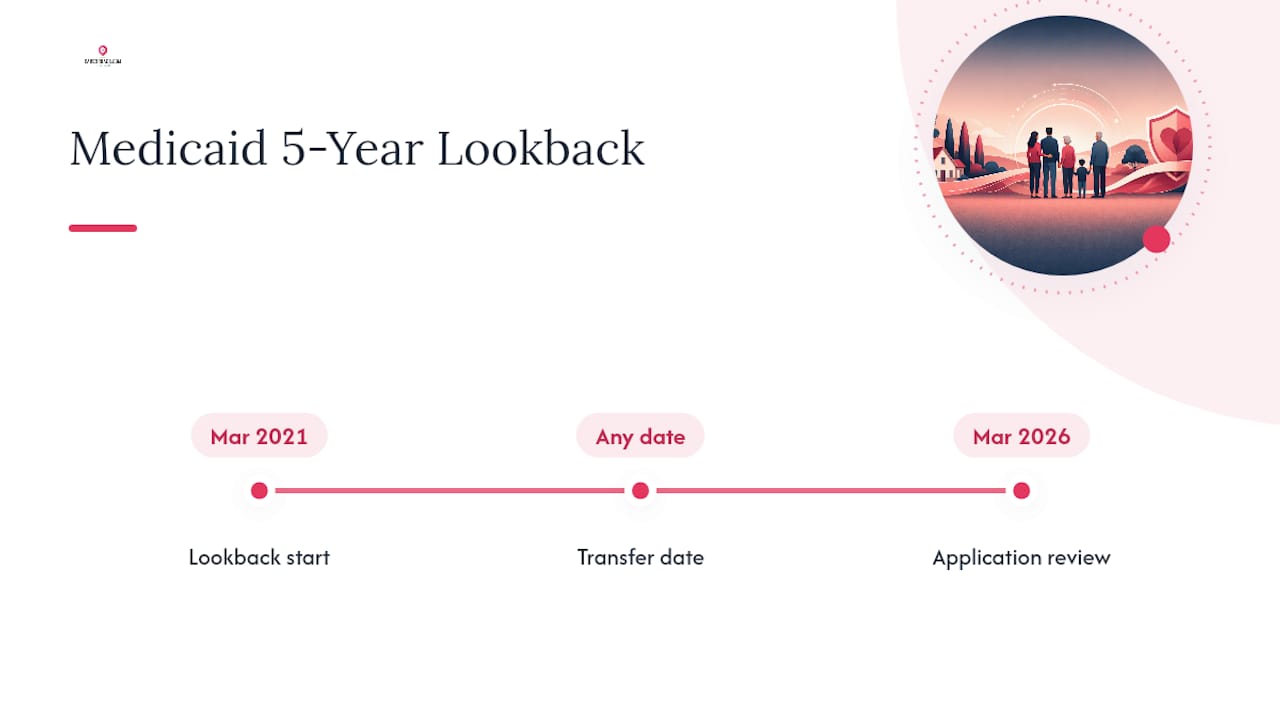
Here's the mechanic that surprises most people: the look-back isn't measured from when you made a transfer. It's measured backward from the date you file your Medicaid application. So if you apply for benefits in March 2026, Medicaid examiners will pull five years of bank statements, deeds, and account records going back to March 2021.
This rule applies specifically to Medicaid long-term care services, meaning nursing home coverage and many home and community-based services (HCBS) waivers that pay for care at home or in assisted living. Routine Medicaid coverage for medical care, doctor visits, and hospital stays doesn't carry a look-back requirement at all. Only the long-term care side of the program scrutinizes your financial history this closely, which is why families applying for a parent's nursing home coverage face a different process than someone applying for regular health coverage.
Which Medicaid Programs and Applicants This Rule Affects
Institutional Medicaid, meaning nursing home coverage, and most HCBS waiver programs both apply the 60-month look-back. If your mother needs a Medicaid-funded home health aide through a waiver program, that application typically triggers the same financial review as a nursing home application would.
Married couples get a specific protection worth understanding before you assume the worst. The Community Spouse Resource Allowance (CSRA) lets the spouse who isn't entering care keep a portion of the couple's combined assets, separate from what the applicant spouse must spend down. Transfers between spouses don't trigger a penalty at all, since federal law exempts them outright. This matters because many couples panic about "losing everything" when in reality the at-home spouse retains meaningful resources under CSRA rules.

Waiver programs vary by state in how strictly they apply look-back rules, and some states administer HCBS waivers with slightly different documentation standards than nursing home Medicaid. If you're applying through a waiver rather than for direct nursing home placement, ask your caseworker directly whether the same 60-month review applies to your specific program, since the answer isn't always identical across every waiver type.
Financial Transactions That Can Trigger a Penalty
Medicaid treats any transfer for less than fair market value as a red flag, and the definition is broader than most families expect. It's not just about writing checks labeled "gift." Adding your daughter's name to your bank account so she can help pay bills counts as a transfer of half that account's value in many states, even if you never intended it as a gift.
Common transactions that draw scrutiny include:
- Direct cash gifts to children, grandchildren, or other family members
- Selling a home, car, or other property to a relative for less than its appraised value
- Adding a family member's name to a deed, bank account, or investment account
- Forgiving a loan you had previously made to a relative
- Transferring assets into certain trusts within the 60-month window
- Deeding real estate to a family member without receiving fair payment in return
Ordinary family generosity is what usually causes the trouble, not deliberate scheming. A father who helped his son with a $15,000 down payment on a house four years before applying for Medicaid may have created a penalty without realizing it. Paying a grandchild's tuition, covering a family member's medical bills that weren't your own, or even routine holiday gifts above a few hundred dollars can all get flagged during the review.
Here's a misconception worth clearing up directly: the IRS annual gift tax exclusion, currently $19,000 per recipient in 2026, has nothing to do with Medicaid's rules. You can give away $19,000 without owing gift tax or even filing a gift tax return, but Medicaid doesn't care what the IRS allows. Every uncompensated transfer within the look-back window counts against you regardless of its tax treatment. Families who assume "it's under the tax-free limit, so it's fine" are working from the wrong rulebook entirely.
How Medicaid Calculates Your Penalty Period
The math behind a Medicaid penalty is straightforward once you see it laid out, though the consequences can be severe. Medicaid divides the total value of your uncompensated transfers by your state's penalty divisor, which represents the average monthly cost of private-pay nursing home care in that state. The result is the number of months you'll be ineligible for Medicaid-funded long-term care.
The national reference divisor for 2026 is approximately $9,900 per month**, though your actual state divisor may be higher or lower and directly determines how long your penalty lasts.**
Say your father gave away $99,000 to his grandchildren over the past four years, spread across several gifts. Using the national reference divisor, Medicaid would divide $99,000 by $9,900, landing on a 10-month penalty period. During those 10 months, Medicaid won't cover his nursing home stay even though he's otherwise financially and medically eligible. There's no cap on how long a penalty period can run. A $500,000 transfer using that same divisor would produce a penalty stretching past four years.
The detail that catches families off guard involves timing. The penalty period doesn't start on the date of the transfer. It starts on the date the applicant is otherwise eligible for Medicaid and would be receiving institutional care, according to Medicaid.gov's eligibility guidance. This creates a genuinely painful scenario: a family spends down the applicant's countable assets to qualify, applies for Medicaid, gets approved on every front except the transfer penalty, and then discovers they must privately pay for care during the penalty period with money they no longer have. It's a double bind that catches people who assumed the clock started years earlier when the actual transfer happened.
Exemptions That Let You Transfer Assets Without a Penalty
Federal law carves out specific exceptions to the look-back rules, and knowing them can save a family from an unnecessary penalty or, alternatively, from assuming an exemption applies when it doesn't.
- Transfers to a spouse are exempt outright, with no waiting period or documentation hurdle beyond normal reporting
- Transfers to a blind or permanently disabled child, of any age, don't trigger a penalty
- Transferring a home to a caregiver child who lived in the home and provided care for at least two years, delaying the parent's need for institutional placement, is exempt
- Transfers to a sibling who has an equity interest in the home and lived there for at least one year before the applicant's institutionalization can also qualify
The caregiver child exemption is the one families most often misuse or misunderstand. It requires documented proof, typically a signed statement from the applicant's physician confirming that in-home care during those two years prevented or delayed a nursing home admission. A grown child who simply lived with a parent and helped occasionally, without that documented care relationship, usually won't qualify. Caseworkers expect records: care logs, medical statements, and sometimes a formal caregiver agreement predating the transfer.
State Medicaid offices interpret these exemptions narrowly, and requirements differ from state to state. Texas, for instance, spells out documentation standards in its own Medicaid Elderly People and Disabilities Handbook, which covers specifics like life estate purchases and promissory note treatment that federal guidance leaves vague. Never assume an exemption applies just because it fits the general description. Confirm it with your state's specific rules before finalizing a transfer.
How Look-Back Rules Differ by State, and What's Changing in California
Federal law sets the 60-month floor, but states control the details that actually decide your outcome. As of 2026, the look-back period runs 60 months in 49 states and the District of Columbia, with California standing as the notable exception.
California is phasing in a different, shorter look-back structure rather than applying the standard five-year window used nationwide. The state has been transitioning its Medi-Cal long-term care rules gradually, and the exact schedule and scope of that phase-in continue to evolve. If you or a family member live in California, don't rely on general nationwide guidance. Contact your county Medi-Cal office directly to confirm which rules apply to your specific application date, since the transition affects timing in ways that a national article can't capture precisely for your circumstances.
Beyond California, states also set their own penalty divisors based on local nursing home costs, which means the $9,900 national reference figure is only a starting point. A state with higher average nursing home costs will have a higher divisor, which actually works in your favor: it shortens the penalty period for the same dollar amount transferred. Call your state Medicaid office and ask for the current divisor before doing any planning math yourself.
Planning Ahead: Strategies That Protect Assets Legally
The single most reliable protection against a Medicaid penalty is time. Elder law professionals consistently point to the same principle: if a transfer happens more than 60 months before you apply, it falls outside the look-back window entirely and Medicaid won't touch it. That's why planning early, ideally five or more years before anyone anticipates needing long-term care, remains the most effective strategy available.
An irrevocable Medicaid asset protection trust is one of the primary tools attorneys use for this. Assets moved into a properly drafted trust more than 60 months before application are protected, but the trust has to be genuinely irrevocable and structured correctly. Poorly worded trust language, or a trust that gives the grantor too much control, can undo the protection entirely and trigger the same penalty as a direct gift.
Medicaid-qualified annuities offer another legitimate route, converting a lump sum into an income stream that doesn't count as a countable asset, provided the annuity meets specific state and federal requirements. Legitimate spend-down strategies also work within the window: paying off medical bills, covering necessary home repairs, or prepaying funeral and burial expenses all convert countable assets into exempt ones without creating a penalty.
For families who didn't plan five years out and now face a crisis, some elder law attorneys use a technique called "half-a-loaf" planning, transferring only a portion of excess assets so the retained funds cover the resulting penalty period through private pay. This is a technical, high-risk maneuver that requires precise calculation and attorney supervision. Getting the math wrong can leave a family without enough money to cover the penalty period they created.
Pro Tip: Keep a dedicated folder, physical or digital, for every financial transaction going back five years before you ever plan to apply. Bank statements, deeds, gift letters, and loan agreements are far easier to gather now than to reconstruct later during a Medicaid crisis.
Never rely on IRS gift-tax exclusions as a substitute for Medicaid planning, and never make a significant transfer without documenting the reason in writing at the time it happens. An elder law attorney can help structure trusts, annuities, and spend-downs correctly. This is not a do-it-yourself area of law, and small drafting errors carry expensive consequences. Resources like Carexroads' guide on advance directives can help you organize the broader legal documentation that often needs updating alongside Medicaid planning.
What to Do If Transfers Already Happened
If you've discovered a transfer within the look-back window after the fact, you still have options. Returning the full value of the transferred asset can cure the penalty entirely, according to Medicaid's own guidance. Some states allow partial cures, but rules vary significantly, and a partial return may only shorten rather than eliminate the penalty period.
Undue hardship waivers exist but remain genuinely rare and hard to secure. They generally require proof that denying coverage would put the applicant's health or life at risk with no alternative means of support.
Start by compiling every relevant record: bank statements, deeds, loan documents, and receipts covering the full five-year window. Consult an elder law attorney before your application goes in, and use your state's penalty divisor to estimate potential exposure so you're not blindsided later.
Carexroads' Take: The Cost of Waiting Is Always Higher Than the Cost of Planning
Families rarely come to us already thinking about Medicaid five years out. They come after a diagnosis, after a fall, after the moment planning ahead stopped being optional. That's the real tragedy of the look-back period: it punishes procrastination more than it punishes intent. A family that meant no harm can still face a ten-month penalty simply because nobody started the clock early enough.
Carexroads maintains a 4.8 average family satisfaction rating because we connect families to vetted professionals before the crisis hits, not after. Organize your records, call your state Medicaid office, and schedule a consultation with an elder law attorney this month, not next year.
— Care
Find an Elder Law Attorney and Care Planner Through Carexroads
Getting Medicaid planning right often comes down to who you find first, and most families searching online end up sorting through directories that list every attorney in a metro area with no way to tell who actually specializes in elder law versus who just added a practice area to their website. Carexroads takes a different approach: verified family reviews attached to every listing, so you can see how other families rated their actual experience with a specific attorney or care planning professional before you ever pick up the phone.

Search the Carexroads directory by location to find elder law attorneys, financial planners, and care coordinators near you, alongside practical guides covering everything from transitioning a loved one into assisted living to navigating hospital discharge paperwork. If your family is weighing a move to be closer to care, our guide on relocating a parent walks through the practical factors that intersect with Medicaid timing. Start your search on Carexroads today and connect with a professional who can review your specific situation before any transfer decisions get made.
This article is general information, not a substitute for advice from a qualified lawyer. Consult a qualified legal professional about your own circumstances before acting on anything here.
Sources
- Medicaid
- CMS — Deficit Reduction Act backgrounder
- Texas Health and Human Services — Medicaid Elderly People and Disabilities Handbook