

Memory care runs between $5,500 and $9,000 a month in most U.S. markets, with a national average near $7,645. Over two to three years, that adds up to $180,000 or more. The financing reality families need to accept early: Medicare generally does not pay for long-term memory care in a residential facility, so most families rely on a mix of savings, Medicaid, long-term care insurance, or VA benefits.
TL;DR:
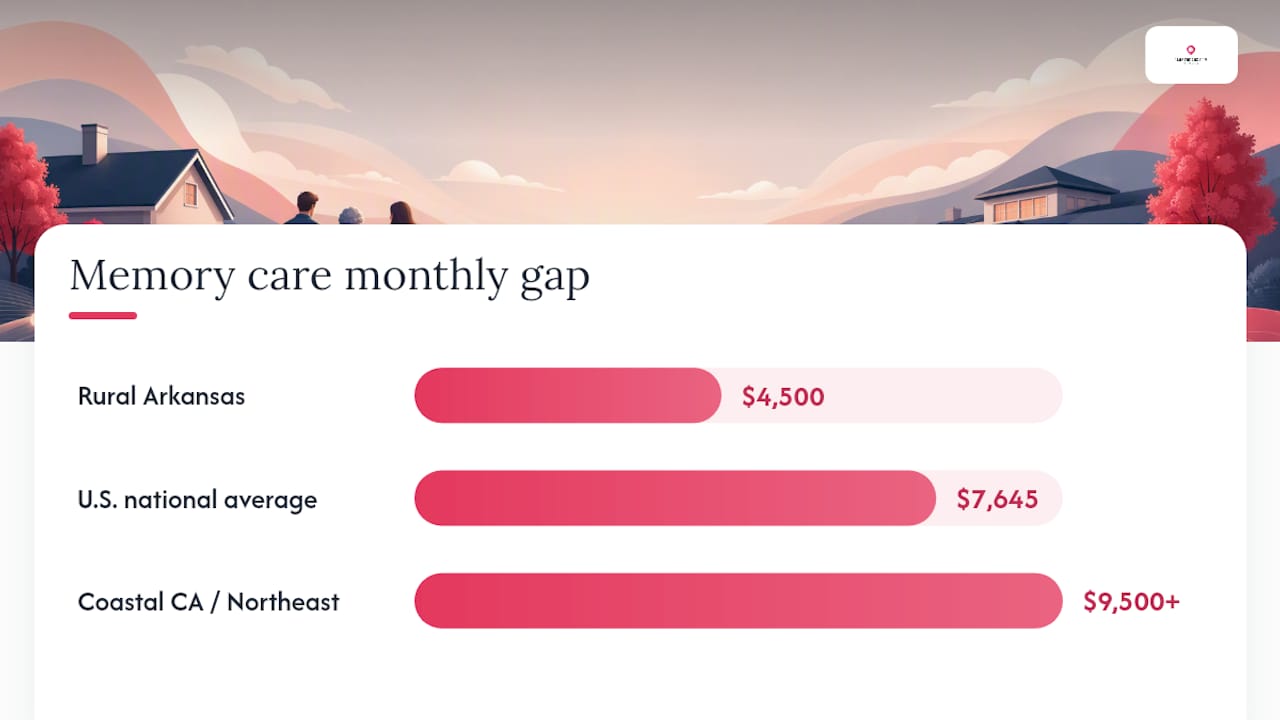
- Memory care costs vary widely by region, with high-cost areas like San Francisco or Boston reaching near $9,500 monthly; rural areas may pay around $4,500.
- The average national expense is about $7,645 per month, totaling over $180,000 for two to three years, with costs increasing significantly for higher care needs.
- Most facilities include room, meals, personal care, and supervision but charge extra for medication, supplies, private therapy, and higher acuity care levels.
- Funding options are limited, with Medicare rarely covering long-term memory care; families often rely on Medicaid, long-term care insurance, VA benefits, or private savings.
- To effectively budget, families should obtain detailed, written estimates from local facilities, clarify what pricing includes, and consider regional differences and tiered pricing models.
Table of Contents
- Memory Care Cost: Key Takeaways Before You Search
- Why National Averages Don't Match Your State's Memory Care Prices
- What Does Memory Care Actually Include and Exclude?
- What Drives the Price Difference Between Two Memory Care Facilities?
- How Can Families Pay for Memory Care Costs?
- What Questions Should You Ask Before Choosing a Facility?
- Practical Ways to Reduce Memory Care Costs
- How Much Will Memory Care Cost Over Several Years?
- Where Carexroads Fits Into Your Memory Care Search
- What Actually Matters When the Money and the Need Both Feel Urgent
- Find Price-Appropriate Memory Care Options Faster
- Where to Verify These Numbers Yourself
- Sources
Memory Care Cost: Key Takeaways Before You Search
Before you start calling facilities, a few facts will save you hours of confusion and help you ask sharper questions.
- National range: Most memory care runs $5,500 to $9,000 monthly, with the U.S. News average near $7,645, though your state's figure could sit well above or below that.
- What's usually included: Room and board, personal care assistance, meals, structured programming, and a secured environment designed for wandering prevention.
- What's usually excluded: Medication copays, incontinence supplies, private therapy sessions, and often a separate "care level" fee based on how much supervision a resident needs.
- Funding routes worth investigating now: Medicaid waivers, long-term care insurance, VA Aid & Attendance for veterans, and, in limited cases, tax deductions under IRS Publication 502.
- Your first move: Get a local, itemized cost estimate from at least two facilities near you rather than relying on national averages to plan your budget.
Why National Averages Don't Match Your State's Memory Care Prices
The $7,645 monthly average U.S. News reports is a useful starting point, but it hides enormous regional swings. A family in rural Arkansas might find memory care for $4,500 a month. A family in coastal California or the Northeast corridor could easily pay $9,500 or more for a comparable level of care. Real estate costs, local wages for caregiving staff, and state licensing requirements all push these numbers in different directions.
CareScout's Cost of Care Survey breaks these figures down by region and service type, which makes it far more useful than a single national number when you're trying to budget for your own situation. The survey reports medians for memory care alongside assisted living and in-home care, so you can compare how much more specialized dementia care costs relative to standard senior living in your area.
Urban centers with high labor costs, like San Francisco, Boston, or Seattle, tend to sit at the top of the price range. A facility in a high-cost metro also faces stricter staffing ratio regulations in many states, which raises overhead and gets passed through to residents.
Reading a published state figure the right way
When you see a state "average monthly cost" for memory care, understand what's baked into that number. Most surveys report a median for a private room in a standard memory care unit, assuming average acuity, no major behavioral add-ons, and no move-in or community fee. That number is a floor, not a ceiling, for what you'll actually pay once fees for higher supervision or specialized programming get added.
To convert a published state figure into something usable for your family:
- Call three to five facilities within a 20-mile radius of where your loved one currently lives or where you want them to be.
- Ask each one for a written, itemized fee sheet rather than a verbal quote, since verbal estimates often omit add-on fees.
- Cross-reference what you hear against CareScout's regional data to spot whether a quote seems unusually high or suspiciously low.
- Check a localized guide, like Carexroads' Palm Desert and Rancho Mirage memory care overview, if you're researching a specific metro area.
What Does Memory Care Actually Include and Exclude?
The advertised monthly rate rarely tells the whole story. Most memory care communities build their base price around a defined bundle of services, then charge extra for anything beyond that baseline.
Typically included in the base rate:
- A private or semi-private room in a secured, wander-resistant unit
- Three daily meals plus snacks, often with menus adapted for dementia-related eating challenges
- Assistance with bathing, dressing, grooming, and toileting
- Structured daily programming: memory-focused activities, music therapy, sensory stimulation
- 24-hour supervision and staff trained in dementia behavior management
Commonly excluded, billed separately:
- Prescription medication costs and pharmacy delivery fees
- Incontinence supplies, unless the community includes a supply package
- Private-duty nursing, physical therapy, or hospice services layered on top of facility care
- One-time community or move-in fees, which can range from a few thousand dollars up to one month's rent
- "Higher acuity" surcharges once a resident needs more one-on-one supervision, wound care, or behavioral intervention
Many facilities use tiered pricing tied to a resident's assessed care level. A resident who needs moderate supervision might pay the base rate, while a resident with aggressive wandering behavior or significant physical dependency could get moved up two or three tiers, adding $1,000 to $2,500 monthly. Ask upfront how the facility assesses acuity and how often those assessments happen. Some communities reassess quarterly, which means your monthly bill could climb even if nothing changes on your end except the passage of time and disease progression.
What Drives the Price Difference Between Two Memory Care Facilities?
Two memory care communities in the same city can differ by $2,000 a month or more, and the reasons usually trace back to a handful of factors.
- Resident acuity: A resident who wanders, resists care, or has significant physical needs requires more staff attention, and facilities charge accordingly.
- Staffing model: Communities with lower staff-to-resident ratios and specialized dementia-trained staff generally cost more, but they often deliver measurably better daily outcomes.
- Room type: Private rooms cost significantly more than shared rooms, sometimes by $1,500 or more monthly.
- Local labor and real estate: Facilities in high-wage, high-rent metro areas pass those costs directly to families.
- Billing structure: Bundled pricing wraps everything into one number, while itemized billing breaks out every service separately. Itemized models can look cheaper upfront but often total higher once add-ons stack up.
Pro Tip: Ask every facility whether their quoted price is "all-inclusive" or "base plus add-ons," and get that answer in writing. A facility quoting $6,200 with no add-ons often ends up cheaper than one quoting $5,800 that tacks on medication management, incontinence care, and a higher-acuity fee within the first 90 days.
How Can Families Pay for Memory Care Costs?
Paying for memory care almost always means combining several sources rather than relying on one. Here's a practical order of operations for figuring out what applies to your family.
- Check what Medicare actually covers. Medicare pays for certain cognitive assessments and short-term skilled nursing care following a qualifying hospital stay, but it does not cover the ongoing cost of living in a memory care facility. If your loved one needs short-term rehab first, review how Medicare's skilled nursing facility coverage limits work before that clock runs out.
- Contact your state Medicaid office early. Medicaid is a joint federal-state program, and some states offer waiver programs that cover memory-care-related services for low-income residents. Rules, wait lists, and covered services vary significantly by state, so start this conversation months before you expect to need it, not after a crisis hits.
- Review any long-term care insurance policy in detail. Check the benefit trigger (usually requiring help with a set number of daily activities), the elimination period before payments start, and the daily or monthly benefit cap. Many families discover their policy pays less than expected once they read the fine print.
- If a veteran or a surviving spouse is involved, look into VA Aid & Attendance. This VA benefit can add several hundred to over a thousand dollars monthly toward care costs, but the application process takes time, so start it as soon as a need becomes likely.
- Consider home equity, life insurance conversions, or a hybrid approach, and ask a tax professional whether any portion of care costs qualifies as a deductible medical expense under IRS Publication 502.
Before making calls, gather key documents: recent tax returns, a list of assets, current insurance policies, veteran discharge papers (DD-214) if applicable, and a physician's statement of diagnosis. Having these ready speeds up every conversation with Medicaid caseworkers, insurance adjusters, and VA representatives.
What Questions Should You Ask Before Choosing a Facility?
A fair comparison between two memory care communities requires asking both the same questions, in the same order, so you're comparing real answers instead of impressions.
Operational and safety questions:
- What is your staff-to-resident ratio during the day versus overnight?
- What specific training do caregivers receive in dementia behavior management?
- What is your protocol when a resident becomes agitated or tries to leave the building?
Pricing transparency questions:
- Can I see a written, itemized fee sheet before signing anything?
- How often do you reassess care level, and how much can that raise my monthly bill?
- What is your fee increase schedule, and how much did rates rise in the last two years?
- Is there a move-in or community fee, and is any portion refundable?
Watch for vague answers on staffing ratios, reluctance to provide a written fee breakdown, or evasiveness about how often rates increase. A well-run facility answers pricing questions plainly and provides documentation without hesitation.
- Write out this exact question list once.
- Use the identical list on every facility you tour.
- Score each answer side by side before making a decision.
Practical Ways to Reduce Memory Care Costs
A few tactics can meaningfully lower what your family pays without sacrificing safety or quality of care.
- Negotiate move-in timing. Facilities sometimes waive community fees or offer a discounted first month when a room has sat empty, so ask directly about current vacancy.
- Search for state and charitable aid programs beyond Medicaid, including local Area Agencies on Aging, which often maintain lists of grants specific to your county.
- Hire a geriatric care manager for an initial consultation. They can often identify a lower-cost setting that still meets your loved one's actual care needs, sometimes saving more than their fee costs.
- Pursue VA Aid & Attendance immediately if a veteran or spouse qualifies, since the application can take months to process.
Pro Tip: Don't wait until a crisis forces a decision. Families who start comparing facilities and funding options six to twelve months ahead typically find better pricing and more room to negotiate than those searching under pressure after a hospital discharge.
How Much Will Memory Care Cost Over Several Years?
At the national average of roughly $7,645 monthly, two years of care totals around $183,000. Three years runs closer to $275,000, and five years approaches $459,000 before any rate increases are factored in.
- Adding $1,000 to $2,000 monthly for higher acuity as dementia progresses can push a three-year total up by $36,000 to $72,000.
- Families in high-cost states easily see totals 25% to 30% higher than the national figures above.
- Experts tracking memory care cost trends note that expenses can climb sharply as a resident's needs intensify, which is why revisiting your budget every six months matters more than setting it once and forgetting it.
Where Carexroads Fits Into Your Memory Care Search
Carexroads carries a 4.8 average family satisfaction rating built on real reviews from families who've already walked this path. Our guide, What to Know About Memory Care, goes deeper into choosing the right community. For location-specific pricing, browse examples like our Palm Desert and Rancho Mirage guide, or use our search tools to pull state-specific listings near your family.
What Actually Matters When the Money and the Need Both Feel Urgent
Nobody plans to have this conversation on a deadline, yet that's how most families end up having it. A parent's confusion turns dangerous, a fall happens, and suddenly cost comparisons feel like a luxury you don't have time for.
Here's what stays true even under pressure: safety and fit matter more than finding the absolute lowest price, but sustainable financing matters just as much, because a placement you can't afford for more than a year isn't really a solution. If you're unsure where to start, call your state Medicaid office, a VA representative if a veteran is involved, or a geriatric care manager who can assess needs independently of any facility's sales pitch. Asking for help is not a failure of planning. It's the smartest step available to you right now.
— Care
Find Price-Appropriate Memory Care Options Faster
Comparing quotes facility by facility eats weeks you may not have, especially when a loved one's needs are changing month to month. Some online platforms help shorten the search by putting family reviews, searchable listings, and local guides in one place, simplifying comparisons of price and quality.

If you're weighing memory care against home-based alternatives before committing to a facility budget, our guide on how home care helps seniors stay independent walks through that comparison honestly. And if you're ready to start narrowing down options for your family right now, visit our page on exploring home care options for a loved one to see what's available near you and get a clearer sense of pricing before you commit to a tour schedule.
Where to Verify These Numbers Yourself
For direct confirmation of coverage rules and benefit programs, consult Medicare coverage details, your state Medicaid office, VA Aid & Attendance, IRS Publication 502, and the Alzheimer's Association's guide to paying for care.
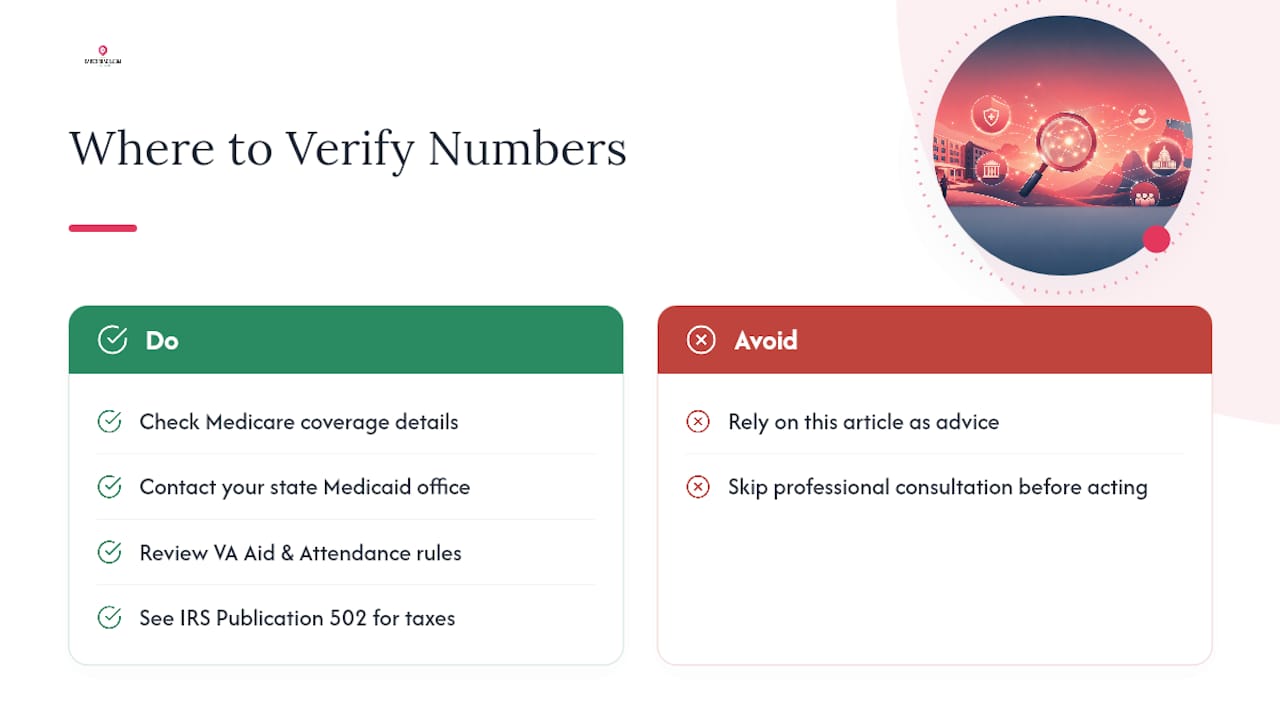
This article is general information, not a substitute for advice from a qualified doctor. Consult a qualified healthcare professional about your own circumstances before acting on anything here.
Sources
- Does Medicare cover memory care? — Humana
- How Much Does Memory Care Cost? 2026 State-by-State Guide & Savings Tips — U.S. News
- Calculate the cost of long-term care near you — CareScout
- Aid & Attendance and Housebound Allowance — U.S. Department of Veterans Affairs