
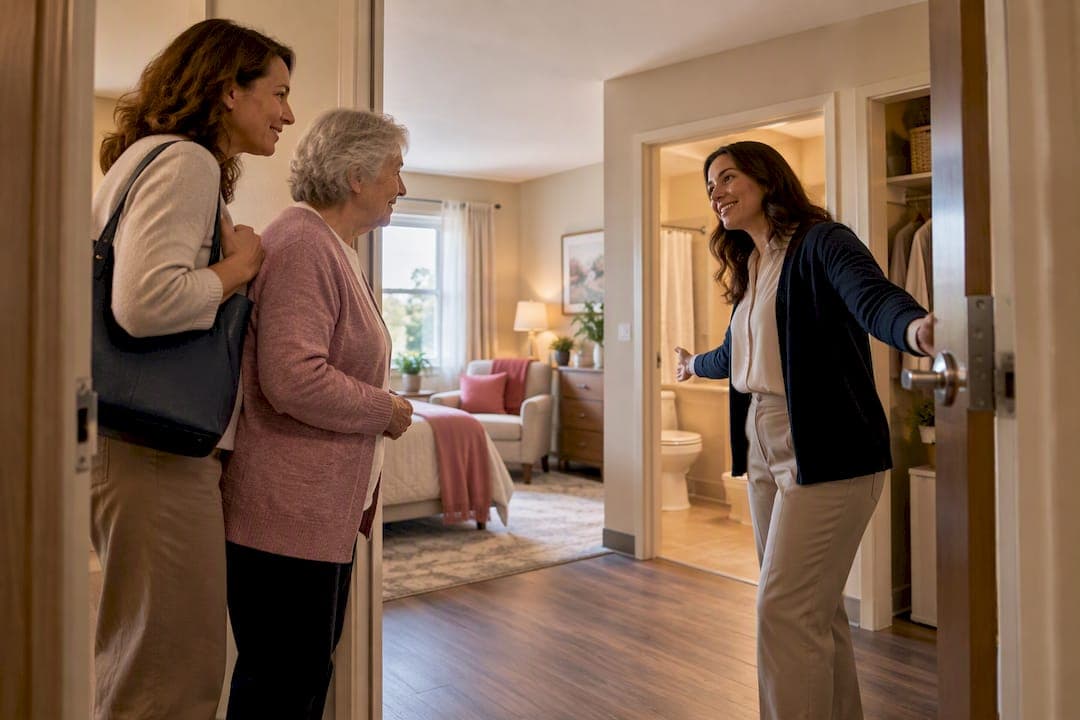
Treat every assisted living tour like a brief, focused interview: ask for overnight staffing numbers, a written fee schedule, and the facility's most recent inspection report before you look at anything else. Beyond those three checks, this guide groups the questions families most need into staffing, safety, daily life, money, and memory care, plus what to look for on a virtual tour and a simple rubric for comparing communities side by side. Federal resources like Medicare's inspection database and your state long-term care ombudsman fill in what a tour alone cannot show you, and Carexroads' directory of verified family reviews can help you narrow your list before you ever schedule a visit.
TL;DR:
- Most assisted living communities have thinner overnight staffing than families expect, so ask whether staff are awake and present on-site during night shifts.
- A recent inspection report with no unresolved citations indicates a more well-managed facility, and hesitation to produce such documents warrants further research.
- Witnessing engaged residents and approachable staff during visits provides a clearer picture of daily life than what is shown in marketing materials or photos.
- Families should obtain a detailed, written fee schedule and understand what triggers care level increases, as base rates often conceal true monthly costs.
- For memory care units, specifically inquire about security measures, staff dementia training hours, and protocols for managing behavioral issues without excessive medication use.
Table of Contents
- Care and staffing: exact questions to ask and what answers mean
- Health, safety, and emergency preparedness questions to verify
- Daily life, activities, meals, and resident experience questions
- Fees, contracts, and money questions to ask on tour
- Memory care and dementia-specific tour questions
- What to observe yourself during on-site or virtual tours
- How to compare tours and decide next steps after visiting
- Resident rights and grievance processes
- Contract terms and conditions overview
- Availability of specialized therapies and rehabilitation services
- Policies on pets and personal belongings
- Carexroads perspective: how our reviews and checklists help families get better answers on tours
- How Carexroads helps: search, compare, and schedule your next tour
- Authoritative resources to consult after tours
- Sources
- FAQ
Care and staffing: exact questions to ask and what answers mean
Staffing is the single factor that shapes almost everything else about daily life in a community, so it deserves the first block of questions on any tour, as resources like Pflegetipp highlight in eldercare. Ask for staff-to-resident ratios broken out by shift: day, evening, and overnight. Night coverage is often thinner than what families assume, and it directly affects how quickly someone responds to a fall or a medical event, so ask specifically whether staff are awake and on-site overnight or simply on call from home, according to guidance on touring senior living communities.
Medication management deserves its own set of questions. Ask who administers medications, whether errors get logged and reported to families, and whether you can review a sample medication administration record.
- Ask for staff-to-resident ratios for day, evening, and night shifts, and whether overnight staff are awake and on-site.
- Ask who manages medications, how errors are caught, and whether administration logs are available for review.
- Ask about average staff tenure and turnover, and whether residents keep a consistent caregiver assignment.
A community that answers turnover questions with specific numbers, rather than a vague reassurance that "staff love working here," is usually more transparent about its operations. High turnover often shows up later as inconsistent care, so it is worth probing directly rather than accepting a general answer.
Pro Tip: Ask the administrator to name the exact overnight staff-to-resident ratio on the unit your loved one would live in, not a community-wide average.
Health, safety, and emergency preparedness questions to verify
Ask to see the facility's most recent state inspection or survey report, and ask directly whether there are any unresolved citations. Every skilled nursing facility's report is available through Medicare's guide to choosing a nursing home, and many assisted living communities will share comparable state survey documents on request, per Medicare's guidance. If a community hesitates to produce this document, that hesitation itself is worth noting.
Emergency preparedness is easy to overlook on a first visit but matters enormously in a crisis. Ask to see the written disaster and evacuation plan, whether backup power covers medical equipment and climate control, and how often drills are conducted and documented.
- Request the facility's most recent inspection or survey report and ask about any unresolved citations.
- Ask to see written emergency and disaster plans, including backup power coverage and drill schedules.
- Ask how falls, medical emergencies, and infection control incidents are documented and reported to families.
A clear, specific answer, backed by a document you can actually read, signals a well-run operation. A defensive or vague answer is a reason to follow up with your state's long-term care ombudsman before signing anything.
Daily life, activities, meals, and resident experience questions
Quality of life shows up in the small, daily details more than in the brochure. Ask to see a current activity calendar, and ask whether you can sample a meal during your visit; a kitchen that welcomes this request usually has nothing to hide. Ask about transportation for appointments, visiting hours, and whether families can suggest or help plan activities.
- Ask to see this week's activity calendar and request to sample a meal if the schedule allows.
- Ask about transportation options, visiting hours, and family involvement in planning activities.
- Ask whether private space is available for family visits, outside the community's shared common areas.
Watch how residents actually spend their time while you are there. Engaged residents chatting with staff or each other, rather than rows of people sitting silently in front of a television, is one of the clearest signs of a healthy social environment, as care experts have noted. A community that feels passive or understaffed during a scheduled tour is likely to feel more so on an ordinary afternoon.
Fees, contracts, and money questions to ask on tour
Ask for a written fee schedule that separates base rent from care add-ons, and ask exactly what triggers a move to a higher, more expensive level of care. Because Medicare does not cover assisted living and most costs are private-pay, the details buried in that schedule matter more than the advertised starting rate, according to a federal assisted living fact sheet. Our own breakdown of what an assisted living community fee really costs walks through the line items families most often miss, and a broader look at assisted living costs covers how those numbers have shifted in recent years.
- Ask for a written fee schedule showing base rent versus care add-ons, and what triggers a higher care level.
- Ask about move-in fees, the notice period for leaving, and the community's history of annual rate increases.
- Ask whether Medicaid or other state programs cover any portion of care, and what stays private-pay.
Read any contract for automatic rate escalators and relocation clauses that let the community move a resident to a different unit or level of care with little notice.
Memory care and dementia-specific tour questions
Memory care deserves its own line of questioning because the stakes around security and behavior management are higher and the answers vary widely between communities. Ask whether the unit is secured and how the staff prevents wandering or elopement without relying on excessive restriction. Ask how many hours of dementia-specific training staff receive, what that training actually covers, and how behavioral changes are de-escalated without defaulting to medication, since there is no single national standard for memory care training, per Medicare's guidance on choosing a facility.
- Ask if the memory care unit is secured and how wandering or elopement risk is managed.
- Ask how many hours of dementia training staff receive and what the curriculum covers.
- Ask about overnight staffing ratios specific to the memory care unit and protocols for sundowning.
A specific number of training hours or a named curriculum tells you far more than a general claim of "specialized care." Our memory care tour questions guide includes a list of documents worth photographing during the visit so you can compare communities later.
What to observe yourself during on-site or virtual tours
Documents and answers only tell part of the story. Your senses, and a few small tests, fill in the rest.
- Notice odors, cleanliness, and whether residents appear groomed and appropriately dressed for the season.
- Watch whether staff use residents by name, seem approachable, and have time to answer your questions without rushing.
- Ask how long it typically takes for a call light to be answered, and ask for a live demonstration if one is possible.
- On a virtual tour, insist on live video rather than a recorded reel, and ask to see the dining room and a full apartment, not just common areas.
Families who visited at different times of day, including mealtimes and evenings, and spoke directly with residents came away with a far more accurate picture than a single scheduled walkthrough provides, ProPublica has reported.
Pro Tip: During a virtual tour, ask the guide to open a resident's closet and bathroom on camera; polished common areas rarely tell you much about daily living space.
How to compare tours and decide next steps after visiting
Once you have visited two or three communities, score each one against the same four axes so the comparison is not just a gut feeling. Rate staffing, safety, daily life, and cost on a simple scale, and note where a community fell short rather than averaging everything into a single vague impression.
- Collect the inspection report, written fee schedule, posted staffing levels, and care-plan review policy from each community.
- Schedule an unannounced return visit and, if possible, eat a meal there before deciding.
- Speak with current residents or their families, and check complaint histories with your state long-term care ombudsman before signing anything, per the Administration for Community Living.
| Axis | What disqualifies a community |
|---|---|
| Staffing | No awake overnight staff and no willingness to share ratios |
| Safety | No current inspection report or unresolved major citations |
| Daily life | Residents visibly unengaged and staff unavailable during the visit |
| Cost | No written fee schedule or refusal to disclose add-on triggers |
Any one of those red flags is reason enough to keep looking.
Resident rights and grievance processes
Every resident in a licensed assisted living community keeps the right to voice a complaint without fear of retaliation, and every community should be able to describe its grievance process clearly and without hesitation. Ask how a resident or family member files a complaint, who reviews it, and how long resolution typically takes.

Ask whether the community's grievance policy is posted somewhere residents and families can see it, and ask for a copy in writing. A community that cannot produce a written grievance policy, or that describes the process only in vague terms, is one where problems are more likely to go unresolved.
Your state long-term care ombudsman program exists specifically to serve as an independent advocate outside the facility's own chain of command, and can investigate complaints that the community itself is slow to address, according to the Administration for Community Living. Ask the community whether it has worked with the ombudsman recently and how it responded. A facility that treats ombudsman involvement as routine, rather than adversarial, tends to be more comfortable with outside oversight in general.
Contract terms and conditions overview
Read the admission agreement in full before you tour a second community, not after you have already decided. Ask what the base contract actually covers, what counts as an add-on, and how the document defines a change in "level of care," since that phrase often triggers a jump in monthly cost.
Pay close attention to the notice period required to leave the community, the refund policy for a partial month, and any clause allowing the facility to relocate a resident to a different room or unit. Ask whether the contract includes an automatic annual rate increase, and if so, ask for the increase history from the past few years rather than accepting a single projected number.
Ask whether an ombudsman or elder law attorney has reviewed the standard contract language, and whether the community is willing to negotiate any terms before signing. A community confident in its agreement will walk you through it clause by clause rather than rushing you to the signature page.
Availability of specialized therapies and rehabilitation services
Ask whether physical, occupational, and speech therapy are available on-site, and whether those services are provided by the community's own staff or through a contracted outside agency. The distinction matters because scheduling and continuity of care often depend on which model a community uses.
Ask how a resident qualifies for rehabilitation services after a fall, surgery, or hospital stay, and whether those services are billed separately from the base rate. Ask how often a therapist reassesses a resident's progress and whether family members are included in those updates.
If a loved one has a specific condition, such as recovering from a stroke or managing Parkinson's disease, ask whether the community has direct experience coordinating care for that condition and how it works with outside specialists. A community that can describe a concrete process, rather than a general assurance that "therapy is available," is usually better equipped to manage a changing medical picture.

Policies on pets and personal belongings
Many families underestimate how much a pet or a familiar piece of furniture matters to a resident's sense of stability during a difficult transition. Ask directly whether pets are allowed, what size or breed restrictions apply, and who is responsible for a pet's daily care if a resident's mobility declines.
Ask what residents are allowed to bring from home, including furniture, artwork, and small appliances, and whether the room size realistically accommodates those items. Ask about insurance coverage for personal belongings and what happens in the event of loss or damage.
Ask how the community handles laundry and labeling of personal clothing, since misplaced items are a common source of family frustration. A clear, specific answer to each of these questions usually reflects a community that has handled the same situation many times before.
Carexroads perspective: how our reviews and checklists help families get better answers on tours
Carexroads aggregates verified family reviews and builds practical checklists so families walk into a tour already knowing which questions matter most. The platform's guides are built to mirror the exact questions covered above. Use Carexroads to compare communities side by side and prepare your own tour questions before you ever set foot in a building.
— Care
How Carexroads helps: search, compare, and schedule your next tour
The platform offers a searchable directory of assisted living, memory care, and related providers alongside verified family reviews, so you can compare fee details and read real experiences before you spend a Saturday touring communities that were never a fit. Use the platform to check inspection notes and pricing patterns side by side, then schedule a tour or request a free in-home care assessment to get a second, guided opinion on what you found.

- Search the assisted living and related care categories to build your shortlist.
- Read verified family reviews before booking a tour to avoid wasted visits.
- Request a free assessment to review your notes with a guide before you decide.
Start comparing communities and browse care providers on Carexroads to see what a verified, family-reviewed search actually looks like.
Authoritative resources to consult after tours
- Medicare's guide to choosing a nursing home: check inspection history and sample questions.
- Long-Term Care Ombudsman Program: check complaint histories and file concerns.
- Eldercare Locator: find your local aging services and referral contacts.
This article is general information, not a substitute for advice from a qualified doctor. Consult a qualified healthcare professional about your own circumstances before acting on anything here.
Sources
- What to Ask When Touring Senior Living Communities — U.S. News
- 02174: Your guide to choosing a nursing home — Medicare
- Long-Term Care Ombudsman Program — ACL
FAQ
What are good questions to ask when touring an assisted living facility?
Start with overnight staffing ratios, a written fee schedule, and the facility's most recent inspection report, since these three checks reveal the most about safety and true cost. Follow up with questions about medication management, staff turnover, and how care plans get reviewed and updated with family input.
What should I include in a checklist when touring an assisted living facility?
A solid checklist groups questions into staffing and medication management, safety and emergency preparedness, daily life and activities, and fees and contract terms. Add a section for memory care specifics if relevant, and leave room to note your own sensory observations, like cleanliness and resident engagement.
What are some common questions asked in assisted living interviews?
Families commonly ask about staff-to-resident ratios by shift, how medication errors are caught, and what triggers a jump to a higher, costlier level of care. They also ask to see a written fee schedule, a recent inspection report, and the community's grievance process for resolving complaints.
What is one of the biggest drawbacks of assisted living?
Because Medicare does not cover assisted living, costs are largely private-pay, and base rates often understate the true monthly cost once care add-ons are included, according to a federal assisted living fact sheet. Families who do not request a full written fee schedule during the tour are the ones most likely to face unexpected charges later.