
Medicaid pays for many of the health and personal care services delivered inside an assisted living community, but it does not pay for room and board, and the exact list of covered services depends entirely on where you live. Forty-four states covered some assisted living services through Medicaid as of March 2025, though most reach that coverage through waivers rather than a guaranteed benefit. The sections below walk through what's covered, how your state fits in, who qualifies, and how to apply.
TL;DR:
- Medicaid covers personal care, medication management, skilled nursing, case management, therapy, and transportation inside assisted living but excludes room and board costs.
- Coverage varies widely by state, often through waivers like 1915(c) or programs like Section 1115, with many programs having enrollment caps and regional restrictions.
- Eligibility depends on meeting both financial limits (income, assets) and a functional assessment showing a high level of care need, with complex look-back periods to verify assets.
- Most states do not pay for rent or meals, requiring families to cover room and board through other sources such as Social Security, VA benefits, private pay, or supplements.
- The key to access is coordinating application timing, understanding specific waiver eligibility, and using local support resources to bridge gaps while waiting for approvals.
Table of Contents
- Understanding Medicaid Assisted Living Coverage: What Services Are Included
- Medicaid Assisted Living Programs Vary Widely by State
- Eligibility for Medicaid Assisted Living: Income, Assets, and Care Needs
- The Four Medicaid Authorities Behind Assisted Living Coverage
- Where Medicaid Assisted Living Coverage Stops: The Room and Board Gap
- Applying for Medicaid Assisted Living Coverage: Steps and Timelines
- Other Federal Programs That Can Help Cover Assisted Living Costs
- Carexroads: Helping Families Turn Medicaid Research Into Action
- What Rights Do Medicaid Recipients Have in Assisted Living Facilities?
- Why the Real Gap Isn't Coverage. It's Coordination.
- Sources
Understanding Medicaid Assisted Living Coverage: What Services Are Included
When people ask whether Medicaid covers assisted living, they're usually picturing one all-or-nothing answer. The reality is more like a menu. Medicaid pays for the care delivered inside the building, not the building itself. That distinction shapes everything else in this guide.
The services Medicaid programs most commonly fund in an assisted living setting include:
- Personal care assistance with bathing, dressing, mobility, and toileting
- Medication management, including reminders and administration oversight
- Skilled nursing visits for wound care, injections, or monitoring chronic conditions
- Case management to coordinate care plans between the facility and outside providers
- Physical, occupational, or speech therapy delivered on-site or through visiting providers
- Non-medical transportation to medical appointments
Housing costs, meanwhile, sit in a separate financial bucket entirely. Rent, meals, and utilities fall under what Medicaid classifies as room and board, and federal rules generally bar Medicaid from paying for that piece no matter which state you're in. Families cover that portion out of pocket, through Supplemental Security Income, or through a state supplement where one exists.
Service delivery also varies by program design. Some states contract directly with the assisted living community, so care staff already on-site deliver the Medicaid-funded services. Others send outside home health agencies into the building to deliver care under a home and community-based services model, which can mean coordinating between two organizations instead of one. When a state runs Medicaid through managed care, an insurance plan (not the state directly) authorizes services, chooses the provider network, and sets visit frequency, which can narrow which assisted living communities accept a given plan.
The scale here is bigger than most families assume. Federal Medicaid and Medicare spending for services delivered inside assisted living facilities reached at least $12 billion in 2024, with federal Medicaid dollars alone accounting for at least $3.5 billion of that total. That's real money flowing into care, even though the housing bill still lands on the resident.
Medicaid Assisted Living Programs Vary Widely by State
No single national Medicaid assisted living benefit exists. Instead, each state builds its own patchwork of waivers, state plan options, and demonstration programs, which is why the coverage your neighbor in another state describes might not exist where you live.
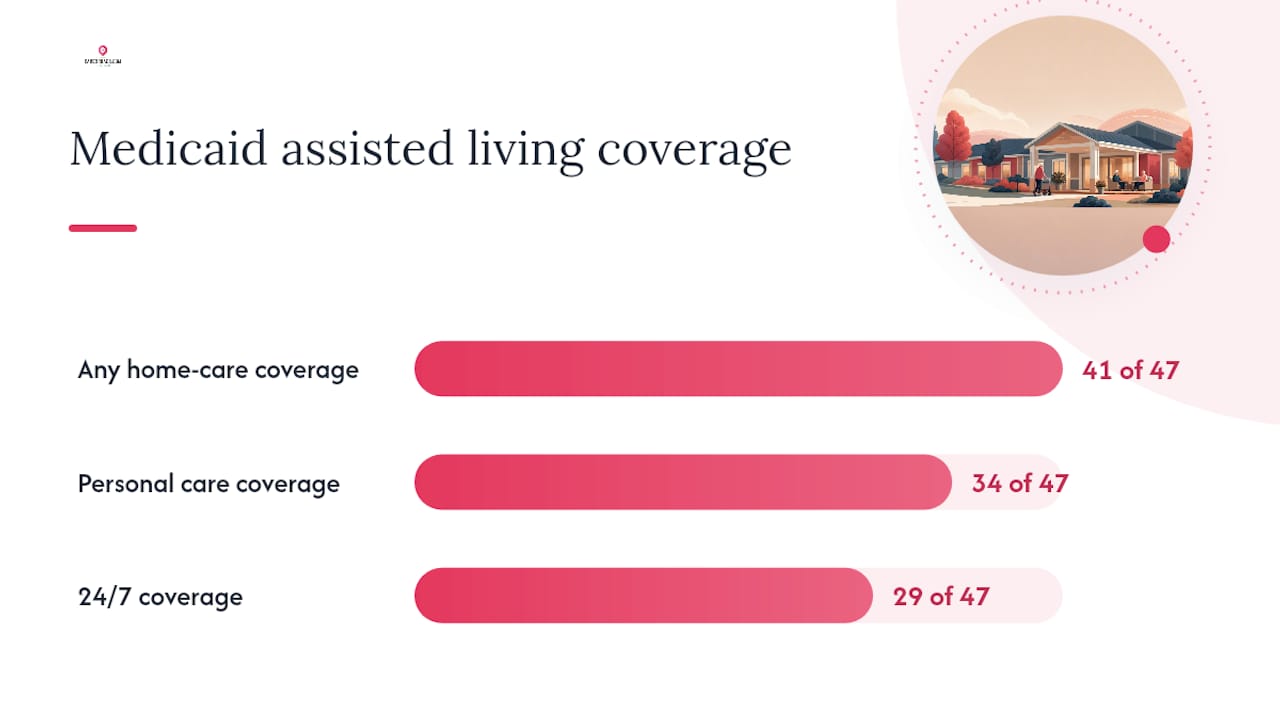
KFF's state survey found that 41 of 47 responding states cover at least some services in assisted living through a Medicaid home care program. Thirty-four of those states cover personal care specifically, and 29 provide 24/7 coverage for residents who need it. That leaves a meaningful number of states offering only partial or limited support, and a handful offering none through this pathway at all.
The authorities states lean on most often include:
- 1915(c) Home and Community-Based Services waivers, commonly used by states that cover assisted living services according to available data
- State plan personal care options, which tend to be broader but often less generous per person
- Section 1115 demonstration waivers, which let a state test alternative coverage models with CMS approval
- Community First Choice (1915(k)), a smaller group of states use this state plan option for attendant care
You can browse CMS's full list of demonstration and waiver programs to see exactly what your state has on file, including the population it targets and whether it's still accepting new applicants.
That last point matters more than most guides admit. Waiver programs almost always come with enrollment caps and geographic targeting, meaning a state can offer a generous-sounding benefit on paper while still leaving eligible residents on a waitlist for years. Access can also differ by county, since some waivers only operate in certain regions or through specific managed care contracts. If you're evaluating options, don't stop at "does my state cover this." Ask which specific waiver applies, whether it's currently accepting enrollees, and whether assisted living communities in your area participate in that program's network.
Eligibility for Medicaid Assisted Living: Income, Assets, and Care Needs
Qualifying for Medicaid-funded services in assisted living involves clearing two separate hurdles: a financial test and a functional one. Meeting only one of them typically isn't enough.
On the financial side, applicants must fall under income and asset limits that vary by state and by which program they're applying through. Many long-term care Medicaid pathways use a higher income threshold than regular Medicaid, often tied to a multiple of the federal benefit rate, alongside an asset limit that commonly sits in the $2,000 to $2,500 range for an individual. Common exemptions include the primary home (up to a state-set equity limit) and one vehicle. Married applicants benefit from spousal impoverishment protections, which let a non-applicant spouse keep a larger share of joint assets and income so they aren't left destitute while their partner qualifies for care.
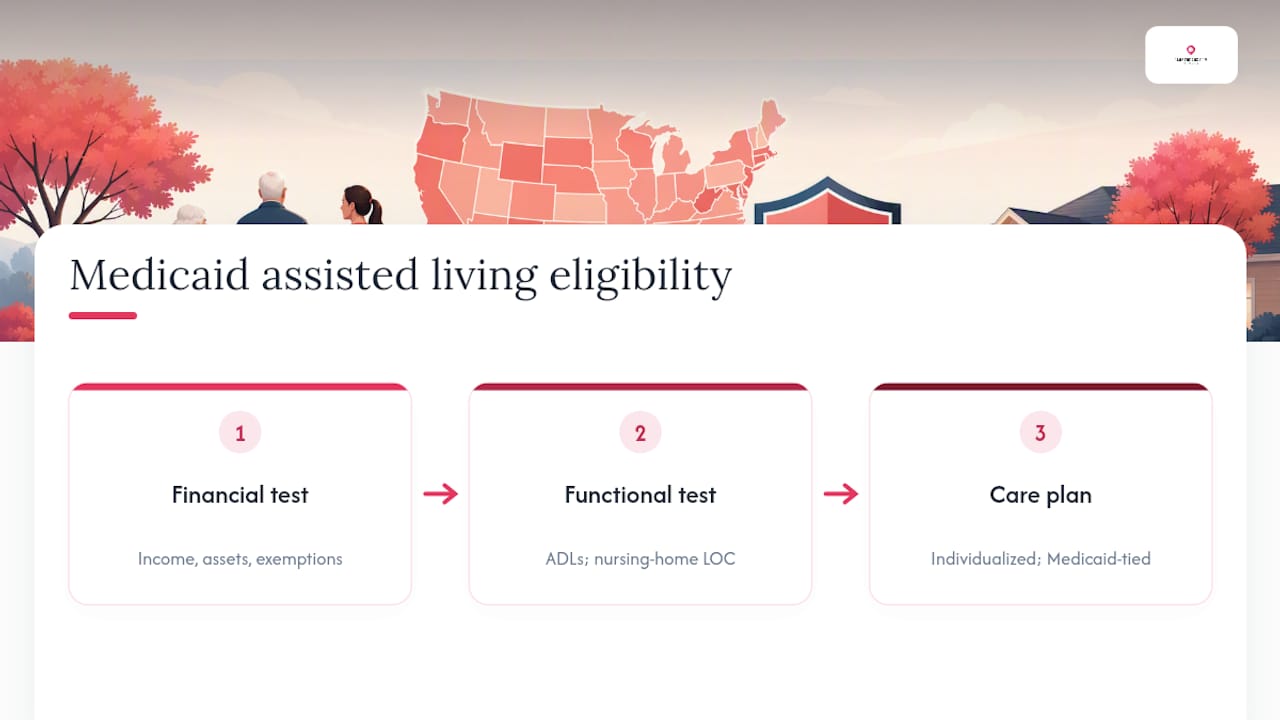
The functional side requires an assessment showing the applicant needs help with activities of daily living, or ADLs, such as bathing, dressing, transferring, or eating. Most waiver programs require the applicant to meet a nursing-home level-of-care standard, meaning the state must determine the person's needs are serious enough to justify an institutional alternative, even though the actual care happens in assisted living. This assessment often happens in person or by telehealth, and case managers use it to build the individualized care plan tied to the Medicaid benefit.
One more detail catches families off guard: the Medicaid look-back period. States review financial transactions going back typically five years to check for asset transfers made to qualify artificially, and penalties for improper transfers can delay eligibility significantly.
Pro Tip: Start gathering bank statements, property deeds, and insurance policies months before applying. An elder-law attorney or a case manager at your local Area Agency on Aging can flag look-back issues early, before they turn into a denial you have to appeal.
The Four Medicaid Authorities Behind Assisted Living Coverage
State Medicaid pages reference program names that sound interchangeable but aren't. Knowing which one applies to you changes what's covered and how long you'll wait.
- 1915(c) HCBS waivers. These are the most common vehicle for assisted living services, but they cap enrollment, meaning states can and do run waitlists even for otherwise-eligible applicants.
- Section 1115 demonstrations. These let a state test a coverage model outside standard Medicaid rules, subject to CMS approval, which is why some states offer benefits others simply don't.
- State plan personal care services. Available more broadly and without the enrollment cap that waivers carry, though the services covered tend to be narrower, often just personal care and medication support.
- Community First Choice (1915(k)). A state plan option focused on attendant care and support for people who'd otherwise need institutional care, adopted by fewer states but generally without a waitlist once approved.
Managed care adds another layer on top of all four. When a state contracts with managed care organizations to run its Medicaid long-term care benefit, the plan (not the state Medicaid office) decides which assisted living communities are in-network and how often services get authorized. Two people with the identical waiver eligibility can end up with different access simply because they're enrolled in different managed care plans.
Where Medicaid Assisted Living Coverage Stops: The Room and Board Gap
Here's the rule that trips up more families than any other: Medicaid does not pay rent, meals, or utility costs at an assisted living community, in any state. That's true even in states with generous waiver programs covering nursing and personal care.
A few states soften the blow. Oregon has used state funds specifically to help offset room and board costs for Medicaid enrollees, and Illinois aligns certain facility rates with SSI payment levels to keep the gap smaller. Most states offer no such supplement, which means the resident's own income, mainly Social Security or SSI, has to cover housing directly.
Families typically close that gap through a combination of:
- SSI payments and any state supplemental payment tied to assisted living
- VA Aid & Attendance for qualifying veterans and surviving spouses
- Long-term care insurance benefits, if a policy exists
- Private pay, often bridging while a waiver application moves through the system
Understanding the true cost of an assisted living community's monthly fee before you commit helps you see exactly how large that room-and-board gap will be.
Pro Tip: Ask facilities directly whether they offer a sliding-scale rate or a bed reserved for Medicaid waiver participants. Some communities negotiate room rates for residents transitioning from private pay to Medicaid, but they rarely advertise it.
Applying for Medicaid Assisted Living Coverage: Steps and Timelines
The application process has a predictable shape, even though timelines shift by state and by which waiver you're pursuing.
- Apply for Medicaid through your state's Medicaid agency, confirming income and assets fall under the relevant long-term care limits.
- Request a functional assessment to establish that ADL needs to meet the nursing-home level-of-care standard most waivers require.
- Apply to the specific waiver or state plan option that covers assisted living in your state, since general Medicaid enrollment alone doesn't guarantee this benefit.
- Confirm a facility accepts that program, since not every assisted living community participates in every waiver or managed care network.
Financial and functional determinations often take several weeks to a few months depending on the state and how complete the initial application is. If a waiver has open slots, placement can follow relatively quickly. If it doesn't, applicants commonly land on a waitlist that can run months or, in some states, years, since enrollment caps limit how many people a waiver can serve at once. If your application is denied, every state offers an appeal process, and requesting it in writing within the state's deadline preserves your right to a hearing.
While waiting, bridging strategies matter. Temporary home health services, a short private-pay stay at an assisted living community, or support coordinated through your local Area Agency on Aging can keep someone safe until a waiver slot opens. Carexroads' Safe Discharge Support resource walks through exactly this kind of transition planning for families moving from a hospital stay into either home care or assisted living while an application is pending.
Pro Tip: Call your state's Aging and Disability Resource Center as soon as you submit a Medicaid application. Case managers there often know which waivers have open slots right now, which can save months of guesswork.
Other Federal Programs That Can Help Cover Assisted Living Costs
Medicaid rarely stands alone as the full financial solution, so it's worth checking these programs too:
- VA Aid & Attendance, a benefit for qualifying veterans and surviving spouses that can add several hundred dollars a month toward personal care or assisted living costs.
- SSI and state supplemental payments, which raise a low-income resident's monthly income and, in some states, get specifically directed toward assisted living room and board.
- HUD housing assistance programs, which occasionally intersect with assisted living costs in states that operate combined housing and services models.
Medicare, worth mentioning here, generally does not pay for assisted living care or room and board at all, though it may cover specific clinical services like home health or hospice delivered to a resident living there.
Carexroads: Helping Families Turn Medicaid Research Into Action
Carexroads built its directory around verified family reviews and an average satisfaction rating, aiming to help families understand Medicaid rules by comparing communities in their ZIP code. Beyond the provider search, resources like Safe Discharge Support and state-specific guides, including one on South Carolina's Medicaid personal care services, help families move from research to an actual application, and from an application to a facility that accepts their program.
What Rights Do Medicaid Recipients Have in Assisted Living Facilities?
Medicaid enrollment doesn't strip away the baseline protections assisted living residents already have, and in some ways it adds a few more. Residents retain the right to a written care plan that reflects their actual needs, the right to be free from unnecessary chemical or physical restraints, and the right to file a grievance without facing retaliation from staff or management.
Because Medicaid-funded services usually come with a state-assigned case manager, recipients also gain a built-in advocate. That case manager is responsible for reviewing whether the care plan still matches the resident's needs, and residents can request a reassessment if their condition changes. If a facility fails to deliver services the state has paid for, or if a managed care plan denies a service without adequate explanation, residents have the right to appeal that decision through the state's Medicaid fair hearing process.
Every state also operates a Long-Term Care Ombudsman program, which investigates complaints about care quality, billing, and resident rights, independent of the facility and independent of the Medicaid agency itself. Families should know this office exists before a problem arises, not after. If a facility threatens discharge over a Medicaid payment dispute, residents generally have the right to a notice period and an opportunity to appeal that discharge, protections that exist specifically because involuntary discharge has historically been used to push out lower-paying Medicaid residents in favor of private-pay ones.
Why the Real Gap Isn't Coverage. It's Coordination.
The GAO, KFF, and NCOA data all point to the same underlying truth: Medicaid's assisted living coverage problem isn't really about generosity. Forty-four states already cover something. The actual failure point is coordination, matching a specific waiver to a specific facility to a specific person's timeline, before a crisis forces a decision.
Conventional advice tells families to "check if your state covers assisted living" as though that's a yes-or-no question. It isn't. The honest answer requires knowing your waiver's enrollment status, your local managed care network, and whether your preferred facility even participates. That's three separate research tasks disguised as one.
If you take away one priority from this guide, make it this: start the functional assessment and the Medicaid application in parallel, not sequentially, and lean on a local case manager or resource like Carexroads' Safe Discharge Support to bridge the gap while a waiver decision is pending. Waiting to apply until you're certain of the outcome is the single most common reason families end up paying privately far longer than they needed to.
— Care
This article is general information, not a substitute for advice from a qualified financial advisor. Consult a qualified financial professional about your own circumstances before acting on anything here.
Sources
- GAO-26-107884, Assisted living facilities: Information on federal spending and Medicaid coverage
- What services does Medicaid cover in assisted living facilities? | KFF
- Does Medicaid pay for assisted living? | NCOA