

Medicaid will pay for nursing home care once a person clears two separate hurdles: a state assessment confirming they need nursing-home level care, and financial rules on income and assets. The facility also has to be Medicaid-certified. Start today by checking your state's income and asset limits, confirming the nursing home accepts Medicaid, and filing the application as soon as eligibility looks possible. The date you file often sets the date coverage can begin.
TL;DR:
- Most states have income limits around $2,982 monthly for individuals and $5,964 for couples in 2025, but these vary significantly by location.
- If income or assets exceed limits, applicants might qualify through spend-down, special income levels, or Qualified Income Trusts, with timing and paperwork being critical for approval.
- Medicaid reviews asset transfers from the past five years, and improperly timed or unreported gifts can result in several months of ineligibility.
- Incomplete application documentation is the main reason for delays, so preparing all required financial, medical, and property records upfront speeds processing.
- Verify nursing homes' Medicaid acceptance through official tools or direct inquiries and consider family reviews to understand each facility's experience with Medicaid residents.
Table of Contents
- What Determines Medicaid Nursing Home Eligibility?
- What If Income or Assets Exceed the Limit?
- Avoiding the Look-Back Trap: Timing and Paperwork
- Confirming a Nursing Home Accepts Medicaid
- How Carexroads Helps Families Through This Process
- Our Take: Where Families Waste Time on This Process
- Get Help Finding Medicaid-Accepting Care Near You
- Sources
- FAQ
What Determines Medicaid Nursing Home Eligibility?
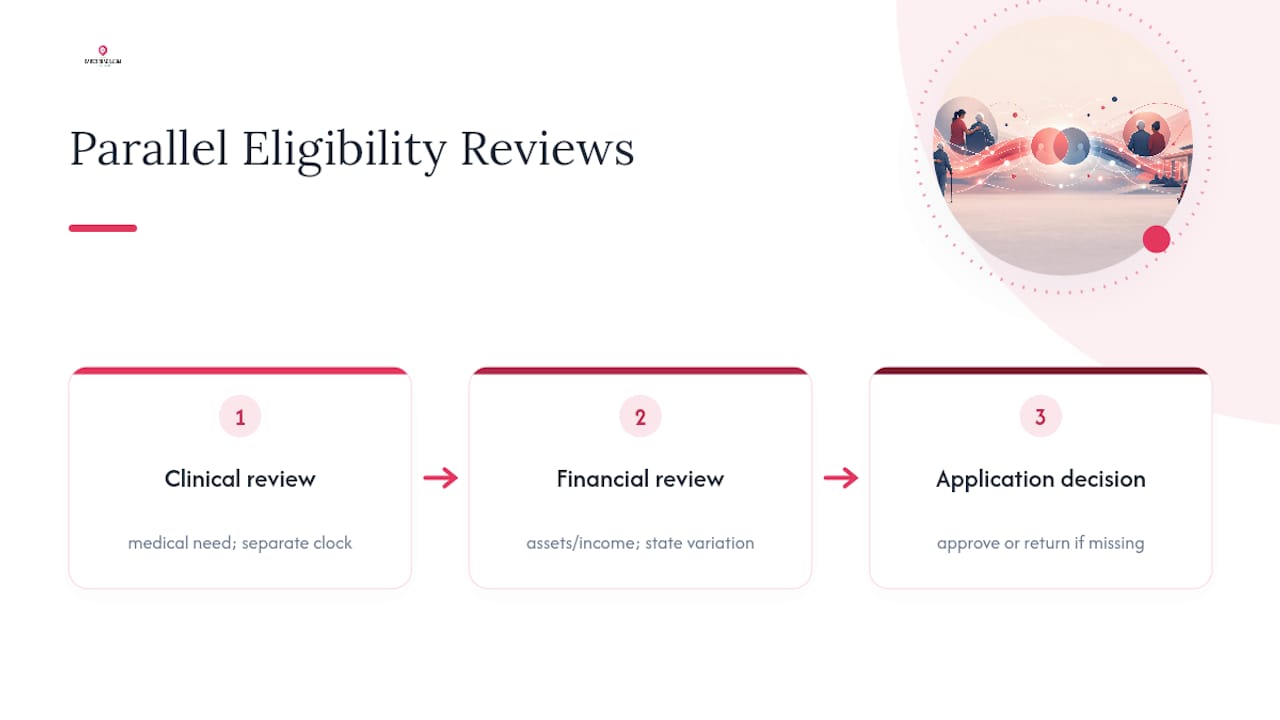
Two separate reviews decide whether Medicaid nursing home eligibility applies to your loved one, and families often focus on only one of them. The clinical review comes first. A state-designated assessor evaluates whether the applicant needs Nursing Home Level of Care (NHLOC), looking at activities of daily living like bathing, dressing, and eating, along with medical needs, cognitive decline, and behavioral symptoms tied to conditions such as dementia. Someone who can't safely manage medications or wanders without supervision typically clears this bar even if they can still walk unassisted.
The financial review runs in parallel and gets more complicated. States count income (Social Security, pensions, retirement withdrawals) and resources (bank accounts, investments, a second property), while exempting things like the primary residence in many cases, one vehicle, and a small life insurance policy. Married couples get extra protection here: spousal impoverishment rules let a non-applicant spouse keep a portion of the couple's income and assets so they aren't left destitute while their spouse is in care.
The dollar figures matter, and they vary sharply by state. KFF's 2025 benchmark data puts the standard institutional income limit at roughly $2,982 a month for an individual and $5,964 for a married couple. Some states set their limits lower or use different formulas entirely, including an optional "special income level" that raises the ceiling for people already in a nursing home.
Before you assume anyone is over or under the line, confirm the actual figures with your state Medicaid office:
- Countable income: wages, Social Security, pensions, annuity payments
- Countable resources: checking and savings accounts, stocks, extra real estate
- Common exemptions: primary home (with equity limits in many states), one vehicle, burial funds, small life insurance policies
- Spousal protections: a community spouse resource allowance and a minimum monthly income allowance for the spouse remaining at home
What If Income or Assets Exceed the Limit?
Being over the limit doesn't automatically disqualify anyone. States built several legal pathways specifically for families in this position, and knowing which one applies can be the difference between six months of private-pay bills and Medicaid coverage starting now.
- Medically needy or spend-down. Thirty-four states let applicants with income above the standard cutoff "spend down" excess income on medical bills until they hit the medically needy limit, at which point Medicaid kicks in for the remainder of that period, according to KFF's state indicator data. It works like an insurance deductible that resets periodically rather than once.
- Special Income Level (the "300% rule"). Many states allow institutionalized applicants to qualify at up to 300% of the federal SSI benefit rate, a substantially higher bar than the standard non-institutional limit.
- Qualified Income Trusts, sometimes called Miller trusts. In states that don't offer medically needy pathways, applicants deposit excess income into an irrevocable trust each month, which lowers their countable income enough to qualify, per NCOA's guidance on over-income eligibility. Not every state recognizes these trusts, and the trust has to be funded and administered correctly from the start.
- Legal asset spend-down. Paying off medical bills, prepaying funeral and burial expenses, or buying exempt items like home modifications can lower countable assets without triggering a penalty.
Pro Tip: Qualified Income Trusts are unforgiving of timing errors. A trust set up even a few weeks late, or funded inconsistently, can be rejected by the state Medicaid agency, so this is one area where a Medicaid planner earns their fee.
What you can't do is give away money or property to get under the limit. That's where the look-back period comes in, and it trips up more families than any other rule in this process.
Avoiding the Look-Back Trap: Timing and Paperwork
Medicaid reviews the five years (60 months) before your application date, checking for any asset transferred for less than fair market value, according to Medicaid. Gifting a grandchild $20,000 for a down payment three years ago counts, even if the money is long gone and the intent had nothing to do with Medicaid planning.
States calculate the penalty by dividing the transferred amount by the average monthly cost of nursing home care in that state. A $60,000 gift in a state where nursing care runs $6,000 a month creates a 10-month period of ineligibility, starting from the date the person would otherwise have qualified, not the date of the transfer. That gap has to be covered privately, which is exactly the situation families are trying to avoid.
If a past transfer exists, disclose it. Don't hope it goes unnoticed. A Medicaid look-back guide can walk you through which transfers carry exemptions (certain transfers to a spouse or a disabled child, for instance) and what remedies exist, such as returning the asset before the application is finalized.
Processing itself moves faster when the paperwork is complete. States generally have 45 days to decide a case, or 90 days if a disability determination is required, according to the Administration for Community Living. Gather these before you file:
- Government-issued photo ID and Social Security number
- Twelve months of bank statements for every account
- Property deeds, vehicle titles, and any trust documents
- Pay stubs, pension statements, and Social Security award letters
- Medical records supporting the level-of-care determination
Incomplete files are the single most common reason applications stall. A spend-down checklist built around 30, 60, and 90-day windows helps families track both the paperwork and the financial moves at the same time.
Confirming a Nursing Home Accepts Medicaid
Medicare rarely covers long-term custodial nursing home stays; it's built for short rehabilitation stints, not months or years of care, according to Medicare. Families sometimes discover this only after a short-term skilled nursing stay ends and the bills keep coming. Check Medicaid status before you sign anything, not after.
Medicare's Nursing Home Compare tool lets you verify a facility's Medicaid certification alongside its inspection history and staffing ratios. Beyond the certification checkbox, ask the facility directly:
- Are you currently accepting new Medicaid residents, or is there a waitlist?
- How many Medicaid-designated beds do you have available right now?
- What happens to my loved one's income once Medicaid coverage begins?
That last question matters more than most families realize. Once approved, the resident's income (minus a small personal needs allowance, typically $30 to $75 a month depending on the state) goes toward the cost of care, with Medicaid covering the rest, per CMS's beneficiary guidance. If the application is denied instead, every state offers an appeal process with a firm deadline, usually 30 to 90 days from the denial notice, so read that letter the day it arrives.
How Carexroads Helps Families Through This Process
Families rarely need convincing that Medicaid rules are confusing. What they need is a way to confirm, quickly, whether a specific nursing home near them actually accepts Medicaid and how other families rate the experience once someone moves in. Carexroads built its directory around that exact gap, pairing verified provider listings with real family reviews so the search doesn't rest on a facility's own marketing.
Guides like Avoid Private Bills walk through state-by-state financial rules in plain language, and Safe Discharge Support exists specifically for the moment a hospital discharge planner says "find a placement by Friday" and a family has no idea where to start with the Medicaid side of that decision.
Our Take: Where Families Waste Time on This Process
The conventional advice on Medicaid nursing home eligibility treats it as a single yes-or-no question. It isn't. It's two separate tests running on different clocks, and the biggest mistake we see is families solving the financial puzzle while ignoring the clinical one, or vice versa, until an application gets kicked back for missing paperwork.
The federal benchmarks from KFF and CMS matter, but they're a starting point, not the finish line. State variation is where families actually get stuck, whether that's a medically needy pathway that exists in one state and not the neighboring one, or a Qualified Income Trust that a caseworker rejects because it was funded a week late. Precision on timing beats effort on research every time.
If we had to name one priority above the rest: apply the moment eligibility looks plausible, not once it looks certain. Waiting to be sure costs families real money, month by month, while the clock the state uses to calculate coverage never pauses for indecision.
— Care
Get Help Finding Medicaid-Accepting Care Near You
Carexroads exists for exactly the moment you're in right now: staring at a list of nursing homes with no way to know which ones actually take Medicaid or how families who've already been through this rate their experience.

Instead of calling a dozen facilities to ask about Medicaid beds, search verified, family-reviewed providers by location on Carexroads and read what other families actually experienced before you commit. If a hospital discharge is looming and you need a placement fast, Safe Discharge Support connects you with options that fit both the timeline and the Medicaid requirements. If nursing home placement isn't quite the right fit yet, our guide on how home care helps seniors stay independent is worth a look before you decide. Start your search today and skip the weeks of guesswork.
This article is general information, not a substitute for advice from a qualified financial advisor. Consult a qualified financial professional about your own circumstances before acting on anything here.
Sources
- Medicaid eligibility levels for older adults and people with disabilities, non-MAGI, 2025 | KFF
- Applying for Medicaid | Administration for Community Living (ACL)
- Medicare
- How will Medicaid cover long-term care if I'm over income? | NCOA
FAQ
What Are the Income Limits for Medicaid Nursing Home Coverage?
The 2025 federal benchmark is about $2,982 a month for an individual and $5,964 for a married couple, but state limits vary, so confirm the figure with your state Medicaid office.
How Long Does It Take to Get Approved for Medicaid Nursing Home Care?
States generally have 45 days to process an application, extending to 90 days if a disability determination is needed, and incomplete paperwork is the most common cause of delay.
What Happens If Income or Assets Exceed the Limit?
Applicants can often qualify through a medically needy spend-down, a Special Income Level pathway, or a Qualified Income Trust, depending on what the state offers.
How Far Back Does Medicaid Check Financial Records?
Medicaid reviews the 60 months before the application date for asset transfers made for less than fair market value, and disqualifying transfers can create a penalty period of ineligibility.
How Do I Confirm a Nursing Home Accepts Medicaid?
Check the facility's certification status through Medicare's Nursing Home Compare tool and ask directly about current Medicaid bed availability, or use a verified directory like Carexroads to compare family-reviewed options in your area.