

Yes, a properly drafted family caregiver agreement can protect Medicaid eligibility by converting payments to a relative into documented compensation instead of a countable gift. To make it work, sign the agreement before care begins, set a rate backed by local market evidence, and start logging hours the same day. Skip any of those three, and you risk a penalty period.
TL;DR:
- Sign the caregiver agreement before care begins and set a fair market rate with supporting local quotes to avoid Medicaid penalty periods.
- Maintain detailed, contemporaneous logs and payment records that match the contract's terms to prove the arrangement's legitimacy.
- Vague job descriptions, retroactive signing, or cash payments without documentation can invalidate the agreement and cause Medicaid ineligibility.
- Families should work with legal and tax professionals when dealing with complex estate issues or regular payments to ensure compliance and documentation accuracy.
- A well-drafted agreement can impact Medicaid, SSI, and tax status, so proper signing, rate setting, recordkeeping, and legal review are essential for protection.
Table of Contents
- What Is a Family Caregiver Agreement?
- How Does This Agreement Affect Medicaid Eligibility?
- What Should a Family Caregiver Contract Include?
- Do Family Caregivers Owe Taxes as Household Employees?
- What Records Prove the Agreement Is Real?
- How Do You Set a Fair Market Caregiver Rate?
- What Mistakes Invalidate a Caregiver Agreement?
- When Should You Consult an Elder-Law Attorney?
- Does This Agreement Affect SSI or Other Benefits?
- Why Formalizing Caregiver Pay Is an Act of Care, Not Just Paperwork
- How Carexroads Can Help Families Move Forward
- Where to Verify These Rules Yourself
- Sources
- FAQ
What Is a Family Caregiver Agreement?
A family caregiver agreement, also called a personal care agreement or caregiver compensation agreement, is a written contract between a care recipient (or their representative) and a family member who provides hands-on care. It typically involves two parties: the person receiving care, often an aging parent, and the adult child, sibling, or other relative doing the caregiving. Some families add a power of attorney as a signing party when the care recipient can no longer manage their own affairs.
Families use these agreements for three practical reasons: to plan around future Medicaid eligibility, to fairly compensate a relative who has scaled back paid work to provide care, and to head off resentment among siblings who wonder where money is going. The legal effect matters more than the paperwork itself. Without a contract, money moving from parent to child looks like a gift, even when real caregiving work is happening. With a signed, prospective agreement describing specific duties and a market rate, that same payment becomes compensation for services. That distinction is the entire reason this document exists.
How Does This Agreement Affect Medicaid Eligibility?
Medicaid's asset rules assume the worst about transfers between family members. Any transfer of money or property within the 60 month look-back period before a Medicaid long-term care application is presumed to be a gift, and gifts trigger a penalty period of ineligibility. A written personal care agreement, signed before services start, is one of the few tools that can rebut that presumption.
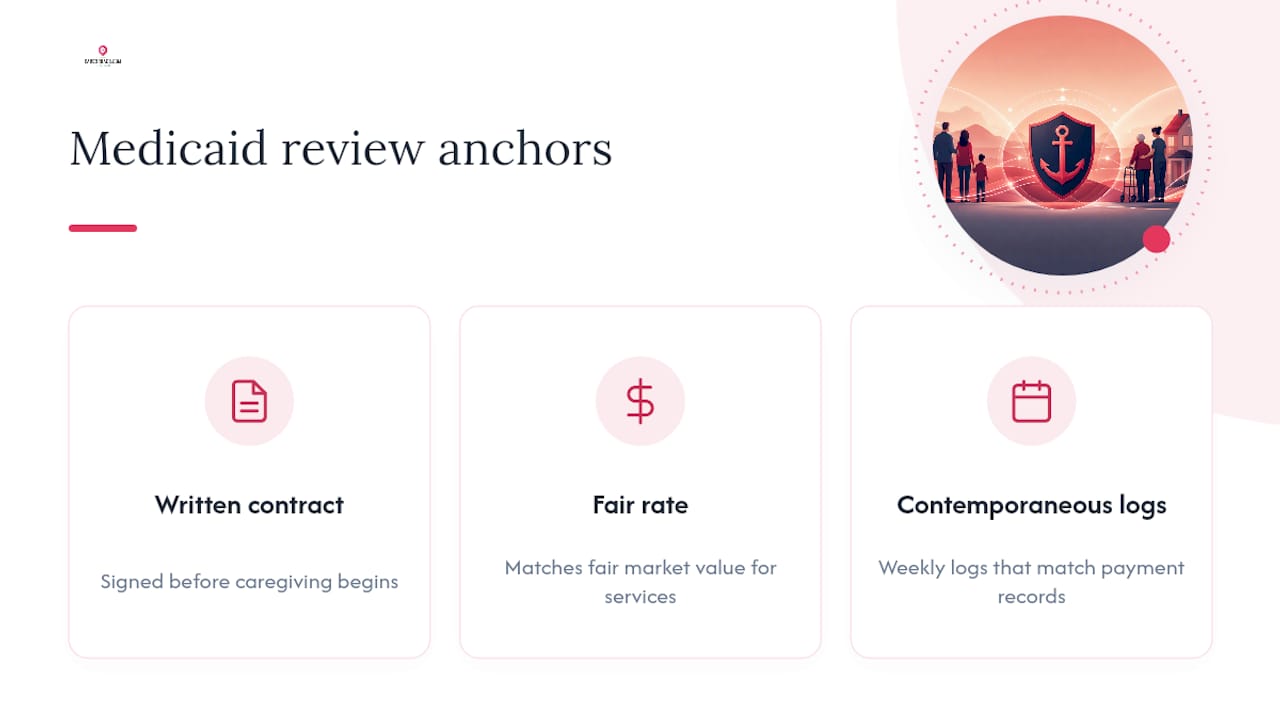
Caseworkers reviewing an application typically examine three things. First, a written, prospective contract, meaning it was signed before the caregiving began, not drafted after the fact to explain payments already made. Second, a rate that reflects fair market value for the services performed, not an inflated number chosen to move money out of an estate. Third, contemporaneous records: logs and payment history that match the contract's terms week by week.
The consequence of getting this wrong is concrete. If Medicaid determines a transfer was an uncompensated gift, it calculates a penalty period by dividing the transferred amount by the average monthly cost of nursing home care in that state. A $60,000 payment with no supporting contract can translate into months of ineligibility right when a family needs coverage most, and the penalty clock often starts at the point the person would otherwise have qualified, not when the transfer occurred. That timing gap is what catches families off guard: they discover the problem only when they file the application, sometimes years after the disputed payments were made.
This is also why documented caregiver payments interact differently with Medicaid than undocumented ones, and why the look-back period varies somewhat by state administration even though the federal 60-month window sets the baseline.
What Should a Family Caregiver Contract Include?
A caregiver contract template that actually holds up under Medicaid or IRS scrutiny needs more than a handshake summary. The American Bar Association's guidance on family caregiver agreements outlines the core requirements, and elder-law practice adds a few practical refinements on top.
At minimum, the agreement should specify:
- Parties and start date. Name everyone involved and state a start date that falls on or after the signature date, never before it.
- Signature authority. If the care recipient lacks capacity, the agent under a valid power of attorney can sign, but the contract should recite that authority and flag the conflict of interest if the agent is also the caregiver being paid.
- Scope of services. List specific tasks (bathing, medication reminders, meal preparation, transportation to appointments, overnight supervision) rather than a vague phrase like "personal care."
- Hours and schedule. Set minimum and maximum weekly hours, including whether the arrangement covers live-in care, part-time hours, or on-call backup shifts.
- Compensation terms. State the hourly rate, pay frequency, and payment method, along with any expense reimbursement process for mileage or supplies.
- Recordkeeping obligations. Require time logs and receipts as a condition of the contract, not an afterthought.
- Termination and modification clauses. Spell out how either party can end or change the arrangement, and require written amendments rather than verbal side agreements.
- Backup care provisions. Address what happens if the family caregiver is sick, traveling, or needs relief, including who can substitute and how that person is compensated.
A sample caregiver agreement template can show what this looks like in practice, but every family should adapt the language to their actual care needs rather than copying a generic form word for word.
Do Family Caregivers Owe Taxes as Household Employees?
Whether a paid family caregiver counts as a household employee or an independent contractor depends on control, not job title. If the care recipient or family sets the schedule, dictates how tasks are performed, and provides supplies, the caregiver is almost always a household employee under IRS rules, even when the "employer" is a parent being cared for by a child.
That classification carries real tax consequences. For 2026, once a household employee's cash wages exceed $2,800 in a calendar year, the employer generally owes Social Security and Medicare withholding, commonly called nanny tax obligations even though the worker is a caregiver, not a nanny.
Quick reference for families paying a relative caregiver:
- Wages above the $2,800 threshold typically require Social Security and Medicare withholding.
- IRS Publication 926 explains the difference between household employees and independent contractors and lays out reporting steps.
- Non-live-in caregivers working over 40 hours a week may trigger overtime pay requirements under the Fair Labor Standards Act.
- Many families hire a payroll service to handle W-2 issuance rather than risk misclassifying a caregiver as a 1099 contractor.
Getting this wrong does not just create a tax problem. It can also undercut the Medicaid case, because inconsistent tax treatment raises questions about whether the arrangement was a real job or an informal family favor dressed up on paper.
What Records Prove the Agreement Is Real?
Medicaid caseworkers and IRS auditors want the same thing: a paper trail that lines up day by day, not a contract that exists in isolation.
- Daily time logs. Each entry needs the date, hours worked, specific tasks performed, and the caregiver's initials or signature.
- Payment proof. Checks, bank transfers, or payroll reports that show payment amounts matching the logged hours and the contracted rate.
- Backup copies. Scanned logs and payment records stored in a shared cloud folder, kept for at least the length of the Medicaid look-back period plus a buffer, generally five to seven years.
- Consistency checks. Regularly confirm that logged hours and paid amounts match; gaps between the two are the first thing reviewers flag.
The most common failure point is not a bad contract. It's a stack of backdated logs filled out all at once before an application is filed, which reads as fabricated the moment a caseworker compares handwriting or ink dates across months.
Pro Tip: Keep a simple shared spreadsheet or a caregiving app log updated in real time. A contemporaneous digital timestamp is far more persuasive to a Medicaid reviewer than a handwritten log filled out from memory.
How Do You Set a Fair Market Caregiver Rate?
The rate written into the contract needs to reflect what a stranger would charge for the same work in the same area, not what feels generous or convenient for the family.
- Collect at least three quotes from local home care agencies for comparable, non-medical care services.
- Check Bureau of Labor Statistics wage data or county-level wage reports for home health and personal care aides in your area.
- Save copies of local job postings advertising similar caregiving roles as backup evidence.
- Write the source of the rate directly into the contract text, and keep copies of the quotes in the same file as the signed agreement.
Ongoing hourly payments tend to hold up better than a single prepaid lump sum, since a large upfront payment draws far more scrutiny from Medicaid reviewers than steady, documented wages paid as work is performed.
What Mistakes Invalidate a Caregiver Agreement?
The single most damaging error is a retroactive agreement, one signed after care has already been happening for months, attempting to explain payments already made. Medicaid treats these as after-the-fact rationalizations, not legitimate contracts.
Other frequent problems include vague job descriptions ("helping mom out"), no contemporaneous logs to back up the hours claimed, and hourly rates set well above local market value with no documentation explaining why. Paying in cash with no bank trail, or failing to report wages on a tax return, compounds the problem: it removes the very paper trail that would otherwise prove the arrangement was real.
When Should You Consult an Elder-Law Attorney?
Complex estates, an existing power of attorney, or prior undocumented payments to a family caregiver are all strong signals to bring in professional help before filing a Medicaid application. An elder-law attorney can review the contract language, confirm state-specific rules, and flag past payments that may need correcting. A tax advisor can confirm household employer obligations separately. The cost of an hour or two of legal review is almost always smaller than the cost of a Medicaid penalty period discovered after the fact.
Does This Agreement Affect SSI or Other Benefits?
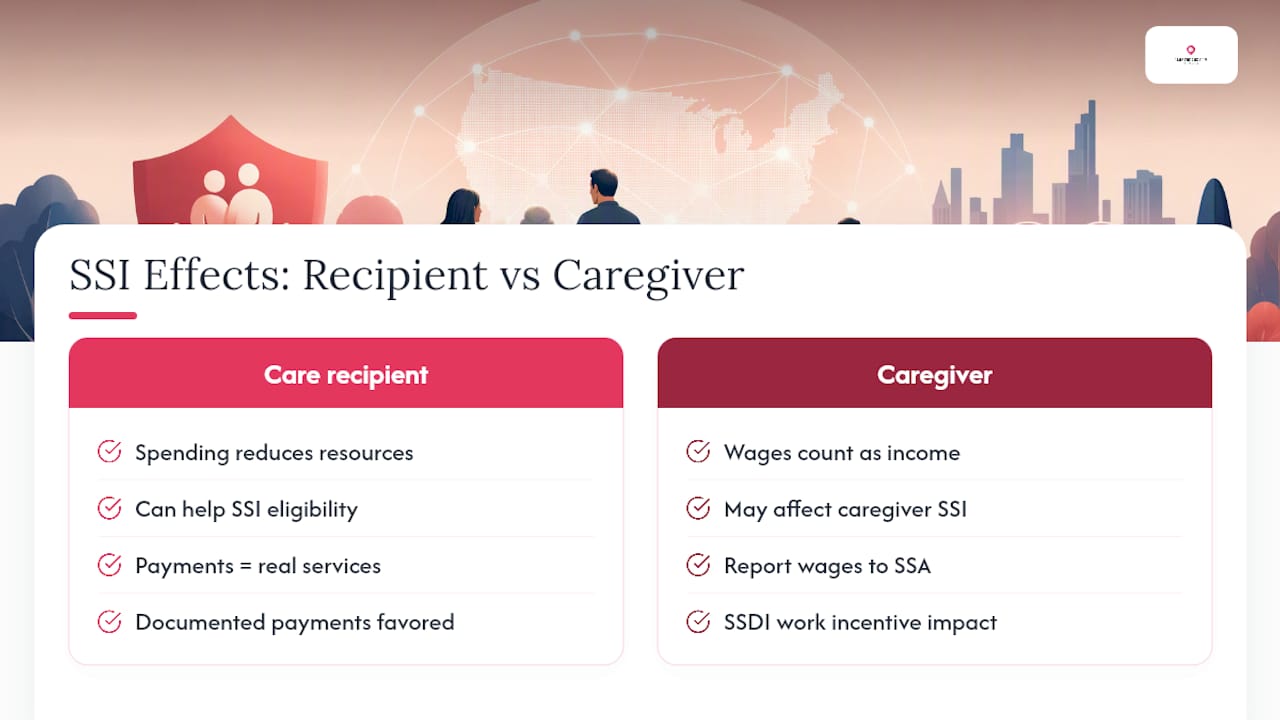
Medicaid is not the only program a family caregiver agreement can touch. Supplemental Security Income (SSI) counts both income and resources, and a care recipient who starts paying a relative caregiver is spending down assets, which can actually help someone qualify for or maintain SSI resource limits by reducing countable savings over time.
The caregiver's side of the ledger matters too. Wages earned from a family caregiver agreement count as income for the caregiver, which can affect their own SSI eligibility if they separately receive benefits, and it may interact with Social Security Disability Insurance work incentive rules if the caregiver is disabled and working part time. A caregiver who also receives SSI needs to report the new wages to the Social Security Administration promptly, since unreported income is one of the fastest ways to trigger an overpayment notice.
There's a ripple effect on the care recipient's own benefits as well. If the care recipient receives SSI, spending assets to pay a documented caregiver is generally treated more favorably than an unexplained gift, but the payments still need to reflect real services at a fair rate. The same documentation standards that protect Medicaid eligibility, prospective signing, market rate, contemporaneous logs, do double duty here. A contract built to Medicaid standards will generally hold up under SSI review too, because both programs are looking for the same thing: proof that money changed hands for a real reason, not to manipulate resource limits.
Why Formalizing Caregiver Pay Is an Act of Care, Not Just Paperwork
Families often feel awkward putting a price on a daughter's help with her father. That discomfort is normal, but it shouldn't stop the paperwork. A signed agreement protects the caregiver's income and the recipient's Medicaid eligibility at once. Review the rate yearly, and talk about it openly at a family meeting. Documentation honors the work being done. It doesn't cheapen it.
— Care
How Carexroads Can Help Families Move Forward
A family caregiver agreement solves the compensation and documentation side of care, but it doesn't answer every question families face when a parent needs more support than one relative can provide alone. That's where having a second option matters.
There are platforms that allow families to compare paid home-care options side by side, using real family reviews to provide insight into backup or supplemental care costs in your area. If a family caregiver agreement is only part of the plan, perhaps you need overnight relief, weekend coverage, or a transition to more consistent home health support, browse vetted providers across home care, home health, and other senior care categories to see what's available near you. Families who aren't sure whether they need a few hours of relief a week or a full care team can start with a free in-home care assessment to get a clearer picture of options and costs before making a decision. It's a practical next step whether the family caregiver agreement is your whole plan or just the first piece of it.
Where to Verify These Rules Yourself
- American Bar Association guidance on drafting effective agreements
- Caregiver on personal care agreements
This article is general information, not a substitute for advice from a qualified financial advisor. Consult a qualified financial professional about your own circumstances before acting on anything here.
Sources
- Creating effective agreements for payment of family caregivers — American Bar Association
- Caregiver
- IRS Publication 926 — Household Employer's Tax Guide
FAQ
Can I Get Paid to Be a Family Caregiver in the US?
Yes, family members can be paid caregivers through a documented personal care agreement, Medicaid self-directed programs in many states, or veterans' benefits programs for eligible households. The specific rules and rates depend heavily on your state's Medicaid program and the payment structure you set up.
What States Pay Family Caregivers the Most?
Rates vary widely by state Medicaid program, local cost of living, and the specific self-directed care option used, so there is no single national figure. The most reliable way to know your state's rate is to check your state Medicaid office directly or compare local home care agency quotes, which is also the evidence you need for your own contract.
Does a Caregiver Agreement Have to Be Notarized?
Notarization is not universally required for a family caregiver agreement, but it can add credibility and help prove the exact date the contract was signed if a dispute arises later. Given how much weight Medicaid places on prospective signing, notarizing the agreement is a low-cost way to remove any doubt about timing.
How Do I Find Someone to Help Draft This Agreement?
You can work with an elder-law attorney for a formal contract review, or start from a sample caregiver agreement template and adapt it to your family's specific care needs. Carexroads' guides can also point you toward vetted elder-law professionals in your area if you want legal review before signing.