

Discharge against medical advice (AMA) means a patient chooses to leave a hospital or clinical setting before the medical team recommends discharge. For families of seniors, that moment can feel alarming. The most important thing you can do right now is stay calm, ask the care team to document the conversation, and request a written plan before your loved one walks out the door.
Here is what to do immediately:
- Confirm decision-making capacity. Ask the nurse or physician whether a capacity assessment has been completed. The American Medical Association and American Family Physician guidelines both require this step before any AMA discharge proceeds.
- Request a written discharge summary that includes the diagnosis, current medications, and emergency return criteria.
- Ask for prescriptions to be dispensed at the bedside pharmacy or sent electronically before leaving.
- Get direct contact information for the discharging clinician and the hospital's case manager or social worker.
- Know that Medicare coverage is not automatically voided. Current guidance confirms that leaving AMA does not trigger a loss of coverage or a premium increase.
Pro Tip: Before your loved one leaves, ask the social worker to connect you with a home health agency or arrange an outpatient follow-up within seven days. Carexroads can help you locate verified home care and post-discharge support options quickly.
Table of Contents
- What does "discharge against medical advice" actually mean?
- How clinicians decide whether a senior can leave AMA
- Why seniors often want to leave early
- Risks and insurance realities after a senior leaves AMA
- Step-by-step checklist when a senior wants to leave AMA
- What clinicians should offer, and families should request
- Choosing what comes next after an AMA discharge
- Key Takeaways
- What families often get wrong about AMA discharges
- Carexroads helps families find post-discharge care fast
- Authoritative sources and further reading
What does "discharge against medical advice" actually mean?
An AMA discharge is primarily an administrative and documentation label. It tells the care team, the hospital's risk management department, and future providers that a patient chose to leave before the recommended endpoint of care. It can apply to several situations: a patient walking out of the emergency department before evaluation is complete, a patient refusing a recommended surgery or procedure, or a patient leaving an inpatient unit before test results are back.
The label itself does not end the clinician's duty of care. Ethically and legally, the care team is still responsible for offering harm-reduction support, documenting the conversation, and arranging follow-up. According to a narrative review in the American Journal of Medicine, AMA discharge practice is highly subjective and variable across physicians and facilities, which means the same patient decision may be labeled differently depending on who is on duty.
Prevalence: Approximately 1%–2% of all U.S. hospitalizations result in an AMA discharge — a small but clinically significant share, given the associated risks.
Common scenarios where the AMA label appears:
- Leaving the emergency department before a workup is complete
- Refusing a recommended inpatient procedure or surgery
- Departing before IV antibiotics or other time-sensitive treatments finish
- Elopement (leaving without notifying staff), which is more common in patients with cognitive impairment
How clinicians decide whether a senior can leave AMA
Before a patient can leave AMA, the care team must confirm that the person has decision-making capacity. This is not the same as a legal competency ruling, which requires a court. Capacity is a clinical determination made at the bedside, and it rests on four abilities, as outlined by American Family Physician (AAFP):
- Understanding: Can the patient state what condition they have and what the recommended treatment is?
- Appreciation: Do they understand how the illness and the proposed treatment apply to their own situation?
- Reasoning: Can they weigh the risks and benefits and explain their logic?
- Communicating a choice: Can they express a consistent decision?
When a senior has dementia, delirium, or significant cognitive impairment, a formal capacity consult from psychiatry or neurology may be needed. If capacity is absent, a legally authorized surrogate, such as a healthcare proxy or power of attorney, steps in. Families should ask whether an advance directive is on file, because it directly shapes who can make decisions in this moment.
One point families often misunderstand: signing an AMA form is not legally required. As documented in peer-reviewed guidance, the legal and ethical requirement is a documented informed-refusal conversation, not a signed waiver. The chart note matters far more than the form.

Pro Tip: If staff pressure your loved one to sign paperwork quickly, ask for a few minutes to review it. You have the right to read any document before it is signed.
Why seniors often want to leave early
Understanding the reason behind an AMA request is often the fastest way to resolve it. Common drivers in older adults include:
- Uncontrolled pain or discomfort from procedures
- Delirium or confusion that makes the hospital feel threatening
- Medication side effects, including sedation or agitation
- Fear, claustrophobia, or anxiety in an unfamiliar environment
- Worry about a pet, a spouse at home, or financial concerns
- Substance withdrawal, which can escalate quickly without treatment
- Prior negative hospital experiences that erode trust
Geriatric-specific contributors add another layer. Sensory impairment (poor hearing or vision without aids) can make communication nearly impossible. Mobility limitations make a hospital bed feel like confinement. Cognitive decline may mean a senior genuinely cannot follow what is happening around them. Many of these triggers are solvable once staff are aware of them. Alerting the nurse early, asking for a patient advocate, or requesting a social work consult can shift the conversation before an AMA request becomes final.
Risks and insurance realities after a senior leaves AMA
The clinical risks of leaving AMA are real and worth understanding clearly. Research cited by AHRQ's PSNet found that AMA patients had a readmission rate of 21% within 15 days, compared to 3% for matched controls. For seniors with cardiac, pulmonary, or infectious diagnoses, leaving before treatment is complete raises the risk of rapid deterioration.
That said, the insurance consequences are widely misunderstood. Many clinicians incorrectly believe that insurers will deny payment for a hospital stay when a patient leaves AMA. Research published in PubMed describes this as a pervasive myth that can lead to coercive statements to patients. Current AMA guidance is clear: leaving AMA does not automatically void Medicare or private insurance coverage, and it does not trigger a premium increase. For a deeper look at how insurance authorization works around discharge, that resource walks through the specifics.
Practical consequences families should still prepare for:
- Difficulty filling prescriptions if they were not dispensed before departure
- Missed window to arrange home health through the hospital's discharge planning team
- Documentation in the medical record that may affect how future providers interpret the stay
- Potential out-of-pocket costs if readmission occurs and the insurer reviews the sequence of events
Step-by-step checklist when a senior wants to leave AMA
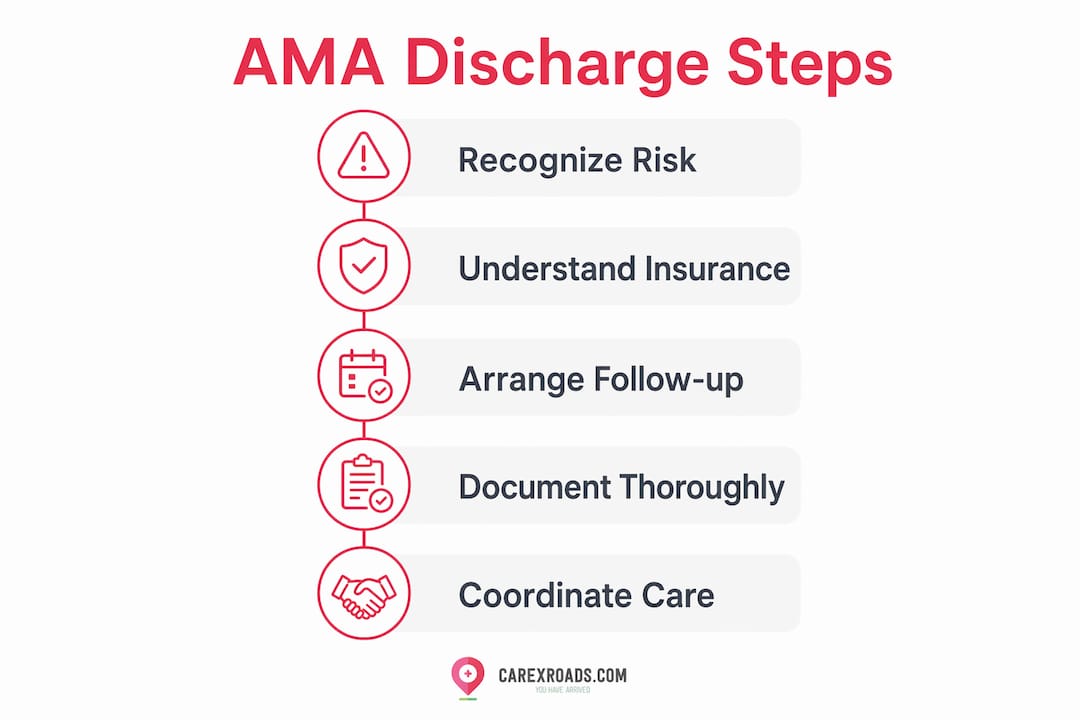
Acting quickly and methodically reduces harm. Here is a prioritized sequence:
- Pause the departure. Ask the nurse to notify the attending physician immediately. A few minutes of conversation can change the outcome.
- Request a capacity assessment if one has not been documented. Ask who performed it and whether it is in the chart.
- Ask the physician to explain risks and alternatives in plain language. Request that a family member be present for this conversation.
- Request prescriptions dispensed at bedside or sent electronically to a pharmacy the senior can reach today.
- Get a written discharge summary that includes diagnosis, current medications, and clear return-to-ED criteria.
- Collect direct contact information for the attending physician and the hospital's case manager or social worker.
- Schedule outpatient follow-up before leaving. AHRQ and AAFP guidance recommends follow-up within seven days to reduce readmission risk.
- Arrange home health or medication delivery through the hospital's social work team or through a resource like Carexroads.
- Call the primary care physician the same day to report the AMA discharge and coordinate ongoing care.
Pro Tip: Ask the case manager for a written copy of any referrals or follow-up appointments arranged before discharge. Verbal promises are easy to lose in the transition.
Post-departure, use Carexroads' post-discharge follow-up guide to track phone check-ins, medication schedules, and home care visits in the days that follow.
What clinicians should offer, and families should request
Harm reduction does not stop when a patient says they want to leave. Evidence-based recommendations include several practical steps clinicians can take before the patient walks out:
- Offer oral medication alternatives when IV treatment is the standard, so the senior can continue therapy at home
- Dispense critical prescriptions at the bedside before departure
- Arrange a home health visit or visiting nurse for the next day
- Schedule an outpatient clinic appointment within seven days
- Use motivational interviewing and nonjudgmental language to address the underlying concern
- Involve a family member, trusted surrogate, or patient advocate in the conversation
- Request a social work or psychiatry consult when withdrawal, mental health, or financial stress is driving the request
These steps lower readmission risk and keep the care relationship intact. Families can and should ask for all of them explicitly.
Choosing what comes next after an AMA discharge
Once a senior is home, the family's job is to assess what level of support is needed and move quickly. Post-AMA options, in rough order of urgency:
- Immediate return to the ED if red-flag symptoms appear: new chest pain, severe shortness of breath, persistent confusion, sudden weakness, or signs of infection such as fever or wound changes.
- Home health services for seniors who are clinically stable but need skilled nursing, wound care, or physical therapy at home.
- Primary care or specialty clinic follow-up within seven days for medication review and monitoring.
- Subacute rehabilitation if the senior needs therapy or skilled nursing but not acute hospital care. Carexroads' guide on subacute rehabilitation explains what to expect.
- Medication delivery or outpatient infusion when oral alternatives are not sufficient but full readmission is not yet warranted.
Decision criteria to weigh: Is the senior clinically stable? Can they take oral medications reliably? Is the home environment safe, and is a caregiver available? Are there mobility or cognitive concerns that make unsupervised recovery risky? Honest answers to those questions point toward the right level of care.
Key Takeaways
AMA discharge does not end care, but it does require families to act fast, document everything, and arrange follow-up before the senior leaves the building.
| Point | Details |
|---|---|
| AMA prevalence | Approximately 1%–2% of U.S. hospitalizations result in an AMA discharge. |
| Readmission risk | AMA patients have a substantially higher readmission rate within 15 days compared to matched controls. |
| Insurance reality | Leaving AMA does not automatically void Medicare or private insurance coverage, nor raise premiums. |
| Capacity, not the form | The legal requirement is a documented informed-refusal conversation, not a signed AMA waiver. |
| Carexroads | Use Carexroads to locate verified home health, subacute rehab, and post-discharge care options quickly after an AMA departure. |
What families often get wrong about AMA discharges
The conventional framing of an AMA discharge as a crisis, or as a patient "giving up," misses what is actually happening in most cases. The majority of seniors who request early discharge are not being irrational. They are responding to something real: pain that is not being managed, fear that is not being addressed, or a home situation that feels more urgent than the hospital stay. The AMA label is an administrative tool, not a moral verdict.
What families can do that most guides underemphasize: advocate loudly for harm-reduction steps before the departure happens. Clinicians have real options, including oral medication substitutions, same-day prescriptions, and next-morning home health visits, that can make leaving significantly safer. These are not last resorts. They are standard of care when a patient is determined to leave. Families who know to ask for them by name are far better positioned than those who simply try to talk a senior out of leaving.
The other underappreciated reality is that the care relationship does not end at the hospital door. A follow-up call from the primary care physician, a home health visit the next morning, and a medication review within a week can close most of the clinical gap that an early discharge opens.
Carexroads helps families find post-discharge care fast
When a senior leaves the hospital earlier than planned, the window for arranging safe follow-up care is short. Carexroads gives families a searchable directory of verified home health agencies, subacute rehabilitation centers, assisted living options, and specialized senior care providers, all with real family reviews and location-based search.

Families using Carexroads can compare providers side by side, read verified reviews from other caregivers, and connect with the right level of care without spending hours on hold. Whether the next step is a home health aide, a short-term rehab stay, or a transition to assisted living, Carexroads has the resources to help you move quickly and confidently.
Find post-discharge care options on Carexroads today and get your loved one the support they need right now.
Authoritative sources and further reading
- PSNet / AHRQ: Discharge Against Medical Advice — Case review and recommendations on AMA protocols, readmission data, and safeguard checklists.
- American Family Physician (AAFP): Curbside on AMA Discharge — Clinical guidance on capacity assessment, documentation, and communication strategies.
- AMA: Do Medicare and Other Payers Deny Payment for AMA Stays? — Authoritative correction of the insurance myth, with current guidance.
- PMC: Harm-Reduction Strategies for AMA Discharges — Peer-reviewed recommendations on oral alternatives, prescription dispensing, and follow-up arrangements.
- American Journal of Medicine: Narrative Review and Systematic Approach — Comprehensive review of AMA discharge research, definitions, and proposed standards.
- PubMed: Clinician Beliefs About Insurance After AMA Discharges — Research documenting the pervasive and incorrect belief that insurers deny payment after AMA departures.
- Carexroads: Post-Discharge Follow-Up Protocol — Family-oriented checklist for scheduling follow-up visits, home care, and medication management after hospital discharge.