

A hospital care navigator is a dedicated professional who guides patients and families through the healthcare system, coordinating appointments, managing transitions between care settings, and connecting people to the resources they need before and after a hospital stay. Patient navigation originated in the U.S. in the 1990s to help underserved patients access cancer care, and it has since expanded across nearly every condition and care setting. If you or a loved one is facing a hospitalization, a care navigator can make the difference between a smooth discharge and a preventable return trip to the emergency room.
Three things navigators consistently do for patients and families:
- Reduce administrative burden by handling insurance questions, prior authorizations, and referral paperwork
- Smooth care transitions by coordinating discharge plans, home services, and follow-up appointments before you leave the hospital
- Connect you to community resources such as transportation assistance, meal programs, and social services that clinical staff rarely have time to arrange
The sections below walk through exactly what navigators do, who they are, when you will meet them, and how to ask for one.
Table of Contents
- What a hospital care navigator actually does
- Who can be a care navigator and what credentials to expect
- When you will meet a navigator during a hospital stay
- Three real-world examples of how navigators help
- How a care navigator differs from a case manager or medical assistant
- Who employs and pays for hospital care navigators in the U.S.
- How to request a care navigator and questions to ask
- What the research shows about care navigator programs
- Key Takeaways
- Why care navigators matter more than most families realize
- Useful sources and further reading
What a hospital care navigator actually does
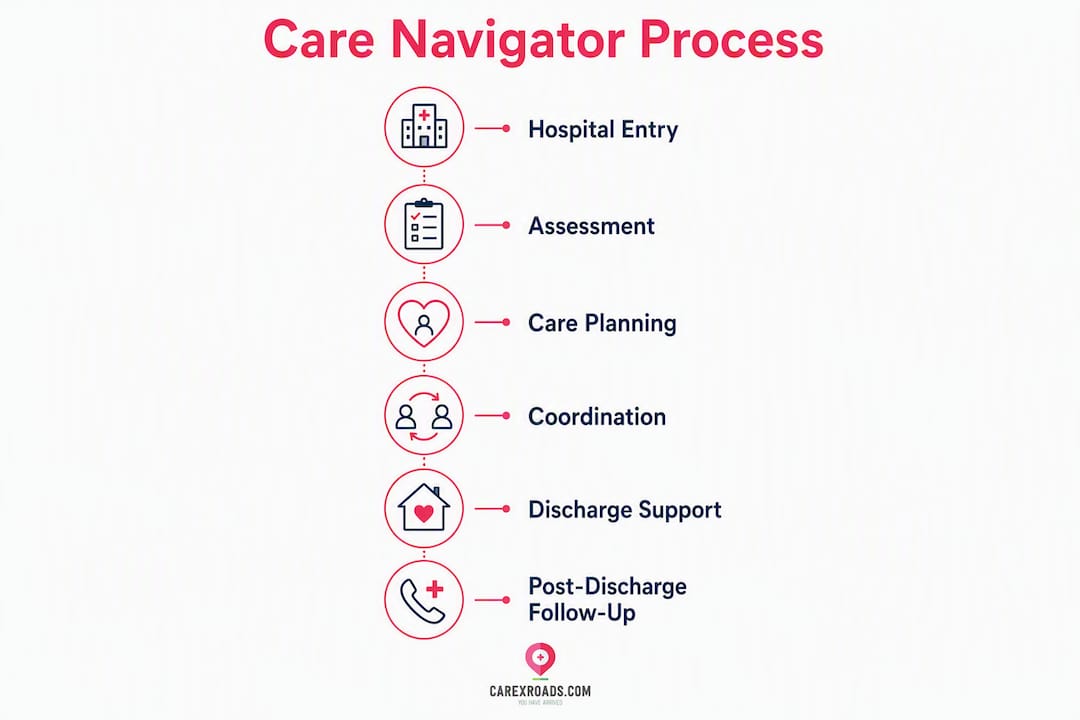
The core functions of a care navigator span both clinical coordination and practical problem-solving. Here is what that looks like day to day:
- Discharge planning support: — Working with the care team to arrange home health services, durable medical equipment, or placement in a rehabilitation facility
Clinical tasks, such as interpreting lab results or adjusting medications, require a licensed clinician. A navigator without clinical credentials handles coordination and advocacy only, and a good one will tell you that clearly. An umbrella review found that navigation tasks are present in 96% of programs reviewed, capacity building/self-management support in 87%, and delivering personalized care in 78% of programs.
Pro Tip: Before your first navigator meeting, write down your three biggest worries about going home: medication costs, getting to follow-up appointments, or managing a new diagnosis. Navigators work most efficiently when families arrive with specific concerns rather than a general sense of overwhelm.
For a deeper look at what good discharge documentation looks like from the family side, the discharge planner documentation guide on Carexroads walks through exactly what to gather and keep.
Who can be a care navigator and what credentials to expect
Navigator backgrounds vary more than most patients realize. Both clinical professionals and trained lay workers serve as navigators depending on how a program is designed, which means the scope of help you receive depends heavily on who is assigned to you.
Common professional backgrounds include:
- Registered nurses (RNs): Typically assigned to complex or high-acuity patients; can perform clinical assessments and handle complicated authorization work
- Licensed clinical social workers (LCSWs): Strong in psychosocial support, community resource connections, and discharge planning for patients with housing or mental health needs
- Community health workers (CHWs): Trained lay navigators from the community; effective for cultural and linguistic support, appointment reminders, and resource navigation
- Lay navigators: Non-clinical staff trained specifically for navigation tasks; scope is limited to coordination, scheduling, and information sharing
| Role category | Typical tasks | Clinical authority | Limits |
|---|---|---|---|
| Clinical navigator (RN) | Assessment, medication review, complex authorizations | Yes | Cannot prescribe; defers to physician for treatment decisions |
| Social work navigator (LCSW) | Psychosocial support, discharge planning, community referrals | Limited (social/behavioral) | Cannot interpret clinical test results |
| Nonclinical navigator (CHW/lay) | Scheduling, resource connection, appointment reminders | None | Cannot advise on medications or clinical findings |
At your first contact, ask two questions: "What is your professional background?" and "What kinds of tasks fall outside your scope?" A navigator who answers both clearly is one you can trust to tell you when to escalate to a physician or social worker.
When you will meet a navigator during a hospital stay
The timeline of navigator contact follows the arc of a hospital episode, though the exact touchpoints depend on the program and your risk level.
- Post-discharge follow-up: — Most programs include at least one check-in call within 48–72 hours of discharge, with additional calls over the following two to four weeks for higher-risk patients
Navigator programs commonly use both in-person and remote contact methods. Phone calls remain the most common post-discharge tool, and video check-ins grew substantially after the COVID-19 pandemic. Secure messaging through patient portals is increasingly available for lower-urgency questions.
A realistic post-discharge exchange looks like this: a navigator calls two days after you return home, confirms you filled your prescriptions, asks whether transportation to your cardiology appointment is arranged, and flags to the care team if you report new symptoms. That call takes ten minutes and can prevent a readmission. Families who understand what to expect from post-discharge follow-up protocols are better prepared to use those calls productively.

Many programs automatically refer patients with frequent emergency department visits or recent admissions, and most also accept clinician referrals or self-referrals from patients who ask.
Three real-world examples of how navigators help
These generalized vignettes reflect common situations navigators handle. No identifying patient details are included.

Vignette 1: Preventing a readmission after heart failure discharge
An older adult is discharged after a heart failure hospitalization with four new medications and instructions to follow up with a cardiologist within seven days. Without help, the appointment might not happen: the patient does not have a cardiologist on file, and the primary care office is not aware of the admission.
The navigator calls within 48 hours, confirms the prescriptions were filled, and schedules the cardiology appointment before the call ends. She also flags a weight gain of three pounds to the care team, who adjust the diuretic dose remotely. The patient does not return to the emergency room.
"Navigators working in transitional care are associated with reduced emergency department visits and improved referral adherence, particularly when programs assign clinically credentialed staff to high-needs patients, such as those in nursing care homes in Scotland."
— NCBI Policy Brief on Patient Navigators
Vignette 2: Resolving an insurance authorization delay
A patient needs home physical therapy after a hip replacement, but the insurer requires prior authorization and the hospital's discharge team is backlogged. Without intervention, the patient goes home without therapy scheduled.
The navigator contacts the insurer directly, submits the clinical documentation, and secures authorization before discharge. She also explains the patient's insurance authorization rights and what to do if the insurer denies the claim after discharge.
Vignette 3: Addressing transportation and food insecurity
A caregiver brings her mother home after a hospitalization for poorly controlled diabetes. The mother lives alone, has no car, and has been skipping meals because grocery shopping is difficult.
The navigator connects the family to a Medicaid non-emergency medical transportation benefit for clinic visits and enrolls the patient in a home-delivered meals program. At the two-week check-in, blood sugar readings have stabilized. The clinical team credits consistent meals and medication adherence.
How a care navigator differs from a case manager or medical assistant
These three roles overlap enough to cause real confusion, and the distinction matters when you need to know who to call.
A care navigator focuses on coordination and patient advocacy, helping you understand your options and move through the system. A case manager, by contrast, typically works on behalf of the hospital or insurer to manage utilization, ensure appropriate length of stay, and plan discharge in line with institutional and payer requirements. A medical assistant provides clinical and administrative support directly to a physician or clinical team, handling tasks like vital signs, rooming patients, and processing orders.
| Role | Primary focus | Typical employer | Clinical authority | When to contact |
|---|---|---|---|---|
| Care navigator | Patient coordination, advocacy, resources | Hospital, insurer, community org | Varies by credential | Appointments, insurance, community needs |
| Case manager | Utilization review, discharge planning | Hospital, insurer | Often RN or social worker | Length-of-stay questions, post-acute placement |
| Medical assistant | Clinical/admin support to physician | Physician practice, clinic | Limited (per state scope) | Scheduling, prescription refills, vitals |
AHRQ frames care coordination as deliberately organizing activities and sharing information among all participants in a patient's care. A navigator is one part of that system, not the whole of it.
Does a care navigator provide medical advice? No. A navigator, even one with clinical credentials, does not diagnose conditions, prescribe treatments, or interpret test results for patients. Clinical questions go to the physician or nurse practitioner on the care team.
Who employs and pays for hospital care navigators in the U.S.
Navigator services in U.S. hospitals are rarely billed directly to patients. The most common funding models are:
- Oncology and specialty programs: — Cancer centers frequently employ dedicated oncology navigators, often supported by hospital philanthropy or federal cancer program funding
Navigators are often embedded in discharge planning teams partly because hospitals are incentivized to reduce readmissions through Medicare quality metrics. That institutional alignment generally works in patients' favor: the navigator's goal and the patient's goal are the same.
Pro Tip: If you are unsure whether your hospital offers navigator services, call the discharge planning office or patient relations department first. If you are a Medicare Advantage member, call the member services number on your insurance card and ask specifically about care management or transitional care programs.
How to request a care navigator and questions to ask
Requesting a navigator is simpler than most families expect. Here is how to do it:
- Ask your nurse or attending physician during the hospital stay to refer you to the care navigation or discharge planning team.
- Contact the discharge planning office directly if no referral is made within 24–48 hours of admission for a complex case.
- Call member services on your insurance card if the hospital does not have a navigator program; your insurer may offer one independently.
- Confirm the assignment in writing by asking for the navigator's name, direct phone number, and the best hours to reach them before you leave the hospital.
Once you are connected, use these questions at your first meeting:
- What is your professional background, and what tasks fall outside your scope?
- How will we communicate, and how quickly can I expect a response?
- Can you help with insurance prior authorizations or appeals?
- What community resources are available for transportation or meal support?
- Who do I contact if I have a clinical question you cannot answer?
- How long will you follow me after discharge?
What navigators generally do not handle: clinical diagnosis or treatment decisions, legal or financial advice, direct prescription management, or disputes requiring a patient advocate or ombudsman. If you encounter a billing dispute, a denial requiring formal appeal, or a safety concern about your care, escalate to the hospital's patient relations office or a licensed patient advocate.
Understanding readmission risk stratification can also help you make the case for navigator support if hospital staff seem uncertain whether you qualify.
What the research shows about care navigator programs
The evidence for navigator programs is encouraging, though not without limits.
On the positive side, studies consistently show that navigator programs:
- Increase completion of diagnostic and screening steps and reduce waiting times for treatment
- Improve referral adherence and follow-up appointment completion after discharge
- Reduce emergency department visits and readmissions for high-risk patients in transitional care programs
- Connect patients to community resources that address social determinants of health, such as food and transportation
An umbrella review of care navigator roles found that navigator programs are associated with increased access to care, higher completion of diagnostic steps, and improved continuity across settings. Timely discharge planning and navigation are consistently linked to lower readmission rates in transitional care literature.
The limitations are real, though. The same umbrella review identified 78 unique job titles overlapping with navigation functions, and task domain frequencies: navigation 96%, capacity building/self-management support 87%, and personalized care 78%. That heterogeneity makes it difficult to say which navigator model works best in which context. Study quality is mixed, and most evidence is context-specific rather than broadly generalizable.
What this means practically: a navigator program at a large academic medical center may look very different from one at a community hospital or a federally qualified health center. Asking about the program's specific scope and staffing is not just reasonable; it is necessary.
Key Takeaways
A hospital care navigator coordinates appointments, manages transitions, and connects patients to resources, and asking for one early in a hospital stay consistently improves outcomes.
| Point | Details |
|---|---|
| What a navigator does | Coordinates appointments, discharge planning, insurance authorizations, and community resource connections. |
| Who they are | Backgrounds range from RNs and social workers to trained lay navigators; scope of help depends on credentials. |
| When to expect contact | High-risk patients are often assigned a navigator within 24–48 hours of admission; post-discharge follow-up typically begins within 72 hours. |
| How to request one | Ask your nurse, attending physician, or the discharge planning office; Medicare Advantage members can also call member services. |
| What they do not do | Navigators do not diagnose, prescribe, or provide legal or financial advice; clinical questions go to the care team. |
Why care navigators matter more than most families realize
The conventional wisdom treats care navigators as a nice extra, something hospitals offer for complicated cases. That framing undersells the role considerably.
The real gap in most hospital discharges is not clinical. Physicians write the orders. Nurses provide the education. What fails is the handoff: the moment a patient leaves the building and the system stops watching. A navigator is the person whose job it is to keep watching, and that continuity is precisely what prevents the 30-day readmission that everyone, patient, family, and hospital alike, wants to avoid.
What families often underestimate is how much of the post-discharge burden is logistical rather than medical. Getting to a follow-up appointment requires transportation. Filling four new prescriptions requires understanding which ones the insurance will cover. Knowing whether a symptom warrants a call to the doctor or a trip to the emergency room requires someone to call. Navigators handle all of that, and they do it before the crisis, not after.
The evidence is not perfect, and role definitions vary enough across programs that you should always ask what your specific navigator can and cannot do. But the underlying logic is sound: a person whose sole job is to keep your care connected is more likely to catch the gaps than a care team managing dozens of patients simultaneously.
For families managing a hospital-to-home transition, Carexroads offers a directory of verified home care providers, practical guides, and real family reviews to help you find the right support after discharge. Whether you need home health, assisted living, or specialized memory care, Carexroads is a practical starting point.
Useful sources and further reading
These sources were used in preparing this article. Each one is worth bookmarking if you want to go deeper on any section.
- Policy brief: Patient navigators and integration of care — NCBI Bookshelf: Covers navigator program models, evidence on outcomes, and how clinical versus nonclinical staffing affects scope.
- Working between systems: an umbrella review of care navigator roles — PMC/NCBI: The 2025 umbrella review identifying 78 job titles, task domain frequencies, and evidence quality across navigator programs.
- Care coordination — Agency for Healthcare Research and Quality (AHRQ): AHRQ's framework for care coordination, useful for understanding how navigation fits into the broader system.
- The role and importance of a care navigator — Blanchard Valley Health System: A hospital-published overview of how navigator programs work in practice, including referral pathways.
- Discharge planner documentation best practices for families — Carexroads: Practical guidance on what to document and keep during a hospital discharge, written for families.
- Post-discharge follow-up protocol: a family guide — Carexroads: Step-by-step explanation of what post-discharge follow-up looks like and how to use navigator check-ins effectively.
- Insurance authorization in discharge: a family guide — Carexroads: Covers prior authorizations, appeals, and how navigators can assist with insurance-related delays after discharge.