

Readmission risk stratification is a clinical scoring process hospitals use to predict which patients are most likely to return within 30 days of discharge, so care teams can direct extra support to those who need it most. If your loved one has been flagged "high risk," three things you can do right now are:
- Confirm a follow-up appointment with a primary care physician or specialist before leaving the hospital.
- Ask the discharge planner about home services — home health, skilled nursing, or a transition coach.
- Verify the medication plan — make sure every prescription is reconciled, filled, and understood.
Pro Tip: A "high-risk" label is not a reason to panic. Treat it as a prompt to ask for a whole-person transition plan that covers medical, social, and logistical needs before your loved one walks out the door.
Table of Contents
- What is readmission risk stratification and how does it work?
- Why does readmission risk stratification matter for your family?
- What interventions does a high-risk score usually trigger?
- Exactly what should you ask and do at discharge?
- What risk scores can and cannot do
- The 30-day window: timeline and insurance checks
- How Carexroads helps families act on a readmission risk score
- Key Takeaways
- A note from Care
- Find post-discharge support through Carexroads
- Sources and further reading
What is readmission risk stratification and how does it work?
Hospitals pull data directly from the electronic health record (EHR) to build a risk score. Common inputs include prior hospitalizations in the past year, current length of stay, lab values such as hemoglobin below 12 g/dL or sodium below 135 mEq/L, insurance type, marital status, and functional status at discharge. Social factors — limited home support, low health literacy, difficulty filling prescriptions — also carry weight, often as much as clinical ones.

These inputs feed into either a rule-based scoring tool or a machine-learning model. A widely used bedside example is the HOSPITAL Score, which assigns points for low hemoglobin, low sodium, a stay of five or more days, prior admissions, the type of admission, and the discharging service. Scores are typically calculated within 24–48 hours of admission or updated at discharge, giving the care team time to act.
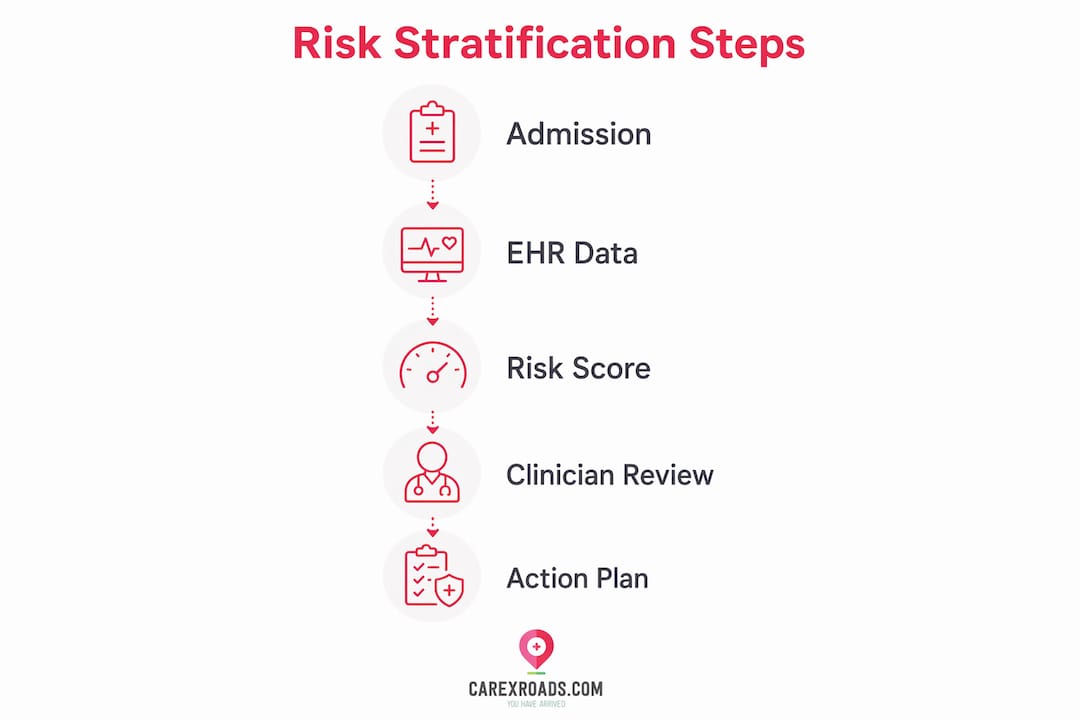
The operational flow looks like this: admission → EHR data extraction → risk score generated → clinician or case manager review → targeted interventions added to the discharge plan. Consider a patient admitted for heart failure who had two hospitalizations in the past six months, a sodium level of 132 mEq/L, and a seven-day stay. That combination pushes the score into the high-risk range, triggering an early home health referral and a follow-up call within 48 hours of discharge.
Why does readmission risk stratification matter for your family?
A substantial portion of hospital readmissions are potentially preventable, according to a systematic review. A 2023 study of 147,358 patient encounters reported a 13.9% 30-day readmission rate, underscoring how common and costly these returns are.
Hospitals have a direct financial incentive to reduce them. Under the Hospital Readmissions Reduction Program (HRRP), the Centers for Medicare and Medicaid Services (CMS) uses an excess readmission ratio (ERR) to measure each hospital's performance against national expectations. Hospitals whose readmission rates exceed those expectations can face Medicare reimbursement reductions. That financial pressure motivates hospitals to invest in discharge planning, follow-up calls, and home health referrals for high-risk patients.
| Factor | Why it matters for families |
|---|---|
| Preventable readmissions (~27%) | Targeted support can reduce avoidable returns |
| 13.9% observed 30-day rate | Shows how frequently patients return without intervention |
| HRRP / ERR (up to 3% penalty) | Hospitals are financially motivated to support high-risk patients |
| AHRQ whole-person planning | Discharge plans should cover social and logistical needs, not just medical ones |
The AHRQ's Whole-Person Transitional Care Planning tools reinforce this: a good discharge plan addresses not just medications and follow-up appointments, but also transportation, caregiver availability, and community supports. For families arranging senior care, knowing that the hospital has both a clinical and a financial reason to get this right can be reassuring.
What interventions does a high-risk score usually trigger?
When a patient is flagged high risk, the care team typically adds several layers of support before and after discharge. Common interventions include:
- Intensified discharge planning with a dedicated case manager or social worker
- Medication reconciliation to catch errors, duplications, or gaps in the prescription list
- Scheduled follow-up with a primary care physician or specialist within 7–14 days of discharge
- Home health or skilled nursing referrals for wound care, physical therapy, or monitoring
- Transition coaches who help patients and families navigate the first weeks at home
- Follow-up phone calls within 48–72 hours of discharge to catch early warning signs
The evidence supports both pre-discharge education and post-discharge actions as effective components of readmission reduction. Specific risk factors map to specific responses: a history of multiple prior admissions usually triggers case management involvement; abnormal lab values prompt medication review and early repeat labs; limited home support leads to social work referrals or community resource connections. Each intervention targets a known failure point — missed follow-up, medication errors, or unmet social needs.
Exactly what should you ask and do at discharge?
Before your loved one leaves the hospital, confirm each of these items with the nurse or discharge planner:
- Follow-up appointment: date, time, provider name, and location
- Complete medication list with dosing instructions and any changes from before admission
- Home health or subacute rehabilitation referral, if ordered
- Durable medical equipment (walker, oxygen, hospital bed) ordered and delivery confirmed
- Transportation plan for the ride home and for follow-up visits
Sample script for the discharge conversation: "Can you confirm the follow-up appointment is scheduled before we leave? And can you walk me through every medication change so we understand what's new and what stopped?"
Red flags to escalate before discharge: worsening symptoms that haven't been addressed, a medication list that doesn't match what the patient was taking at home, or no scheduled follow-up appointment. If any of these are unresolved, ask to speak with the attending physician or patient advocate before signing discharge papers. A post-discharge follow-up protocol can help you stay organized once you're home.
What risk scores can and cannot do
Risk stratification tools are genuinely useful, but they have real limits families should understand.
- Models rely heavily on administrative data — prior admissions, length of stay — which are automatically pulled from the EHR. A patient can appear clinically stable yet still score high risk because of past utilization patterns.
- Scores may not capture the full caregiving picture: whether a family member can be home during the day, whether the patient lives alone, or whether there are language barriers.
- A high-risk score does not guarantee that specific services will be ordered or covered by insurance.
- Models generally cannot distinguish between a planned readmission (a scheduled procedure) and an unplanned one.
- Even high-performing predictive models leave room for communication gaps and social-determinant failures to cause readmission.
The biggest failure points after discharge are often human: a prescription that never got filled, a follow-up call that went to the wrong number, or a caregiver who didn't know what symptoms to watch for.
Pro Tip: You can close many of these gaps yourself. Write down the name of every outpatient provider who should receive the discharge summary, and follow up with each office within 48 hours to confirm they received it. That single step catches a surprising number of handoff failures.
The 30-day window: timeline and insurance checks
The 30-day readmission window starts at discharge. Risk scoring typically happens within 24–48 hours of admission and may be updated at discharge. The monitoring period for HRRP metrics runs 30 days from the discharge date, which is why follow-up timing matters so much.
Before leaving the hospital, run through this insurance checklist:
- Verify home health benefit eligibility under Medicare or private insurance
- Confirm whether prior authorization is needed for home health, skilled nursing, or durable equipment
- Check that outpatient follow-up visits are covered and within the insurer's required timeframe
- Ask who covers durable medical equipment and whether a specific supplier is required
Medicare covers home health services when a physician certifies medical necessity and the patient meets homebound criteria. For families navigating these authorizations, a step-by-step insurance authorization guide can prevent coverage gaps that lead to delayed care. Keep in mind that HRRP incentives may influence how aggressively a hospital coordinates post-discharge services — hospitals with higher ERR scores have a stronger financial reason to ensure follow-up is in place before discharge.
How Carexroads helps families act on a readmission risk score
When a loved one is flagged high risk, knowing where to find vetted post-discharge support quickly can make a real difference. Carexroads maintains a searchable directory of home health agencies, skilled nursing facilities, adult day care programs, and community support services, all with verified family reviews. The platform's 4.8 average family satisfaction rating reflects real caregiver experiences, not marketing copy.
To find providers after a hospital discharge, search by location on Carexroads and filter by care type — home health, post-acute rehab, or memory care — depending on what the discharge plan recommends. Each listing includes verified reviews so you can read what other families experienced during similar transitions. If the discharge planner has recommended a specific level of care and you're not sure what that means in practice, Carexroads's guides on transitioning to assisted living and related topics can help you evaluate options with confidence.
Key Takeaways
Readmission risk stratification gives hospitals a structured way to identify patients who need extra support at discharge, and families who understand the process are better positioned to act on it.
| Point | Details |
|---|---|
| 30-day window is critical | Risk scoring targets the 30-day post-discharge period; follow-up within 7–14 days reduces preventable returns. |
| About 27% of readmissions are potentially preventable | Targeted discharge support can reduce avoidable hospital returns for high-risk patients. |
| HRRP creates real incentives | Hospitals face Medicare reimbursement reductions up to 3% for excess readmissions, motivating stronger discharge planning. |
| Ask for a whole-person plan | Confirm that the discharge plan covers medications, follow-up, home services, and social supports before leaving. |
| Carexroads supports the transition | Use Carexroads's verified provider directory and family reviews to find home health and post-acute care after discharge. |
A note from Care
Hospital discharge is one of the most stressful moments a family faces, and a "high-risk" label on top of it can feel alarming. What I've seen, working through the questions families bring to Carexroads, is that the label itself is less important than what happens next. The families who navigate this well are the ones who ask specific questions, confirm every piece of the plan in writing, and know where to find support once they're home. That's exactly what Carexroads's guides and provider directory are here for. If you're in the middle of a hospital-to-home transition right now, the resources on this site are a good place to start.
Find post-discharge support through Carexroads
When a loved one is discharged with a high-risk score, the next step is finding the right care providers quickly. Carexroads connects families with verified home health agencies, skilled nursing facilities, and community support services — all searchable by location, with real family reviews to guide the decision.

Visit Carexroads to search for home health and post-acute care providers near you. Use the location filter and care-type categories to match what the discharge planner recommended. This resource is provided for informational purposes and is not a substitute for medical advice; always confirm care decisions with your loved one's clinical team.
Sources and further reading
- Hospital Readmissions Reduction Program (HRRP) — CMS: Official CMS program page explaining the ERR metric and Medicare reimbursement adjustment framework.
- AHRQ Whole-Person Transitional Care Planning Tools: Practical discharge planning prompts from the Agency for Healthcare Research and Quality; updated guidance for discharge teams.
- Reducing Hospital Readmissions — StatPearls, NCBI: Systematic review reporting the median ~27% preventable readmission proportion and evidence-based intervention strategies.
- Machine Learning Readmission Prediction Model — MDPI (2023): 2023 study of 147,358 encounters reporting a 13.9% 30-day readmission rate and validating an interpretable prediction model.
- Risk Prediction Models for Hospital Readmission — NCBI Bookshelf: Systematic review of readmission risk models and guidance on targeting transitional care interventions.
- HOSPITAL Score Calculator — MDCalc: Bedside scoring tool listing the specific variables (hemoglobin, sodium, length of stay, prior admissions) used in clinical practice.
Recent studies (2023–2026) matter here because predictive models and HRRP penalty structures are updated regularly; always check CMS and AHRQ for the most current program parameters.