
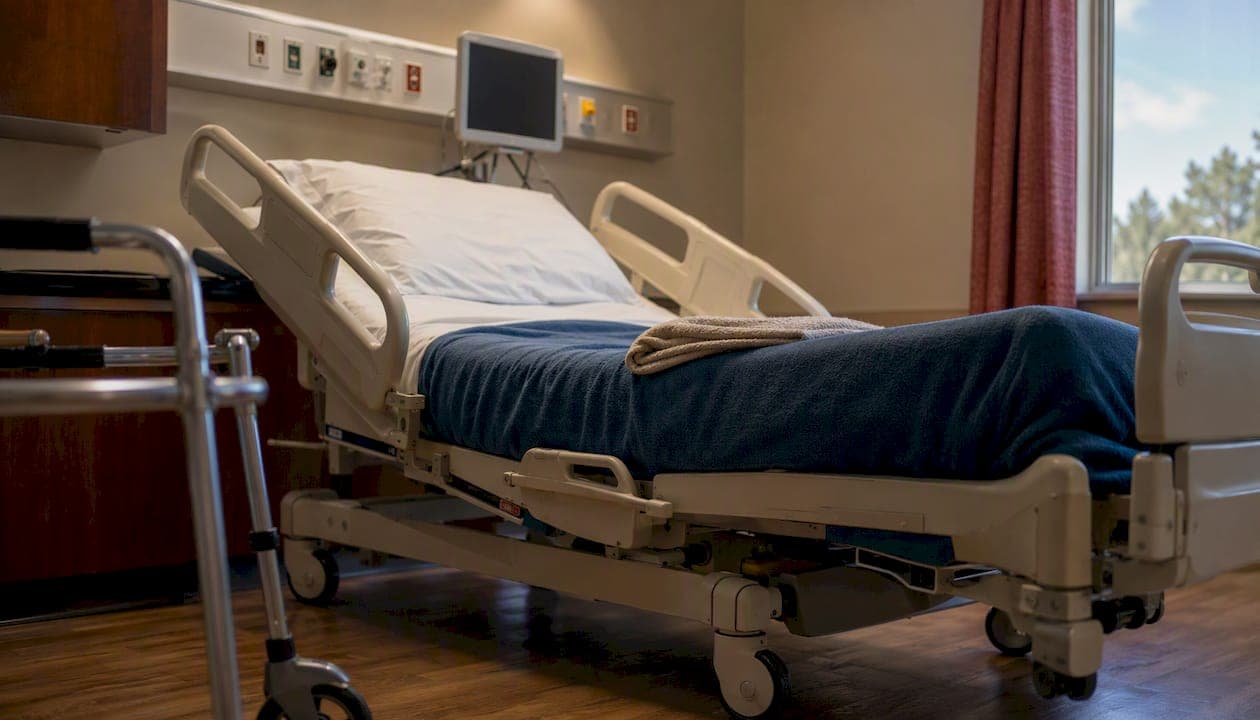
A swing bed is not a physical bed — it is a change in reimbursement and care status that allows certain rural hospitals and Critical Access Hospitals (CAHs) to provide skilled nursing facility (SNF)-level post-acute care using their existing acute-care beds, with Medicare Part A covering those services when qualifying rules are met.
Three things families should know right away:
- Medicare can cover it when the patient meets the qualifying inpatient stay requirement of three consecutive days and has a documented skilled nursing or therapy need.
- The patient often stays in the same room with the same nursing team — the "swing" is a paperwork and billing change, not a physical move.
- Ask the discharge planner early about eligibility, the qualifying stay requirement, and whether the hospital has swing-bed approval from the Centers for Medicare & Medicaid Services (CMS). The Rural Health Information Hub documents how this model was specifically designed to keep rural patients close to home.
Key Takeaways
Swing beds give rural patients access to SNF-level care inside their local hospital under Medicare Part A, provided the 3-day qualifying inpatient stay and skilled-need requirements are met.
| Point | Details |
|---|---|
| Swing bed definition | A reimbursement and care-level change allowing rural hospitals and CAHs to provide SNF-level post-acute services. |
| Medicare 3-day rule | The patient must have 3 consecutive calendar inpatient days in a qualifying hospital before Medicare Part A covers swing-bed SNF services. |
| No Medicare LOS limit | Medicare imposes no maximum length of stay; ongoing medical necessity determines how long the stay continues. |
| Payment differs by hospital type | CAHs receive reasonable cost; non-CAH swing-bed hospitals are paid under the SNF Prospective Payment System. |
| First action to take | Ask the case manager on day 1 or 2 of the hospital stay to confirm qualifying days and swing-bed approval. |
Table of Contents
- What does "swing bed" actually mean in a rural hospital?
- Who qualifies for swing bed services?
- Which hospitals can offer swing bed services?
- How does Medicare cover and pay for swing bed care?
- What does day-to-day care look like in a swing bed?
- What are the real benefits and limits of swing bed programs?
- How do you request and arrange a swing bed?
- Why swing beds matter: evidence and key rules
- Carexroads' perspective on what families should prioritize
- Sources
What does "swing bed" actually mean in a rural hospital?
The word "swing" describes what the bed does: it swings from acute-care status to skilled nursing care status. The hospital does not build a new wing or hire a separate staff. Instead, CMS authorizes the facility to reclassify a patient's care level and reimbursement under the Social Security Act, allowing the same bed to serve a different clinical purpose.
Picture a patient admitted for pneumonia who has stabilized but still needs daily IV antibiotics and physical therapy before going home. She no longer needs acute hospital care, but she is not ready for discharge either. A swing bed lets her stay in the same room while her care transitions to SNF-level services — therapy, skilled nursing assessments, wound care — billed under a different Medicare benefit.
This continuity matters enormously in rural communities, where the nearest standalone SNF may be 40 or 60 miles away. Rural Health Information Hub notes the model was developed specifically to match bed capacity with patient needs in areas where separate post-acute facilities are scarce or unavailable.
Who qualifies for swing bed services?
Eligibility has two layers: the patient must qualify medically, and Medicare has specific payment requirements that determine whether the stay will be covered.
Medical and clinical requirements:
- The patient must have a skilled nursing or therapy need — meaning care that requires the judgment of a licensed nurse or therapist, not just assistance with daily activities.
- A physician must certify that skilled care is medically necessary and must sign admission orders for the swing-bed status.
- Progress notes must document the patient's ongoing need for skilled services throughout the stay.
Medicare payment requirements:
- The patient must have had at least 3 consecutive calendar days as a Medicare inpatient (not observation) in a qualifying hospital during the same spell of illness. This is a payment rule, not a clinical certification rule — a patient can be admitted to swing-bed status even if Medicare will not cover the services, but families should confirm coverage before the status change takes effect.
- Medicare that when a swing bed provides SNF-level care, the same coverage and cost-sharing rules apply as in a traditional SNF.
The critical distinction: Swing bed services cover skilled needs — rehabilitation after a hip fracture, IV therapy, complex wound management. They do not cover custodial care such as help with bathing or dressing when no skilled need exists. If a loved one needs only assistance with daily activities, a swing bed will not qualify for Medicare coverage.
Pro Tip: Ask the case manager to confirm in writing that the qualifying inpatient days are documented before agreeing to swing-bed placement. Observation stays do not count toward the 3-day rule, and the difference can mean thousands of dollars in out-of-pocket costs.
Which hospitals can offer swing bed services?
Not every rural hospital automatically qualifies. CMS sets specific facility criteria, and a hospital must receive formal swing-bed approval before it can offer these services.
Under 42 CFR §482.58, a hospital seeking swing-bed approval generally must:
- Be located in a rural area as defined by Census Bureau classifications.
- Have fewer than 100 beds, excluding intensive care and newborn beds.
- Hold a Medicare provider agreement.
- Not have a waiver of certain nursing care requirements that would conflict with swing-bed operations.
CAHs follow a separate path. Critical Access Hospitals — small rural facilities that meet specific CMS criteria for distance from other hospitals — operate under their own regulatory framework. CAHs have distinct bed limits and are reimbursed differently (more on that below). They are, however, among the most common swing-bed providers because their mission centers on preserving local access to care.
How to verify approval: Call the hospital's case management or patient services office and ask directly whether the facility has CMS swing-bed approval. Hospital administration can also confirm this. Do not assume approval based on the hospital's rural location alone — the formal CMS designation is what matters for Medicare billing.
How does Medicare cover and pay for swing bed care?
Medicare Part A covers swing-bed SNF-level services when the qualifying rules are met. The payment method, however, differs depending on whether the hospital is a CAH or a standard rural hospital.
| Hospital type | Payment method | Key detail |
|---|---|---|
| Non-CAH swing-bed hospital | SNF Prospective Payment System (PPS) | Paid per diem based on patient classification; MDS assessments required |
| Critical Access Hospital (CAH) | Cost-based reimbursement | Paid at reasonable cost; exempt from SNF PPS |
The CMS MLN fact sheet on swing-bed services explains this distinction clearly. For non-CAH hospitals, the SNF PPS applies, which means the hospital must complete resident assessment data (Minimum Data Set, or MDS) and classify the patient under the Patient Driven Payment Model. HHS guidance provides additional detail on how SNF PPS policy changes after the Balanced Budget Act affect non-CAH swing-bed hospitals.
Patient cost-sharing: Because swing-bed SNF-level care follows the same Medicare rules as a traditional SNF stay, the standard SNF benefit-day structure and coinsurance apply. Coverage beyond 100 days requires supplemental insurance.
Pro Tip: Contact the hospital's billing office and call 1-800-MEDICARE before discharge to confirm exactly how the stay will be billed and what your out-of-pocket responsibility will be. Surprises in billing are far easier to resolve before discharge than after.
What does day-to-day care look like in a swing bed?
Once a patient's status changes to swing-bed, the clinical team shifts its focus from acute treatment to rehabilitation and recovery. Typical services include skilled nursing assessments, physical and occupational therapy, speech therapy when indicated, wound care, and IV infusions when clinically necessary. That last point matters: some standalone SNFs cannot administer certain IV medications, but a hospital-based swing bed can, because the facility's pharmacy and clinical infrastructure remain available.
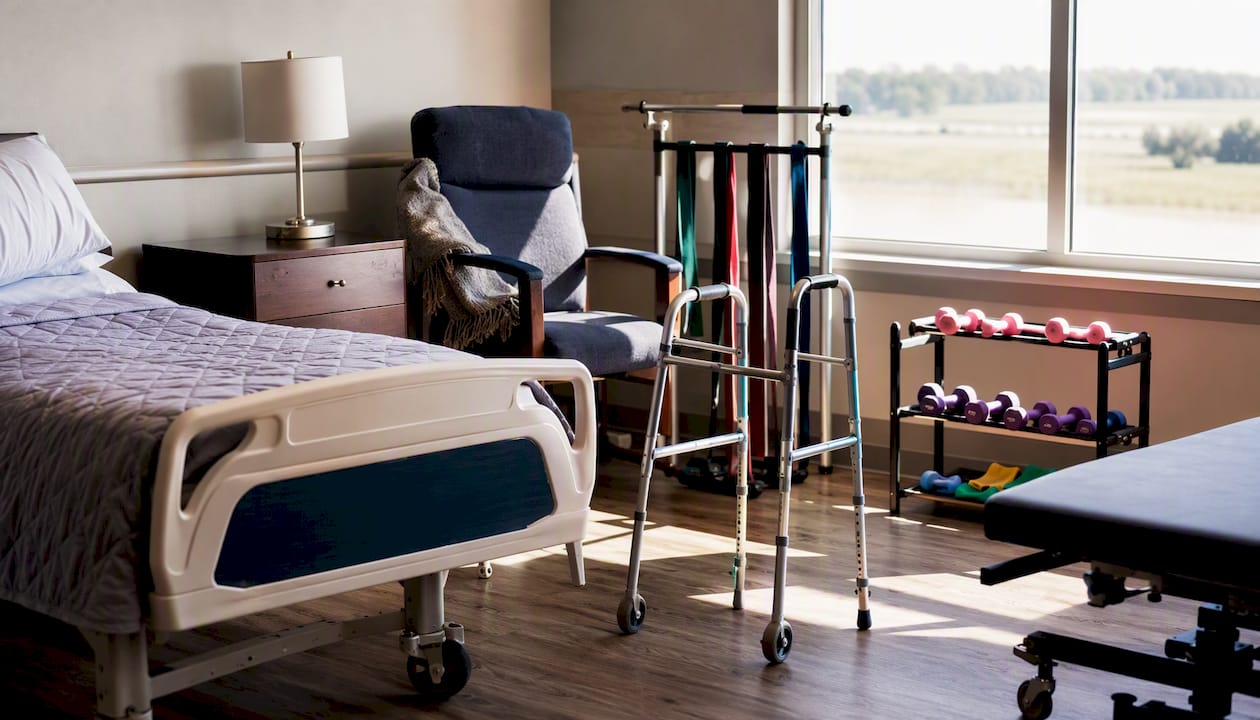
The status change requires specific documentation. The treating physician must write discharge orders from acute-care status and separate admission orders for swing-bed status. Progress notes must be maintained in a distinct section of the medical record, and the care plan must reflect the skilled services being provided. CMS SOM Appendix T outlines these documentation requirements in detail and clarifies that patients do not have to move rooms when their status changes — the room transfer is optional and depends on hospital policy and bed availability.
Families should confirm three things are in place before the status change takes effect:
- Physician orders: Both the discharge-from-acute and admission-to-swing-bed orders are signed.
- Progress notes: The medical record reflects the skilled need and the care plan.
- Coverage verification: The billing office has confirmed Medicare will cover the stay based on the qualifying inpatient days.
What are the real benefits and limits of swing bed programs?
For rural patients, the practical advantages of swing-bed care are meaningful. Staying in the same hospital means the same nurses, the same physicians, and no ambulance ride to an unfamiliar facility. Family members who live nearby can continue visiting without added travel. The hospital setting also provides access to diagnostic services and higher-acuity clinical support that a standalone SNF may not offer.
Rural Health Information Hub documents that swing-bed programs also benefit the hospitals themselves — improving financial stability and bed utilization, and during public health emergencies, helping with surge capacity. That financial stability, in turn, helps small rural hospitals stay open and serve their communities.
The limits are real, though. Swing-bed care requires a genuine skilled need; families hoping to use it as a longer-term assisted-living arrangement will not meet Medicare's coverage criteria. Smaller hospitals may have limited therapy staff or rehabilitation intensity compared to larger post-acute facilities. And the 3-day qualifying stay requirement remains a firm Medicare payment rule.
If swing-bed care is not available locally or the patient does not qualify, ask the case manager about subacute rehabilitation options, nearby SNFs, or home health services. Those alternatives may better fit the patient's needs and location.
Pro Tip: If the hospital's swing-bed program has limited therapy hours, ask whether outpatient therapy can supplement the inpatient stay — some rural hospitals coordinate both.
How do you request and arrange a swing bed?
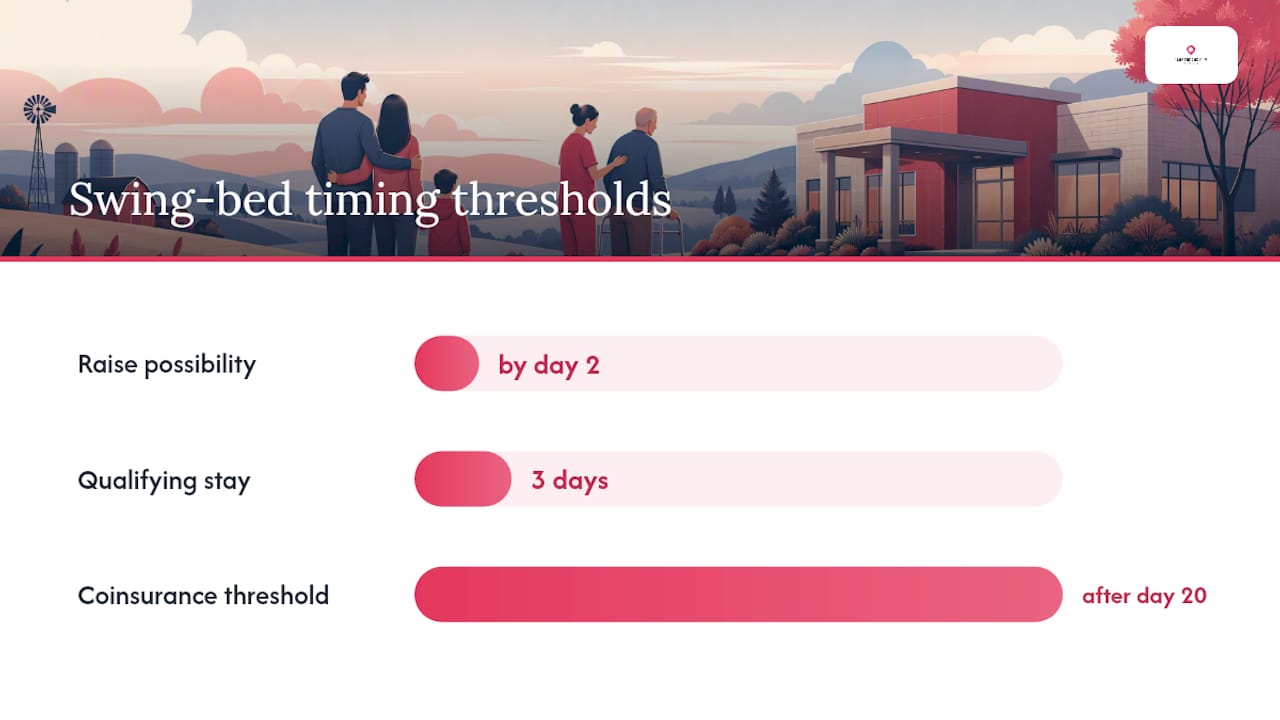
Timing is everything. Raise the possibility of swing-bed care with the treating physician and case manager as soon as the patient's acute condition begins to stabilize — ideally by day 2 of the hospital stay, before the 3-day qualifying period is complete.
- Confirm the qualifying stay. Ask the case manager to verify that the patient's days are counted as inpatient (not observation) and that 3 consecutive calendar days will be met.
- Document medical necessity. The physician must certify a skilled nursing or therapy need. Ask what specific services will be ordered.
- Verify hospital approval. Confirm with the case manager or hospital administration that the facility has CMS swing-bed approval.
- Request the appropriate orders. The physician writes discharge-from-acute orders and swing-bed admission orders. Review discharge planner documentation best practices to understand what paperwork to expect.
- Confirm Medicare coverage. Contact the billing office to verify Part A coverage and your cost-sharing responsibility.
- Plan for the transition. Ask about the expected length of stay, which services will be provided, and what the discharge criteria look like. Timely discharge planning reduces readmission risk and helps families prepare for what comes next.
Questions worth asking the case manager: Is this hospital swing-bed approved? Does my family member meet the 3-day qualifying stay? What skilled services will be provided, and how often? Questions for the billing office: Will Medicare Part A cover this stay? What is my daily coinsurance after day 20? Is there a supplemental insurance claim I should file?
A practical SNF admissions eligibility checklist can help families and coordinators track each step before the status change is finalized.
Why swing beds matter: evidence and key rules
The swing-bed model has regulatory depth behind it. CMS maintains dedicated guidance through the State Operations Manual (SOM) Appendix T, MLN fact sheets, and the Swing Bed Providers page — all of which confirm the program's structure and requirements. The Rural Health Information Hub traces the model's origins and its documented impact on rural access to post-acute care.
| Rule | Value | Source |
|---|---|---|
| Qualifying inpatient stay | 3 consecutive calendar days | CMS / Medicare Part A |
| Hospital bed limit (non-CAH) | Fewer than 100 beds (excluding ICU/newborn) | 42 CFR §482.58 |
| CAH reimbursement rate | reasonable cost | CMS MLN |
| Medicare LOS restriction | None — medical necessity drives duration | SOM Appendix T |
That last row surprises many families. SOM Appendix T is explicit: there is no Medicare-imposed maximum length of stay for swing-bed patients. The stay continues as long as the physician certifies an ongoing skilled need and Medicare's coverage rules are satisfied.
Carexroads' perspective on what families should prioritize
The most common mistake families make is waiting too long to ask. By the time a discharge planner raises the swing-bed option, the qualifying inpatient days may already be at risk, or the window to arrange orders has narrowed. Raising the question on day 1 or 2 of a hospital stay — even before the patient is fully stable — gives the care team time to document properly and gives the family time to verify coverage without pressure.
The second priority is documentation. Swing-bed coverage disputes almost always trace back to incomplete or missing physician orders, undocumented skilled needs, or observation-status days counted incorrectly. Families who understand what paperwork should exist — and who ask to confirm it — are far better positioned to avoid billing surprises.
Carexroads offers a searchable directory of local post-acute providers, home health agencies, and care coordination resources to help families plan the transition from hospital to home. Whether a swing bed is the right fit or a different post-acute path makes more sense, Carexroads' hospital-to-home resources can help you find verified local options and make a confident, informed decision.
Sources
- Swing Bed Providers | CMS
- Medicare
- Medicare SNF PPS: Swing Bed Providers | HHS
- Understanding the Rural Swing Bed: More than Just a Reimbursement Policy | Rural Health Information Hub
This article is general information, not a substitute for advice from a qualified doctor. Consult a qualified healthcare professional about your own circumstances before acting on anything here.