

Every working estate plan rests on the same foundation: a will, a durable power of attorney, a healthcare directive, a HIPAA release, current beneficiary designations, an asset inventory, and a plan for where originals live. Sign these first, and consider a revocable living trust if you own property in more than one state or want to skip probate. If long-term care is a realistic risk, start Medicaid planning now, since the Medicaid look-back period can penalize gifts made too close to an application. Complex family or financial situations deserve a review from an estate planning attorney, not a guess.
TL;DR:
- Updating beneficiary designations and account titling is critical, as these pass assets independently of the will and can cause family disputes if outdated.
- A durable power of attorney and healthcare directive must be signed while fully capable, with the former taking effect immediately and the latter naming decision-makers and preferences.
- Storing original estate documents in a secure, accessible location like an attorney escrow or safe deposit box prevents delays or loss after death.
- For long-term care risks, understanding Medicaid's five-year look-back period and avoiding informal gifts without legal advice can prevent costly penalties.
- Complex family situations or property in multiple states usually require consulting an estate planning attorney rather than relying solely on DIY tools.
Table of Contents
- What Is an Estate Planning Checklist and Why It Matters
- Your Step-by-Step Estate Planning Checklist
- The Core Documents: What Each One Actually Does
- Planning for Incapacity: Powers of Attorney and Directives
- Checking Beneficiary Designations and Account Titling
- Creating a Document Locator and Asset Inventory
- Medicaid Look-Back Rules and Long-Term Care Planning
- Deciding Between DIY Tools and an Estate Planning Attorney
- Where to Store Originals So They're Actually Findable
- How Often You Should Review and Update Your Plan
- Writing a Letter of Intent for Your Heirs and Executor
- Naming Guardians for Minor Children
- Understanding Tax Implications in Estate Planning
- Selecting an Executor or Trustee and Understanding Their Role
- Carexroads Perspective: Estate Plans and Senior Care Decisions Go Together
- How Carexroads Supports Families Building an Estate Plan
- Sources
- FAQ
What Is an Estate Planning Checklist and Why It Matters
An estate plan is the set of legal documents and decisions that determine who manages your affairs if you become incapacitated and who inherits what after you die. A checklist turns that abstract goal into a sequence of signatures, forms, and conversations you can actually finish.
The National Council on Aging points out that estate planning matters at every asset level, not just for wealthy families. Without a plan, a probate court decides who raises your kids, a judge appoints a stranger to manage your finances if you're incapacitated, and your assets get distributed according to state law rather than your wishes. For families already coordinating senior care, that's an added layer of stress on top of decisions that are hard enough already.
This guide walks through the estate planning checklist step by step: the documents, the order to tackle them in, and the traps that catch even organized families off guard.
Your Step-by-Step Estate Planning Checklist
Work through these in order. Some steps take an afternoon; others take a few weeks because you're waiting on an attorney or a financial institution.
- Gather your core documents (urgent, 1 to 2 hours). Pull together IDs, deeds, insurance policies, account statements, and any existing legal paperwork before you meet with anyone.
- Choose your agents and executor (urgent, a few days of conversation). Decide who will act as your financial power of attorney, your healthcare agent, and the executor of your will. Ask them before you name them.
- Sign a durable power of attorney and healthcare directive (urgent, 1 to 3 weeks with an attorney). These are the two documents that keep a court out of your affairs if you're incapacitated.
- Draft or update your will (urgent, 2 to 4 weeks). Name your executor, guardians for minor children, and how you want assets divided.
- Update beneficiary designations (urgent, 1 to 2 hours per account). Retirement accounts and life insurance pass outside your will, so this step matters as much as the will itself.
- Decide whether a revocable living trust makes sense (important, 3 to 6 weeks with an attorney). Worth it if you own real estate in multiple states or want to avoid probate.
- Build an inventory of assets and debts (important, a weekend). List everything, including digital accounts, so nothing gets missed later.
- Document funeral and burial wishes (optional but kind, 1 hour). Sparing your family a guessing game during grief is a real gift.
- Address long-term care funding (important if care is a realistic risk, ongoing). This is where Medicaid planning and the five-year look-back come into play, covered in detail below.
Treat the first five items as the floor. Everything after that strengthens the plan, but those five are what stand between your family and a probate judge making decisions for them.
The Core Documents: What Each One Actually Does
Every estate plan is built from a handful of essential estate planning documents, each solving a different problem.
- Last will and testament. Names your executor, designates guardians for minor children, and states how you want property distributed. Without one, state intestacy law decides for you.
- Revocable living trust. Holds assets during your lifetime and passes them to beneficiaries without probate. Worth considering if you own real estate in more than one state, value privacy (wills become public record in probate; trusts generally don't), or want a faster, less costly transfer process.
- Durable financial power of attorney. Lets a named agent manage your bank accounts, pay bills, and handle financial matters if you can't.
- Healthcare power of attorney and advance directive (living will). Names someone to make medical decisions on your behalf and records your preferences for life-sustaining treatment.
- HIPAA authorization. Gives your named agents and family members legal access to your medical records and the ability to speak with your doctors.
Execution requirements vary by state. Some require two witnesses, others require notarization, and a few require both for certain documents. Check your state's statutes or ask an attorney before you sign, because a document executed incorrectly can be challenged or thrown out entirely.
Pro Tip: Keep a signed, notarized copy of your durable power of attorney with your primary bank in advance. Some banks reject POA documents at the counter simply because they've never seen them before, and pre-registering avoids that fight when your agent needs to act fast.
Planning for Incapacity: Powers of Attorney and Directives
A durable power of attorney takes effect the moment you sign it and stays valid if you become incapacitated. A springing power of attorney only activates once a doctor certifies incapacity, which sounds safer but often creates delays exactly when your agent needs to act. Most estate planning attorneys recommend durable over springing for this reason.
Your healthcare proxy and your advance directive serve different jobs. The proxy names a person to make medical decisions for you. The advance directive, or living will, records your actual preferences: whether you want a ventilator, feeding tube, or CPR under specific circumstances, so your proxy isn't guessing during a crisis.
- Name a primary healthcare agent and at least one backup in case the first is unavailable.
- Record specific preferences rather than vague instructions like "no heroic measures."
- Add a HIPAA authorization so your agent and adult children can actually get information from doctors and hospitals.
- Use your state's statutory short-form power of attorney where available. Banks and financial institutions accept these more readily than custom-drafted versions, which can create friction at exactly the wrong moment.
Getting these signed while you have full capacity avoids court-appointed guardianship later, a process that's slower, more expensive, and more invasive than most families expect. For more on how these documents work in practice, this breakdown of advance directives walks through common scenarios.
Checking Beneficiary Designations and Account Titling
Your will doesn't control everything. Retirement accounts, life insurance policies, and transfer-on-death or payable-on-death accounts pass directly to whoever is named on the beneficiary form, regardless of what your will says.
- Pull beneficiary forms for every 401(k), IRA, life insurance policy, and TOD/POD account you hold.
- Confirm the primary and contingent beneficiaries still reflect your wishes.
- Update forms directly with each institution. A line in your will does not override an outdated beneficiary form.
- Watch for three common pitfalls: an ex-spouse still listed as primary beneficiary years after a divorce, a contingent beneficiary that no longer matches your estate plan, and joint-tenancy titling on real estate that unintentionally hands full ownership to one heir instead of splitting it as intended.
This review takes an afternoon and closes one of the biggest gaps in most estate plans. Attorneys who handle probate disputes will tell you outdated beneficiary forms cause more family conflict than almost anything else in the process.
Creating a Document Locator and Asset Inventory
Your executor can't act on documents they can't find. A document locator, a single organized record of what exists and where it lives, matters more than most people realize.
- List every account: banking, investment, retirement, and digital, with institution names and account numbers.
- Record the location of originals: your will, trust, deeds, insurance policies, and vehicle titles.
- Add professional contacts: your attorney, financial advisor, accountant, and insurance agent.
- Note login information for digital assets, stored securely, not in the document itself.
- Give one trusted person a copy or clear access instructions, whether that's a co-signer on a safe-deposit box, an attorney holding a sealed copy, or an encrypted digital vault.
A document locator that's updated annually is often more useful to an executor than another legal document. Paper without a map is nearly as useless as no paper at all.
Pro Tip: Set a recurring calendar reminder every January to review and refresh your document locator. Life changes fast: accounts close, new ones open, and a locator that's three years stale sends your executor chasing dead ends.
Medicaid Look-Back Rules and Long-Term Care Planning
If nursing home or long-term care costs are a realistic possibility, Medicaid planning belongs on this checklist well before you think you'll need it.
The Medicaid look-back period reviews five years of financial transactions before an application. Any uncompensated transfer or gift made in that window can trigger a penalty period during which Medicaid won't cover long-term care costs, even if the applicant genuinely needs them.
That's the rule according to Medicaid's own eligibility guidance, and it catches families off guard constantly, usually because the "gift" didn't feel like planning at the time. It felt like helping a grandchild with tuition or adding a child's name to a deed for convenience.
- Avoid informal gifts to family members without first checking Medicaid rules in your state.
- Don't add an adult child to a deed or bank account without legal advice. It can trigger both look-back penalties and unexpected tax consequences.
- Keep records of any transfer made in the past five years, even small ones, in case an application is ever needed.
- Ask about legitimate spend-down strategies, which differ significantly from simply giving assets away.
Large informal gifts can also carry gift tax reporting obligations separate from Medicaid concerns, so a transfer that seems harmless can create two problems instead of one. Read the full mechanics of the look-back period or the 30/60/90 day spend-down checklist if care needs feel close. An elder-law attorney is worth the consultation fee before you move a single dollar.
Deciding Between DIY Tools and an Estate Planning Attorney
Online templates work fine for a simple will with no real estate, no business interests, and one clear set of heirs. Most other situations benefit from a licensed attorney, and some genuinely require one.
- Hire an attorney if you own a business, hold real estate in more than one state, have a blended family, or are managing a Medicaid risk.
- Ask prospective attorneys about their experience with Medicaid and elder-law planning specifically, not just general estate work.
- Ask whether they charge a flat fee or hourly, and request a sample engagement letter before you commit.
- Understand that online document services can produce a valid will but won't catch state-specific execution errors or advise on trust strategy.
Pro Tip: Bring your document locator and asset inventory to the first attorney meeting. It cuts consultation time significantly and often lowers the flat fee, since you've already done the information-gathering work they'd otherwise bill for.
For help finding someone qualified in your area, this guide to choosing an elder-law attorney covers the right interview questions in more depth.
Where to Store Originals So They're Actually Findable
A perfectly drafted will is worthless if nobody can find it. Compare your options honestly.
-
Home safe: convenient but vulnerable to fire, flood, or simply being overlooked by family who don't know it exists.
-
Bank safe-deposit box: secure, but some states restrict access after death until an executor is formally appointed, which can delay things at the worst time.
-
Attorney escrow: often the most reliable option, since the attorney's office stays accessible and typically already has copies of related documents.
-
Tell your executor and healthcare agent exactly where originals live before an emergency happens.
-
Give at least one trusted person direct access, not just knowledge that documents exist.
-
Build a short executor checklist: document locations, account list, attorney contact, and login instructions for digital access.
How Often You Should Review and Update Your Plan
Set a standing review every three to five years, and treat certain life events as automatic triggers regardless of when your last review happened.
- Marriage or divorce.
- Birth or adoption of a child or grandchild.
- A significant change in assets, including inheritance or business sale.
- A move to a different state, since execution requirements and estate laws vary from state to state.
- Death of a named executor, agent, or beneficiary.
Keep a simple dated log of every change so your attorney and executor can see the plan's history at a glance, not just its current state.
Writing a Letter of Intent for Your Heirs and Executor
A letter of intent isn't a legal document, but it's often the piece families remember most. It's your chance to explain the reasoning behind decisions your will can't communicate on its own.

Use it to explain why you split assets a certain way, especially if the division isn't equal among children. Explain your reasoning for a guardianship choice, or share final wishes that don't belong in a formal legal document, like which family stories or photos matter most, or how you'd like a family business handled beyond what a trust can specify.
Address it directly to your executor and your heirs, and store it with your other estate documents rather than as a separate, easily lost note. Update it whenever your family situation changes enough that the reasoning behind your decisions no longer applies the way it once did.
This letter also gives you room to say things a will simply isn't built for: gratitude, context, or a personal explanation that keeps siblings from filling in the blanks themselves during a period when tensions often run high. Families who skip this step frequently end up with disputes rooted not in the legal terms but in unanswered questions about why a parent chose what they chose.
Naming Guardians for Minor Children
If you have children under 18, naming a guardian in your will is one of the most consequential decisions in the entire plan. Without it, a court decides who raises your children, based on factors that may not reflect your relationships or values at all.
Choose someone who shares your parenting values, has the capacity and willingness to take on the role, and ideally lives close enough that your children wouldn't also lose their school, friends, and community. Talk to that person before naming them. A guardian who finds out only after a tragedy, through a will reading, is a recipe for confusion at the worst possible moment.
Name a backup guardian in case your first choice is unable or unwilling to serve when the time comes. Consider separating the role of guardian (who raises the children) from the role of trustee (who manages any money left to them) if you're leaving a meaningful inheritance. Combining both roles in one person works fine for many families, but splitting them adds a layer of financial oversight some parents prefer, especially with a large or complex estate.
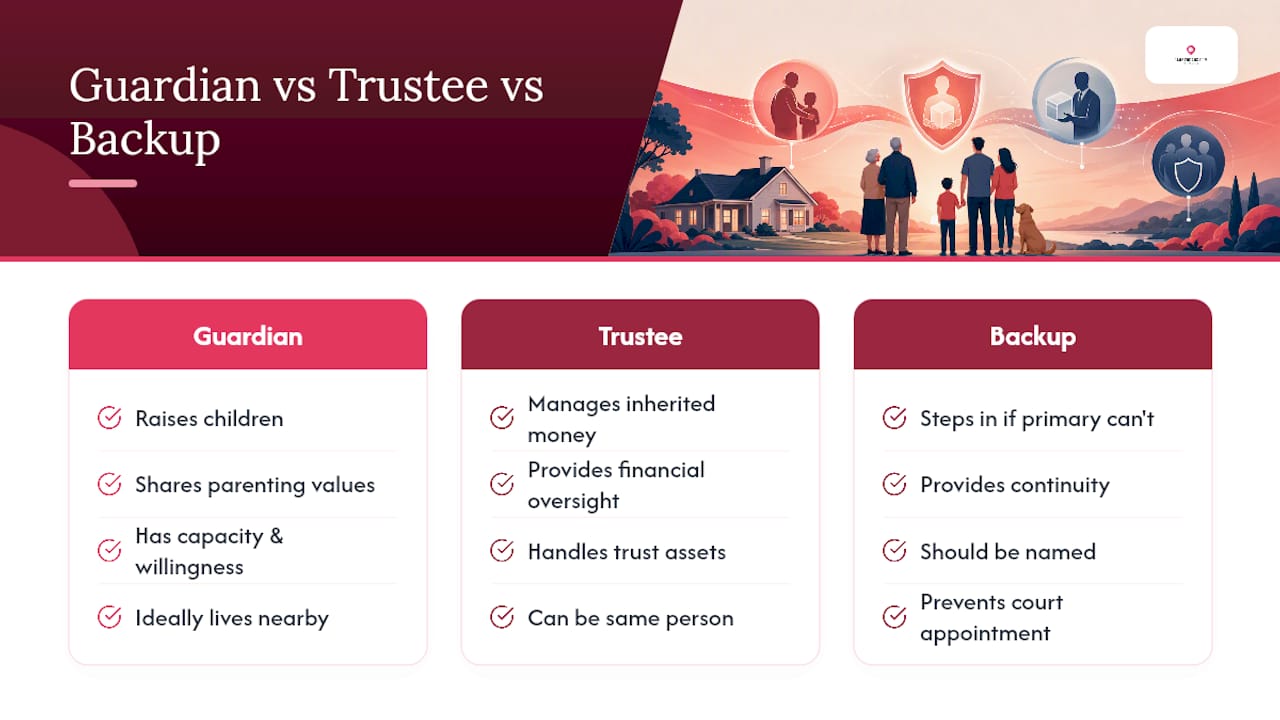
Revisit this decision every time you complete your regular estate plan review, since relationships and living situations change over the years in ways that can quietly make an old guardian choice outdated.
Understanding Tax Implications in Estate Planning
Most American families won't face federal estate tax, since the federal exemption applies only to very large estates. That said, taxes still shape estate planning strategies in several practical ways.
Some states impose their own estate or inheritance taxes at thresholds well below the federal level, so where you live and where you own property both matter. A revocable living trust doesn't reduce taxes on its own, but it can simplify administration and avoid the delays and costs of probate. Large lifetime gifts, meanwhile, can trigger IRS gift tax reporting requirements even when no actual tax is owed, because the filing threshold is often lower than people assume.
Retirement accounts carry their own tax complexity. Beneficiaries who inherit a 401(k) or traditional IRA generally owe income tax on distributions, and the rules governing how quickly they must withdraw those funds have changed in recent years. This is exactly the kind of detail worth confirming with a tax professional or estate attorney rather than assuming last decade's rules still apply, since getting it wrong can mean an heir loses a meaningful share of the inheritance to an avoidable tax bill.
Selecting an Executor or Trustee and Understanding Their Role
Your executor manages your estate through probate: filing your will with the court, paying debts, and distributing assets according to your wishes. A trustee does similar work but for assets held in a trust, sometimes over years rather than months, particularly with trusts designed to support minor children or a beneficiary with special needs.
Choose someone organized, trustworthy, and willing to handle paperwork and, at times, difficult family dynamics. It doesn't need to be your oldest child or closest relative. Many families do better naming a sibling who's more detail oriented, or splitting duties between a family member and a professional fiduciary or attorney for complex estates.
Always name a backup executor and trustee. Talk to your choice before naming them. It's a real responsibility, and someone who feels ambushed by the role after your death is far more likely to struggle with it or resign partway through, leaving the court to appoint a replacement.
Carexroads Perspective: Estate Plans and Senior Care Decisions Go Together
Families rarely think about estate planning and senior care as the same project, but they are. A clear plan means an adult child isn't guessing what a parent wanted while also trying to choose a memory care facility under pressure. Carexroads sees this collide constantly: care decisions made harder by missing paperwork, not missing love. Organizing documents early, alongside understanding how home care fits into end-of-life planning, removes one entire layer of conflict during an already difficult transition.
— Care
How Carexroads Supports Families Building an Estate Plan
There are directories that combine estate planning help and senior care guidance in one place. Instead of separately hunting for an elder-law attorney and researching memory care facilities on unrelated sites, Carexroads brings verified provider reviews, a searchable directory covering estate planning professionals alongside home care, home health, and assisted living, and practical guides that connect the two decisions the way families actually experience them.

If long-term care feels like it might be on the horizon for you or a parent, a free in-home care assessment is a low-pressure way to understand what support actually looks like before a crisis forces the decision. Pair that with browsing local elder-law attorneys through a directory, and you've covered both the legal and the caregiving side of the plan in one place. Join Carexroads to start comparing providers and get organized before you need to.
Sources
- Estate planning | National Council on Aging (NCOA)
- Frequently asked questions on gift taxes | Internal Revenue Service
- Personal Estate Planning Kit | AARP Foundation
This article is general information, not a substitute for advice from a qualified lawyer. Consult a qualified legal professional about your own circumstances before acting on anything here.
FAQ
What 5 documents do you need for estate planning?
The core five are a last will and testament, a durable financial power of attorney, a healthcare power of attorney, an advance directive (living will), and a HIPAA authorization. A revocable living trust is a common sixth document for people who own property in multiple states or want to avoid probate.
What are the top mistakes people make when estate planning?
The most common mistakes include leaving beneficiary forms outdated after a divorce, signing a springing rather than durable power of attorney, and making informal gifts without checking Medicaid's five-year look-back rules first. Skipping guardian designations for minor children and never telling anyone where original documents are stored round out the list.
What is the 5 by 5 rule in estate planning?
The "5 by 5" clause is a trust provision that lets a beneficiary withdraw the greater of $5,000 or 5% of trust assets each year without triggering certain tax consequences. It's a specific trust drafting technique, not a general estate planning rule, so it applies only when your attorney builds it into a trust document for that purpose.
Is there a free estate planning checklist available?
Yes. AARP offers a free Personal Estate Planning Kit that helps you organize documents and preferences at no cost. Carexroads also publishes free guides connecting estate planning steps with senior care decisions for families managing both at once.
Do I need a lawyer to create an estate plan?
Not always. A simple will with no real estate, no business, and clear heirs can work with a template, but an attorney becomes worth the cost once you're dealing with Medicaid risk, a blended family, or multi-state property. Carexroads' directory can help you find and compare local elder-law attorneys if your situation calls for one.