

The national median cost for a semi-private nursing home room is high, but your family's real number depends entirely on your state. Use your state's median, not the national figure, to calculate private-pay runway, and check Medicaid eligibility rules before you assume your parent qualifies.
TL;DR:
- The cost difference across states can be over $7,500 per month, with urban, union-heavy states charging significantly more than rural, low-wage areas.
- The total private-pay budget should include additional costs like community fees, personal care, transportation, and incidentals, adding 10-15% to basic rates.
- Medicaid covers long-term care only after private assets are depleted, with eligibility rules and asset limits varying by state and a complex look-back period.
- Medicare covers only short-term skilled nursing care for up to 100 days post-hospitalization, and the remaining long-term care is paid privately or through Medicaid.
- Families should start early with financial documentation and Medicaid planning, as processing delays and paperwork pitfalls can significantly increase costs.
Table of Contents
- Nursing Home Cost by State: How to Read the Numbers That Matter
- What a Nursing Home's Base Rate Actually Covers
- How Medicare, Medicaid, VA Benefits, and Private Pay Actually Cover the Bill
- What Actually Pushes Nursing Home Prices Up or Down
- How to Calculate Your Family's Private-Pay Runway
- Where to Verify Real Numbers for Your State
- How Carexroads Helps Families Compare Nursing Home Options
- The Nursing Home Admission Timeline, Step by Step
- The Hidden Costs Families Forget to Budget For
- Why Waiting to Plan Costs Families More Than They Realize
- Find Verified Nursing Home Options Through Carexroads
- Sources
- FAQ
Nursing Home Cost by State: How to Read the Numbers That Matter
Nursing home cost varies more by geography than almost any other senior care expense. National long-term care surveys, including the Federal Long Term Care Insurance Program's cost data, place semi-private room rates in the range of $112,000 to $120,000 a year depending on the survey cycle, with private rooms running noticeably higher. That national figure is a useful starting point, but it can mislead a family in Ohio or Mississippi just as easily as it can mislead one in Connecticut.
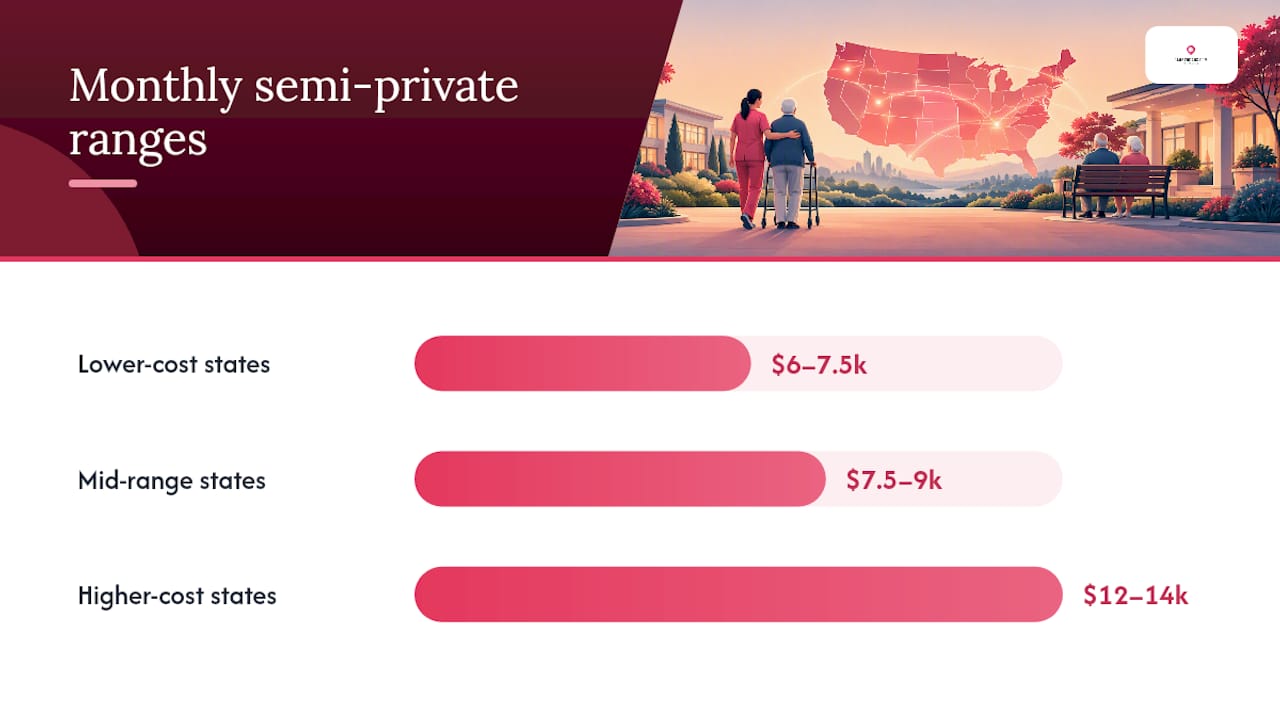
State medians swing by tens of thousands of dollars annually. Southern and rural states, including Louisiana, Missouri, and Oklahoma, tend to post lower private-pay rates because of lower labor costs and cheaper real estate. States with dense urban markets and higher union wage floors, including New York, Connecticut, Massachusetts, and Alaska, run well above the national median, sometimes substantially more a year for a comparable semi-private room.
Here's a practical illustration of how the range typically looks when you compare lower-cost and higher-cost markets:
| Cost tier | Example states | Typical monthly semi-private range | What drives the difference |
|---|---|---|---|
| Lower cost | Missouri, Louisiana, Oklahoma | Roughly $6,000 to $7,500 | Lower wages, lower real estate costs, rural facility mix |
| Mid-range | Ohio, Pennsylvania, Georgia | Roughly $7,500 to $9,000 | Mixed urban/rural markets, moderate Medicaid reimbursement |
| Higher cost | Connecticut, New York, Massachusetts, Alaska | Roughly $12,000 to $14,000 | High labor costs, dense real estate markets, strong union presence |
To turn a monthly rate into a planning figure, multiply by 12 and compare that annual number against liquid, non-exempt assets. A family looking at a $9,000 monthly rate is facing $108,000 a year. If your parent has $200,000 in countable savings, that's roughly 22 months of private-pay coverage before you need Medicaid, assuming no rate increases. Since rates rarely stay flat for two years, plan on padding that estimate downward.
A few things to keep in mind when you're pulling your own numbers together:
- Semi-private rooms are typically 10% to 25% cheaper than private rooms at the same facility.
- Memory care units almost always carry a premium above standard nursing home rates, often adding several hundred dollars a month.
- Rural facilities may quote lower base rates but have fewer beds and longer waitlists, which can force families toward pricier options anyway.
- A facility's "sticker price" isn't fixed. Occupancy rates and payer mix can shift what you actually negotiate, a detail worth remembering before you assume the quoted rate is final.
What a Nursing Home's Base Rate Actually Covers
A quoted daily or monthly rate almost never covers everything your parent will need. Base rates typically include the room, meals, basic nursing supervision, and standard activities. What they usually don't include: incontinence supplies beyond a basic allotment, specialized therapy beyond what's medically ordered, transportation to outside appointments, and a private room upgrade.
That last one matters more than most families realize. If your parent qualifies for Medicare's skilled nursing facility benefit after a hospital stay, a semi-private room is what's covered. If they want or need a private room during that stay for medical reasons, that's typically their bill, not Medicare's, unless a doctor certifies it as medically necessary.
Skilled nursing care and long-term custodial care are billed completely differently, and confusing the two is one of the most common and costly mistakes families make.
- Skilled nursing (SNF) care is short-term, post-hospital rehabilitation covered partially by Medicare for a maximum of 100 days per benefit period.
- Custodial long-term care, the kind most nursing home residents actually receive, is not a Medicare benefit at all. It's paid privately, through long-term care insurance, or through Medicaid once assets are spent down.
- Memory care add-ons for residents with dementia or Alzheimer's typically raise the base rate further, reflecting higher staffing ratios and secured units.
Statistic to remember: Medicare covers $0 per day (after the deductible) for days 1 through 20 of a qualifying SNF stay, then $217 per day for days 21 through 100 in 2026, and nothing after day 100, according to Medicare's own coverage rules. That 100-day ceiling is the single most misunderstood number in nursing home financing.
How Medicare, Medicaid, VA Benefits, and Private Pay Actually Cover the Bill
No single payer covers the full cost of a long-term nursing home stay for most families, and each program has its own rules, limits, and blind spots.
Medicare pays only for short-term skilled nursing care following a qualifying hospital stay of at least three days. Days 1 through 20 carry no daily coinsurance after the deductible, days 21 through 100 cost $217 a day in 2026, and after day 100 the patient covers everything. Medicare was never designed to pay for long-term custodial care, a distinction that trips up more families than any other rule in this article. Our guide on avoiding surprise day 21 bills walks through how to track your benefit days so you're not blindsided by the coinsurance jump.
Medicaid is the actual backbone of long-term nursing home financing in the United States, covering the majority of residents once private funds run out. Eligibility hinges on state-specific income and asset limits, often around $2,000 in countable assets for an individual, according to Medicaid's nursing facility guidelines. Some states offer "medically needy" pathways for people whose income is too high for standard eligibility but who face high medical costs. States are also required to pursue estate recovery, meaning Medicaid can claim reimbursement from a deceased recipient's estate for covered long-term care costs. Rules vary enough by state that checking your own state's Medicaid page before assuming eligibility is worth the hour it takes. Carexroads breaks down the Medicaid nursing home eligibility timeline if you want to start that process sooner rather than later.
VA Aid & Attendance pension benefits can help eligible wartime veterans and surviving spouses offset nursing home costs, but eligibility and payment amounts depend on service history, income, and care needs. Verify current eligibility criteria directly through the Department of Veterans Affairs before counting on this as a funding source.
Long-term care insurance pays out only when specific benefit triggers are met, usually an inability to perform a set number of activities of daily living, and policies without inflation riders can lose real value over a decade or more. Denials happen most often when documentation of care needs is incomplete, so keep detailed records from day one. If your family has an LTC policy, our guide to using long-term care insurance without delays covers the paperwork traps that cause denials.
Private pay is where negotiation actually happens, something few families think to try.
- Ask directly whether the facility offers private-pay discounts, especially if occupancy is below capacity.
- Ask whether a private room deposit or upgrade fee is refundable if your parent later moves to a shared room.
- Ask about seasonal or promotional rate adjustments, which some facilities use to fill empty beds.
Pro Tip: Call at least three facilities and ask the exact same three questions about discounts, refund policies, and what's included in the quoted rate. The answers will vary more than you expect, and that variation is where real savings hide.
What Actually Pushes Nursing Home Prices Up or Down
Labor is the single largest cost driver in nursing home pricing, typically representing more than half of a facility's operating budget. States with higher minimum wages and stronger nursing unions, think California, New York, and Massachusetts, pass those costs directly into resident rates. Rural facilities in lower-wage states can offer meaningfully lower rates for the same level of care, though staffing shortages in those areas sometimes mean longer waits for admission.
Real estate and capital costs are the second major factor. Urban facilities pay more for land, construction, and renovation, and that shows up in the bill. A facility built in 2005 in a rural county has a very different cost structure than one built in 2020 in a metro area with high commercial real estate values.
State Medicaid reimbursement rates set an effective price floor across the entire local market. Research from the Assistant Secretary for Planning and Evaluation shows that Medicaid payment policy directly shapes nursing home finances and pricing. When a state pays facilities poorly for Medicaid residents, facilities often raise private-pay rates to cover the gap, meaning your private-pay bill can be partly a function of how well your state funds Medicaid, not just the local cost of care.
Demand pressure is rising too. Census projections show that by 2030, every Baby Boomer will be 65 or older, a demographic wave that's already tightening bed availability in many markets.
If today's rate is $9,000 a month, plan for something closer to $9,450 to $9,900 a year from now, and compound that forward for multi-year projections rather than assuming a flat rate.
How to Calculate Your Family's Private-Pay Runway
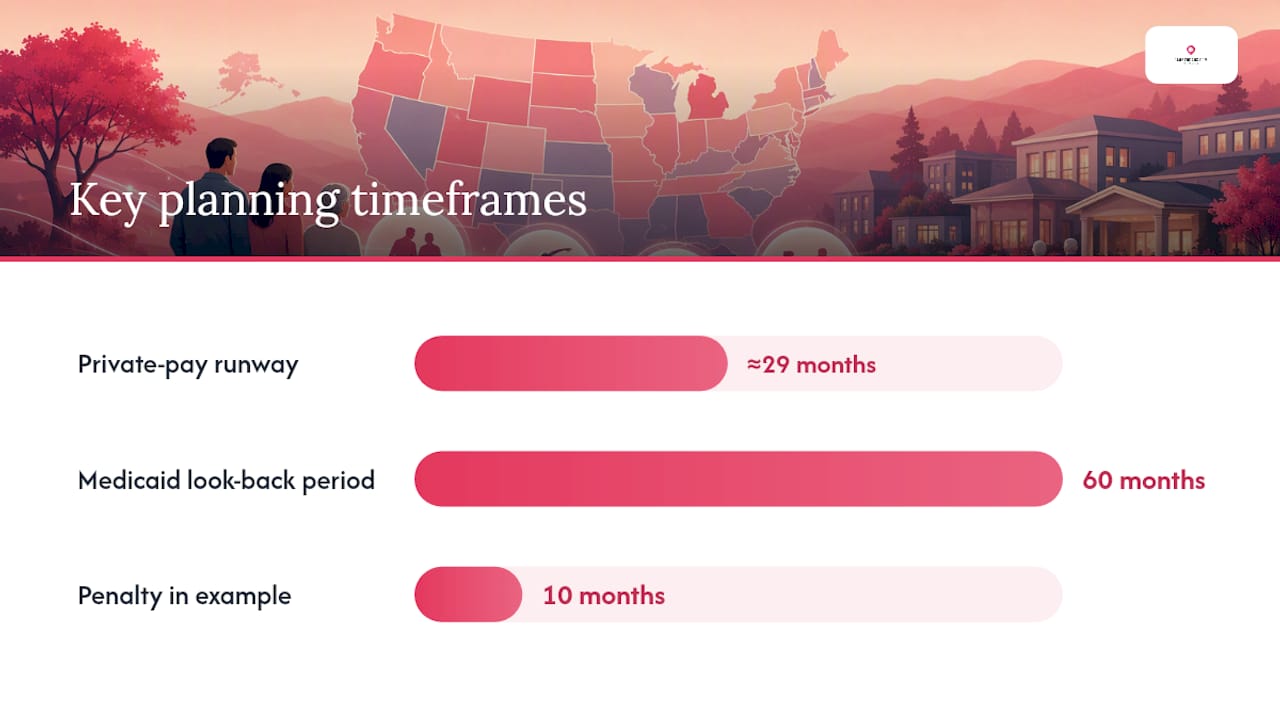
Start with a simple formula: liquid assets divided by monthly private-pay rate equals private-pay months. If your parent has $250,000 in accessible savings and the local facility charges $8,500 a month, that's roughly 29 months before assets run out, assuming rates don't rise.
Here's how to move from that number to an actual plan:
- Gather financial documents now. Bank statements, retirement account balances, life insurance policies, deeds, and a list of any gifts made in the past five years all matter for Medicaid planning.
- Understand the look-back period. Medicaid reviews financial transactions going back 60 months in most states, and transfers made for less than fair value during that window can trigger a penalty period. Carexroads' breakdown of the Medicaid look-back period explains exactly how states apply this rule.
- Know the penalty divisor concept. States calculate ineligibility periods for improper transfers by dividing the transferred amount by the state's average monthly nursing home cost. A $60,000 gift in a state with a $6,000 penalty divisor creates a 10-month period of Medicaid ineligibility. Small differences in your state's median cost can meaningfully shift that math.
- Call your state Medicaid office and the Long-Term Care Ombudsman early. The Long-Term Care Ombudsman Program exists specifically to help families navigate facility quality concerns and complaints, and can point you toward local resources.
- Get legal or financial help if your parent has assets above the Medicaid limit, owns a home, or has made any transfers in the last five years. An eldercare attorney or certified Medicaid planner earns their fee fast in these situations.
Pro Tip: Don't wait until assets are nearly gone to start the Medicaid application. Processing can take 45 to 90 days in many states, and a gap between running out of private funds and Medicaid approval leaves your family covering the bill out of pocket.
For a structured version of this process, Carexroads' 30/60/90-day Medicaid spend-down checklist lays out exactly what to do in each window.
Where to Verify Real Numbers for Your State
State Medicaid websites publish current eligibility limits and, in most cases, reimbursement rates that hint at local private-pay pricing. Medicare.gov's facility comparison tool shows which nursing homes accept Medicare and Medicaid, plus inspection history. Before touring a facility, confirm directly with them whether they're currently Medicaid-certified, since certification status can change.
A short verification checklist for calls or tours:
- Ask whether the quoted rate is for a semi-private or private room, and get the difference in writing.
- Ask what's excluded from the base rate: therapy, supplies, transportation, laundry.
- Ask whether the facility is currently accepting new Medicaid residents, not just whether they're "Medicaid certified" in general.
- Ask how often rates have increased over the past three years, and by how much.
How Carexroads Helps Families Compare Nursing Home Options
Comparing facilities by phone and spreadsheet is exhausting, and most families do it while already stretched thin. The platform is built around a searchable directory of senior care providers paired with verified real family reviews, providing actual experiences instead of marketing copy.
For families sorting through nursing home options alongside assisted living, memory care, or in-home alternatives, that combination shortens the research phase considerably. Instead of cold-calling a dozen facilities to ask the same basic questions, you can filter by location and care type, read what other families actually experienced, and narrow your list before you make a single call.
The Nursing Home Admission Timeline, Step by Step
Admission rarely happens overnight, and knowing the typical pace helps you plan the financial side alongside the logistical one.
Referral and initial contact usually takes one to three days. This starts either through a hospital discharge planner, a physician referral, or a family reaching out directly to a facility.
Assessment and eligibility screening takes roughly three to seven days. A facility nurse or admissions coordinator evaluates the applicant's medical needs, care level, and whether the facility can meet them.
Financial and insurance verification runs concurrently and typically takes five to ten days. This is where Medicare eligibility, Medicaid status, or private-pay documentation gets confirmed, and it's often the slowest step if paperwork is incomplete.
Bed availability and placement can happen immediately if a bed is open, or take weeks if the facility or unit type your parent needs is full. Memory care units in particular often have waitlists.
Move-in and care plan development happens within the first 48 to 72 hours of admission, when staff finalize a personalized care plan based on the initial assessment.
Total time from first contact to move-in can range from under a week for a straightforward Medicare-covered rehab stay to several weeks for a Medicaid-pending long-term placement. Starting the financial verification step early, even before a bed is confirmed, is one of the most effective ways families shorten this timeline.
The Hidden Costs Families Forget to Budget For
Base rates are only the starting point. A realistic budget accounts for several categories most families underestimate.
Community fees and deposits. Many facilities charge a one-time entrance or community fee ranging from a few hundred to several thousand dollars, separate from the monthly rate. Ask directly whether this fee is refundable if your parent leaves within a set window.
Personal care items. Toiletries, clothing, hairdressing services, and personal laundry beyond what's included often run $50 to $200 a month, depending on the facility and how much is bundled into the base rate.
Medical and therapy add-ons. Physical, occupational, or speech therapy beyond what's medically ordered, along with specialized wound care or medication management outside standard nursing coverage, can add hundreds of dollars monthly.
Transportation. Non-emergency transportation to outside medical appointments is frequently billed separately, sometimes per trip.
Private room upgrades. As covered earlier, moving from semi-private to private accommodations can add 10% to 25% to the monthly bill, and this cost is rarely covered by Medicare or Medicaid.
Incidentals and activities. Off-site outings, special events, or premium cable and phone service typically fall outside the base rate entirely.
Building a 10% to 15% buffer into your monthly budget for these extras keeps your private-pay runway estimate realistic instead of optimistic.
Why Waiting to Plan Costs Families More Than They Realize
The families who handle this well aren't the ones with the most money. They're the ones who started documenting finances and calling Medicaid offices before the crisis hit. Waiting until a hospital discharge planner says "your parent needs placement in three days" turns a manageable financial process into a scramble, and scrambles lead to rushed decisions about facilities, rushed asset transfers that trigger look-back penalties, and rushed private-pay commitments that could have been avoided.
Start the documentation now, even if placement feels months away. Call your state Medicaid office and your local Long-Term Care Ombudsman before you need them, not after. The paperwork doesn't get easier under pressure, and the facilities don't get more available.
— Care
Find Verified Nursing Home Options Through Carexroads
Comparing nursing home costs across facilities usually means hours of phone calls, conflicting quotes, and no easy way to tell which reviews are real. This platform combines a searchable directory of senior care providers with verified real family reviews, so you can compare options by location and care type without guessing which facility is actually worth touring.
Start by browsing the full directory of senior care categories, including nursing homes, memory care, and home health alternatives, to see what's available near your parent. If you want a more personalized starting point, request a free in-home care assessment to get a clearer picture of care needs and rough cost expectations before you commit to touring facilities. It's a practical first step whether your family is weeks or months from making a placement decision.
This article is general information, not a substitute for advice from a qualified financial advisor. Consult a qualified financial professional about your own circumstances before acting on anything here.
Sources
- Skilled nursing facility (SNF) care | Medicare
- Nursing Facilities | Medicaid
- Costs of Long-Term Care | Federal Long Term Care Insurance Program (FLTCIP)
- Long-Term Care Ombudsman Program | Administration for Community Living
- Assessing Medicaid payments and the costs of nursing homes | ASPE
FAQ
What happens if an elderly person can't afford a nursing home?
Most families in this situation apply for Medicaid once private assets are spent down to their state's eligibility limit, since Medicaid covers the majority of long-term nursing home stays nationally. Families can also explore VA Aid & Attendance benefits for eligible veterans, or negotiate directly with facilities about private-pay discounts before assets run out entirely.
How do most Americans pay for nursing home care?
Medicaid is the primary payer for long-term nursing home stays once a resident's private assets are exhausted, while Medicare only covers short-term skilled nursing rehabilitation for up to 100 days per benefit period. Many families combine private savings, Medicare's limited short-term coverage, and eventual Medicaid eligibility rather than relying on a single source.
Is it cheaper to have a live-in caregiver or move to a nursing home?
It depends heavily on your parent's care needs and location, but live-in caregiver arrangements typically cost less than a nursing home for someone who doesn't need round-the-clock skilled nursing supervision. Our guide on live-in caregiver costs breaks down typical monthly ranges for comparison against your local nursing home rates.
What is the cheapest state for nursing home care?
Southern and rural states, including Louisiana, Missouri, and Oklahoma, generally post the lowest private-pay nursing home rates, often in the $6,000 to $7,500 monthly range for a semi-private room. Lower labor costs and cheaper real estate in these markets are the main drivers, though bed availability and facility quality still vary within any state.
Does Carexroads help families estimate nursing home costs?
Carexroads offers a searchable directory of verified senior care providers along with real family reviews to help you compare local options, and a free in-home care assessment to help clarify care needs and rough cost expectations. Current pricing for Carexroads' provider plans is available on its site.